One day, a civilization might face a problem no spacecraft could solve: its home star could become a liability. Instead of abandoning the planets around it, what if that civilization could slowly move the star itself? A theoretical concept called the Caplan Thruster explores exactly that possibility—a giant stellar engine that could use a star’s own energy and material to change its motion through the galaxy. It would take millions of years, but the physics suggests the idea is not simply impossible.
The Strange Idea Of Moving An Entire Solar System
The Caplan Thruster belongs to a class of hypothetical machines called stellar engines. Unlike an ordinary rocket, which moves a spacecraft through space, a stellar engine is designed to alter the motion of an entire star and the planets gravitationally bound to it. The acceleration would be extremely small, but over millions of years, even a tiny push could change a star’s galactic trajectory by enormous distances.
That immediately creates a strange possibility. Earth would not have to leave the Sun behind, because the Sun itself would be moving with Earth still in orbit around it. The entire solar system could effectively become a slowly traveling object, crossing the Milky Way on a timescale far beyond any human lifetime.
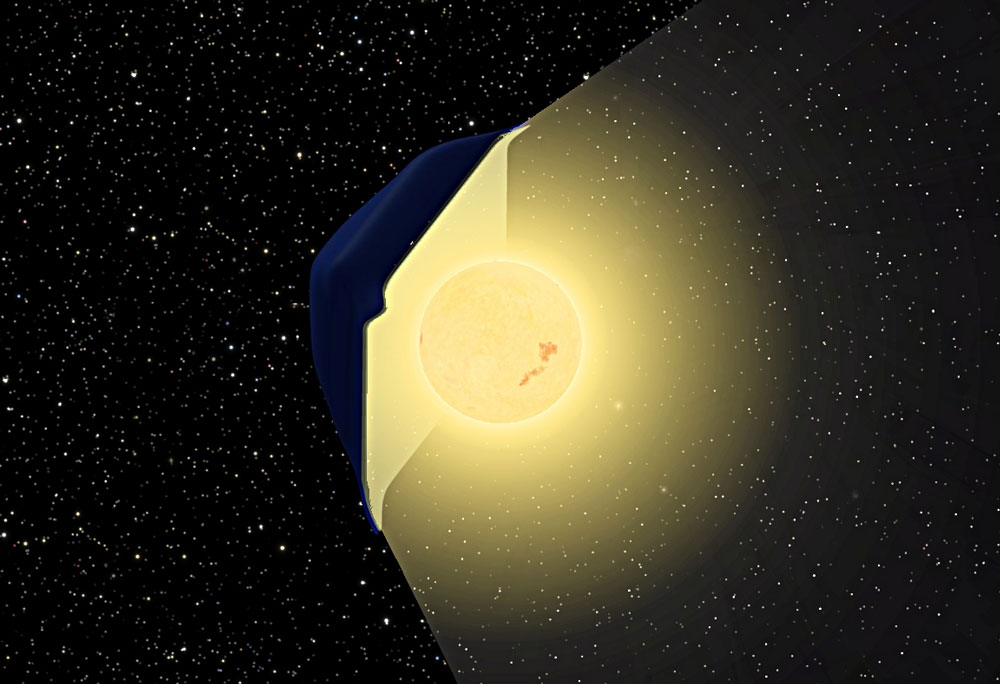
The concept is not new. In 1987, physicist Leonid Shkadov proposed a much simpler version in which a gigantic reflective structure would redirect some of a star’s radiation. The resulting imbalance in radiation pressure would produce a tiny force, gradually pushing the star in one direction.
Ever wondered if we could actually steer our entire solar system through the galaxy? Discover the mind-bending science behind Stellar Engines and how advanced civilizations might one day move the Sun to escape cosmic dangers. Watch the full video now to explore these incredible megastructures and the future of humanity!
The Problem With The Original Stellar Engine
The Shkadov concept works because photons carry momentum. If enough starlight is reflected asymmetrically, the star experiences a tiny net force in the opposite direction.
The problem is speed—or rather, the lack of it. Caplan’s analysis found that a Sun-like star using a passive system could be accelerated by roughly 10⁻¹² meters per second squared. After a million years, that would amount to only about 20 meters per second of additional velocity, moving the star just a fraction of a light-year from where it started.
That could still matter over geological timescales. But if the goal were to escape a serious cosmic threat, waiting hundreds of millions of years for a useful change in position could be too slow.
So Caplan asked a more ambitious question: What if the stellar engine actively used the star itself?

The Caplan Thruster Turns The Star Into A Propulsion System
The active concept is far more elaborate. Instead of relying only on reflected sunlight, it would use enormous collectors and mirrors to harness stellar energy and help pull material away from the star. That material could then be processed and used in a thermonuclear propulsion system, producing a powerful jet of exhaust.
The system essentially acts like a gigantic tug. Solar material is collected, hydrogen and helium are separated, and helium can be used as fusion fuel to drive a high-speed exhaust jet. Some hydrogen can then be returned to the star, transferring additional momentum and helping accelerate the entire system.
The important detail is that the machine does not need to carry a conventional fuel tank. The star provides the raw material. Its enormous energy output provides the power, while its own matter can become part of the propulsion process.
That is what makes the concept so different from a conventional spacecraft. The engine is not taking the civilization away from its star. It is effectively using the star as the engine that carries the civilization with it.
Millions Of Years Make The Impossible Look Different
The numbers are still extraordinary, but they become more understandable when the timescale is stretched.
Caplan’s calculations suggest that the active design could produce accelerations roughly a thousand times greater than the passive stellar-engine approach. Under the assumptions of the model, that could allow a Sun-like star to be deflected by about 10 parsecs in as little as one million years—roughly 33 light-years.
Paul Gilster’s discussion of the concept describes the result more casually as moving a star roughly 50 light-years over a million years, illustrating just how different the active and passive designs are.
To humans, a million years is almost meaningless. To a civilization capable of surviving for geological periods, however, it could become an engineering schedule.
That changes the question from “Can we move the Sun?” to something more interesting: Could a civilization plan its survival on a million-year timetable?
Why Would A Civilization Move Its Star?
One possible answer is cosmic danger.
Caplan’s paper discusses the possibility of using stellar engines to reduce the threat posed by events such as nearby supernovae. A sufficiently close supernova could expose a planetary atmosphere to intense radiation, potentially causing severe biological consequences. An advanced civilization with a detailed understanding of stellar evolution might theoretically have millions of years of warning before a dangerous event.
A stellar engine would not need to take the star across the galaxy. It would only need to change its trajectory enough to move the system away from a dangerous region.
There is another possible reason: colonization. Caplan suggested that a civilization that had exhausted the useful resources of its home system might choose to move that entire system toward another star rather than relying entirely on enormous generation ships. Once the new system was developed, it could eventually build its own stellar engine and continue the process, creating a form of expansion that unfolds across millions of years.
It is an extraordinary idea because the vehicle is no longer a spacecraft. The vehicle is the star.

Could We Detect A Civilization Doing This?
The concept becomes even more interesting when it moves from engineering into astronomy.
If an advanced civilization could deliberately accelerate its star, astronomers might eventually see stars behaving in ways that are difficult to explain through ordinary stellar dynamics. Caplan specifically discussed hypervelocity stars and stars on unusual trajectories as potential candidates for searching for megastructures, provided other natural explanations for their motion could be ruled out.
That would turn the stellar engine into a possible technosignature.
Instead of listening only for radio messages, scientists could look for evidence that a star itself has been engineered. A strange trajectory would not prove the existence of an alien civilization, but it could provide a reason to investigate further.
And that possibility connects the Caplan Thruster to a much larger family of hypothetical megastructures, including Dyson swarms and other enormous systems built around stars. None has been confirmed as evidence of an advanced extraterrestrial civilization.
The Sun Could Become A Ship
The Caplan Thruster is not a machine sitting in a laboratory somewhere. It is a theoretical design for a civilization unimaginably more advanced than ours, and the engineering challenges are enormous. Building structures around a star, controlling stellar material, sustaining high-energy fusion propulsion and maintaining the system for millions of years are problems far beyond current technology.
But the concept is fascinating precisely because it changes how we think about space travel.
We normally imagine a civilization escaping a dying or threatened world by building bigger spacecraft. The Caplan Thruster asks us to reverse that assumption. Rather than leaving the home system, a sufficiently advanced civilization could theoretically modify the system itself.
The Sun would no longer be simply the star that Earth orbits. It would become the engine.
The Caplan Thruster is one of those ideas that sounds like science fiction until the physics is examined. It does not promise a practical way for humanity to move the Sun, and no such technology exists today. Instead, it explores what might be possible for a civilization capable of engineering on stellar scales and planning millions of years ahead. The most remarkable part is not that the machine could move a star incredibly slowly. It is that, in theory, a civilization might one day choose not to leave its home behind at all—and simply take the entire solar system with it.
P.S. This article is based on Paul Gilster’s Centauri Dreams discussion of the Caplan Thruster and Matthew Caplan’s 2019 study, Stellar Engines: Design Considerations for Maximizing Acceleration, published in Acta Astronautica. Source: https://www.centauri-dreams.org/2026/04/30/moving-a-civilization-the-caplan-thruster/