On Earth, evolution has transformed life over billions of years, producing everything from microscopic organisms to enormous mammals and highly complex ecosystems. But what if the idea of evolution could be taken much further? Some physicists have proposed that the universe itself might undergo a kind of evolutionary process, with one universe potentially giving rise to others with slightly different physical properties. It remains a speculative idea, not an established fact, but it raises an extraordinary question: could our universe be part of a much larger cosmic family tree?
Evolution Doesn’t Only Mean Animals Changing
When most people hear the word “evolution,” they think of animals adapting to their surroundings. But evolution, in its basic biological sense, involves populations changing across generations through processes such as variation, inheritance and natural selection.
A giraffe does not decide to grow a longer neck because it wants to reach higher leaves. Instead, differences arise among individuals, some characteristics can be inherited and certain traits may become more common over many generations.
That process requires something important: reproduction.
This is where applying the idea of evolution to the universe becomes much more complicated.
The universe does not reproduce in the way a population of organisms does. There is no known cosmic equivalent of parents producing offspring.
So for the universe to evolve in anything resembling the biological sense, scientists would first need to imagine a mechanism through which one universe could somehow produce another.
That is where one of the strangest ideas in modern theoretical physics begins.

What Would A Universe Need To Evolve?
Physicist Lee Smolin proposed an idea known as cosmological natural selection.
The concept is highly speculative, but its basic logic is fascinating.
Imagine, hypothetically, that universes could produce new universes. The new universe might inherit physical properties from the universe that produced it, but those properties could vary slightly.
Over enormous numbers of generations, universes with characteristics that made them more likely to produce additional universes could become more common.
In this scenario, there would be no conscious designer choosing which universe survives.
The process would resemble natural selection.
A universe would not “try” to reproduce. Universes that happened to have properties associated with producing more offspring would simply contribute more descendants to the cosmic population.
The idea sounds strange because our everyday experience gives us no reason to think of universes as members of a reproducing population.
But theoretical physics often begins with questions that sound strange precisely because they ask us to look at familiar concepts on an entirely different scale.
What happened in the universe’s very first moments? This fascinating video takes you on a journey through the first fractions of a second after the Big Bang and the extraordinary events that shaped the cosmos we see today.
The Strange Idea That Black Holes Could Create New Universes
The most unusual part of Smolin’s proposal involves black holes.
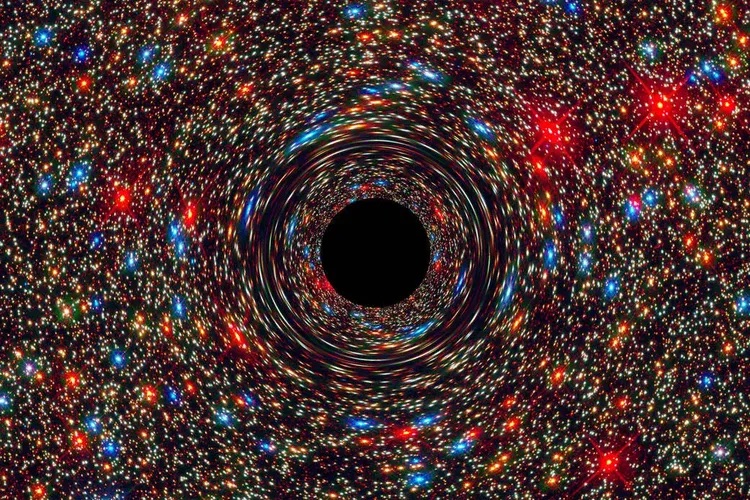
Black holes are regions of spacetime where gravity becomes so strong that, beyond the event horizon, escape is impossible. They are among the most extreme objects known in the universe.
Smolin’s hypothesis suggests that black holes could somehow be connected to the birth of new universes.
In this picture, the physical constants of a newly created universe might differ slightly from those of its parent universe.
That difference would be analogous, in a very loose sense, to variation in biological evolution.
If universes with certain physical characteristics produced more black holes, and black holes in turn produced more universes, then those characteristics could become increasingly common across generations.
The result would be a kind of cosmic natural selection.
It is an extraordinary idea.
But there is an important qualification: this does not mean scientists have discovered that black holes actually create baby universes.
That remains a theoretical possibility rather than an established observation.

Could The Laws Of Physics Be The Result Of Selection?
This is where the hypothesis becomes particularly interesting.
Our universe has physical constants with very specific values. Those values determine how matter behaves, how stars form and how different forces operate.
Change some of those constants significantly, and the universe could look dramatically different.
Perhaps stars would never form.
Perhaps heavy elements would not be produced.
Perhaps galaxies would never develop.
Perhaps complex chemistry would be impossible.
Cosmological natural selection asks whether there could be a deeper explanation for why the constants of our universe have the values they do.
Instead of assuming that every possible universe is equally represented, the hypothesis imagines that universes capable of producing more offspring could become statistically favored over many generations.
That would mean the apparent suitability of our universe for producing stars and other structures might not be entirely accidental.
But this is where the distinction between an intriguing hypothesis and an established scientific explanation becomes essential.
There is currently no evidence showing that the universe’s physical constants were selected through such a process.
The idea offers a possible framework for thinking about the question.
It does not provide a proven answer.
What If Our Universe Is Just One Generation In A Much Bigger Family?
Imagine, for a moment, that the hypothesis were correct.
Our universe would no longer necessarily represent the beginning of everything.
Instead, it could be one member of an enormous cosmic lineage.
A hypothetical sequence might look something like this:
Universe → black holes → new universes → more black holes → more universes.
Over unimaginable periods of time, generations of universes could theoretically emerge.
Each might resemble its predecessor in some fundamental ways while differing slightly in its physical constants.
Some universes might produce very few black holes.
Others might produce enormous numbers.
If the mechanism proposed by cosmological natural selection were correct, the latter could eventually dominate the cosmic family tree.
That would give the universe something resembling biological ancestry.
Earth has an evolutionary history stretching back billions of years. Under this hypothesis, the universe itself could have an evolutionary history stretching across generations of universes that existed before ours.
It is difficult to imagine because we have no direct experience of anything remotely similar.
And that is precisely what makes the idea so fascinating.

The Biggest Problem: How Would We Ever Test It?
There is a major obstacle confronting any theory involving other universes.
How do you observe something that may be permanently beyond our ability to observe?
Science depends on testing ideas against evidence. A hypothesis becomes much more powerful when it makes predictions that observations can confirm or contradict.
Cosmological natural selection therefore faces a difficult challenge.
If previous universes are completely inaccessible, how could scientists determine whether they ever existed?
Smolin’s proposal was not simply intended as a philosophical thought experiment. It was connected to predictions about the physical properties of our universe and the kinds of objects it should produce.
But testing such predictions is extraordinarily difficult.
We can observe our universe.
We can study stars, galaxies and black holes.
We can measure physical constants.
What we cannot currently do is travel outside our universe and inspect its hypothetical ancestors.
That makes the idea fundamentally different from biological evolution, where scientists have enormous amounts of evidence from fossils, genetics, comparative anatomy and direct observation.
Cosmic evolution remains a much more uncertain proposition.
Maybe The Universe Doesn’t Evolve At All
There are other ways to think about why our universe has the properties we observe.
Some physicists have explored inflationary cosmology and various multiverse models. Others have considered anthropic reasoning, in which the fact that we observe a universe compatible with our existence is itself part of the explanation for why we see these particular conditions.
None of these ideas should be treated as a simple final answer.
The important point is that cosmological natural selection is only one possible way of approaching a much larger mystery.
The universe may have a cosmic family tree.
Or it may not.
Black holes may play a role in producing new universes.
Or they may not.
The physical constants of our universe may have been shaped by some kind of selection process.
Or their values may have another explanation entirely.
At present, there is no reason to turn a fascinating hypothesis into a scientific certainty.
The Question Is Bigger Than The Answer
The most fascinating thing about the idea of an evolving universe is not that scientists have proved it.
They haven’t.
Its value lies in the question it allows us to ask.
For centuries, humans have wondered why the universe exists and why its laws have the particular form we observe. Cosmological natural selection adds another possibility: perhaps our universe is not an isolated event, but part of a much larger process that we cannot yet see.
Instead of asking only:
Why does our universe look the way it does?
we can ask something even more extraordinary:
What if our universe is the product of a cosmic process that began long before it existed?
For now, that question belongs somewhere between theoretical physics and the edge of what science can test.
But if future discoveries ever reveal that universes really can produce other universes, our understanding of evolution would have to become dramatically larger.
Evolution would no longer be only the story of life on one planet.
It could be part of the story of the cosmos itself.