A 1959 Chevrolet Bel Air may look like the kind of car that could survive almost anything, while a 2009 Chevrolet Malibu appears far less imposing. But put the two through the same crash test, and the results reveal a surprising truth about automotive safety. The older car’s rigid, heavy construction offered far less protection for its occupants, while the modern Malibu was designed to absorb and redirect crash energy. The comparison shows how five decades of engineering changed not just cars, but our understanding of what “safe” really means.
The Crash Test That Changed How We Think About Old Cars
What if the car that looks tougher is actually the one you’d rather not be sitting in during a crash?
Picture a 1959 Chevrolet Bel Air parked beside a 2009 Chevrolet Malibu. Half a century separates the two cars, and at first glance, the older Bel Air seems like the tougher machine. It is large, heavy and wrapped in the kind of thick steel that once made American cars famous for feeling almost indestructible.
Then the two cars are put through a crash test.
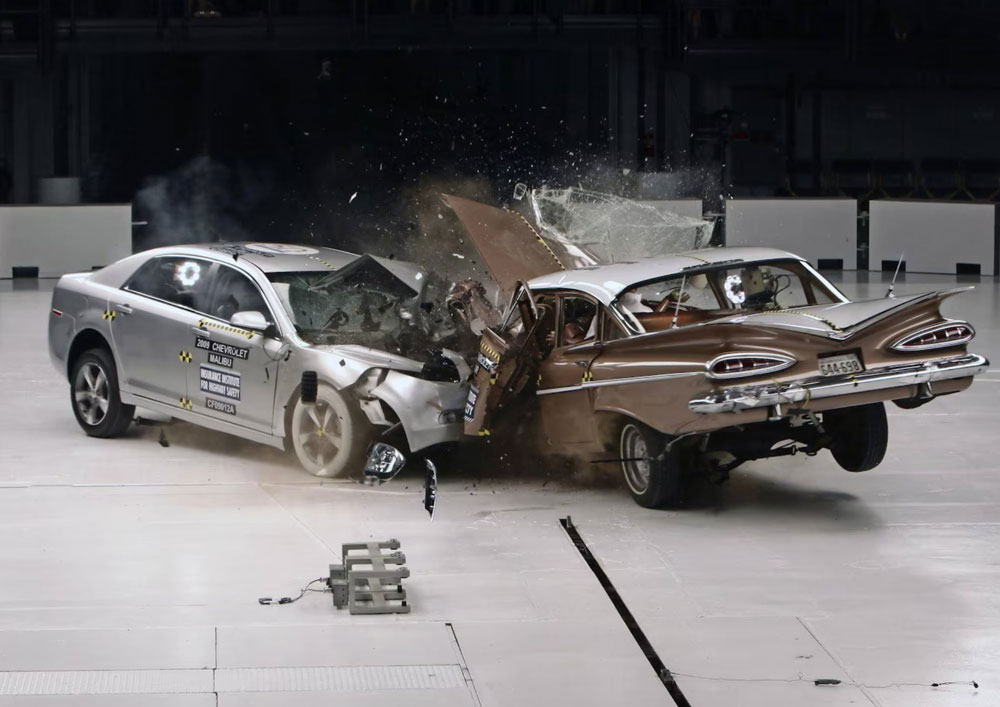
The result challenges that intuition. When the vehicles collide, the Bel Air’s front end and passenger compartment suffer dramatic deformation, with parts of the structure moving deep into the space where the driver would be sitting. The Malibu, meanwhile, also crumples—but much of that damage is concentrated in the front of the vehicle, while its passenger compartment remains far better protected.
The test was conducted by the Insurance Institute for Highway Safety (IIHS) in 2009 as part of its 50th anniversary, using the two Chevrolets to demonstrate how dramatically vehicle safety had evolved over five decades.
That makes the comparison more than a collision between two old and new cars. It is a lesson in how our understanding of safety changed.
For much of the 20th century, a car that felt solid and barely moved in a crash could seem reassuring. Modern engineering introduced a counterintuitive idea: the car itself can absorb the violence of a collision so the people inside experience less of it.
In other words, old cars were built like tanks—but tank-like does not necessarily mean safe.
The real question is not how much of the car survives.
It is how much of the person inside does.
Why the Old Car Looked Stronger—but Protected You Less
The Bel Air Didn’t Crumple the Way Modern Cars Do
The 1959 Chevrolet Bel Air looked like the kind of car that should be able to withstand almost anything. Its massive body, heavy steel construction and rigid-looking frame created an immediate impression of strength. To the eye, it seemed logical that a car that deformed less would provide better protection in a crash.
But crash safety is not really about keeping the vehicle looking intact.
During the crash test, the Bel Air’s passenger compartment suffered severe deformation. Parts of the structure moved significantly into the space where the driver would have been sitting, while the steering column and dashboard moved backward toward the occupant. The car’s impressive solidity therefore offered a misleading sense of security. Its structure was not effectively managing the crash forces before they reached the person inside.
The Point of a Modern Car Is to Sacrifice the Car
Modern vehicles are designed around a surprisingly different principle: A car can be designed to deform so the people inside don’t have to.
Instead of trying to keep every part of the vehicle rigid, engineers deliberately create areas that can collapse during a collision. These crumple zones absorb and redirect some of the crash energy, while the passenger compartment is engineered to remain as stable as possible.
Seat belts and airbags then work together to control the movement of occupants and reduce the forces acting on their bodies.
That is why the 2009 Chevrolet Malibu can look badly damaged after a crash while still providing substantially better protection for the people inside. Its front structure is designed to absorb energy, while intrusion into the passenger compartment is kept much lower than in the Bel Air.
The difference reveals one of the most counterintuitive lessons in automotive safety: The goal isn’t to keep the car intact. The goal is to keep the occupant alive.
Curious how car safety evolved from basic protection to airbags, crash technology and modern safety systems? Watch this quick video to see how decades of innovation changed the way cars protect us.
Fifty Years of Safety Engineering Changed the Equation
From Strong Metal to Controlled Energy
The evolution of car safety was never simply a story about replacing old materials with stronger ones. It was about learning how to manage the enormous amount of energy released during a crash.
Modern vehicles combine multiple systems to work together: crash structures, crumple zones, reinforced safety cages, seat belts, airbags and carefully engineered steering columns. Each has a different role, but they share the same basic objective: controlling where the energy of a collision goes and how much of it reaches the people inside.
That created a counterintuitive principle in automotive engineering:
The safest part of a modern car is often the part that doesn’t collapse.
The front end can be designed to deform dramatically, absorbing energy before it reaches the passenger compartment. Meanwhile, the cabin is reinforced to resist intrusion and preserve survival space for occupants.
The Numbers Make the Difference Visible
The 1959 Bel Air and 2009 Malibu crash test makes that engineering progress difficult to ignore.
In the Bel Air, footwell intrusion reached about 62 centimeters, while the steering column moved approximately 31 centimeters rearward. The A-pillar also moved about 26 centimeters toward the occupants.
The Malibu performed dramatically differently. Footwell intrusion was only about 7 centimeters, while the steering column and A-pillar each moved roughly 2 centimeters rearward.
Those numbers represent more than improved construction. They show how engineers learned to control deformation instead of simply resisting it.
The Bel Air’s structure allowed much more of the crash forces to penetrate the space occupied by the driver. The Malibu’s structure was designed to absorb and redirect those forces while keeping the passenger compartment substantially more stable.
That is why 50 years of safety engineering wasn’t cosmetic. It fundamentally changed what happens to a vehicle—and, more importantly, to the people inside it—when two cars collide.
A modern car may look more damaged after a crash. But sometimes, that damage is exactly what means the engineering worked.

The Biggest Change Wasn’t the Car. It Was the Way We Think About Safety
“Built Tough” Isn’t the Same as “Built Safe”
For much of American car culture, strength was easy to recognize. Bigger bodies, heavier steel, thicker-looking structures and a sense of durability could all make a vehicle feel safer. A car that barely seemed to move after a collision might look like the obvious winner.
Crash testing revealed a more complicated reality.
A vehicle can look destroyed but protect the passenger, while another can appear relatively intact yet allow enormous forces and structural components to move into the occupant compartment. What matters is not simply how much of the car survives the impact, but how effectively the vehicle manages the forces acting on the people inside it.
That distinction changed the way engineers—and eventually consumers—understood automotive safety.
Safety Became an Engineering Discipline
Over the decades, safety became a fundamental part of vehicle design rather than something achieved simply by building a stronger body. Engineers increasingly focused on human biomechanics, crash energy, restraint systems and occupant-compartment intrusion, studying not only how a vehicle reacts to a collision but how that reaction affects the human body.
The goal became more sophisticated: control the crash, absorb energy in specific areas and preserve a survivable space around the occupants.
The 1959 Bel Air and 2009 Malibu comparison makes that evolution particularly visible. The two cars represent different philosophies of protection—one that relied heavily on structural mass and rigidity, and another that deliberately combines controlled deformation with a reinforced passenger compartment.
The deeper lesson is bigger than either Chevrolet: Modern cars aren’t necessarily safer because they’re tougher. They’re safer because they know where—and how—to break.
That may be one of the strangest developments in automotive history: a car can become better at protecting you precisely by becoming better at destroying itself.
The Car Doesn’t Have to Survive the Crash. You Do.
The 1959 Chevrolet Bel Air still looks impressive today. Its massive proportions and heavy steel body evoke an era when American cars were often celebrated for their size, durability and imposing presence. The 2009 Chevrolet Malibu, by comparison, looks far more ordinary. Yet when the two were subjected to the same crash test, the modern Malibu demonstrated a dramatically better ability to protect the person inside.
That contrast captures one of the biggest changes in automotive thinking.
- Old car culture often celebrated durability.
- Modern safety engineering celebrates survivability.
The difference is subtle but profound. A car is no longer judged simply by how much damage its body can withstand. Engineers now ask a much more important question: How well can the vehicle protect the human being inside it?
That shift changed everything from the shape of a car’s front end to the design of its passenger compartment, seat belts and airbags. A modern vehicle may crumple spectacularly in a collision, but that destruction can represent energy being absorbed before it reaches the occupants.
So perhaps the better question is not:
“How much damage can the car take?”
but:
“How well can the car protect the person inside?”
A crash test can destroy a car in seconds, but it can also reveal decades of engineering progress. The Bel Air and Malibu didn’t just show us two different cars—they showed us two completely different ideas of what a car is supposed to protect.

The crash test between the 1959 Bel Air and 2009 Malibu reveals how dramatically our understanding of car safety has changed. Older cars were often built to feel strong, heavy and durable, while modern vehicles are designed to manage crash energy and protect the people inside. A car that crumples may look less impressive, but that destruction can be exactly what saves a life. In the end, the best measure of a vehicle’s strength is not how well the car survives a crash, but how well its occupants do.