When you look up at the night sky, the Milky Way may seem like an enormous collection of stars stretching across the darkness. But our galaxy is only one of countless galaxies in the universe, each containing stars, gas, dust and dark matter shaped by gravity over billions of years. Some form elegant spirals, others become enormous elliptical systems, and some are transformed by violent interactions. Understanding these galaxies offers scientists a way to explore not only distant worlds, but the history and structure of the universe itself.
The Universe Is Full of Galaxies We Can Barely Imagine
Look up at the night sky on a clear evening, and it is easy to feel as though you are looking at an endless field of stars. But almost everything visible to the naked eye belongs to just one galaxy: the Milky Way. Our Sun is only one star among hundreds of billions scattered throughout this enormous cosmic system.
Now imagine zooming out. What if the Milky Way is just one tiny island in an ocean of galaxies?
A galaxy is far more than a collection of stars. It is a vast gravitational system containing stars, gas, dust and dark matter, all bound together by gravity. Some galaxies contain only millions of stars, while the largest can contain hundreds of billions or even more.
And they do not all look alike.
Some stretch into elegant spiral arms. Others form enormous elliptical shapes, while some appear irregular and chaotic. Their sizes, structures and histories can be dramatically different, giving astronomers clues about how galaxies form and evolve over cosmic time.
Even more surprising is how these galaxies are distributed. They are not scattered randomly through empty space. Galaxies can gather into groups and clusters, connected across immense distances by a much larger cosmic structure.
That means the Milky Way is not the universe. It is not even close to being the whole story. t is simply the galaxy we happen to call home. And once you realize that, looking at the night sky becomes a very different experience. The Milky Way isn’t the universe. It’s simply the place we happen to live.

What Exactly Is a Galaxy?
More Than Just a Collection of Stars
It is tempting to think of a galaxy as simply an enormous collection of stars scattered through space. But a galaxy is much more than that. It is a vast gravitational system containing stars, gas, dust and dark matter, all held together by gravity.
The stars we see are only the most visible part of the picture. Gas and dust provide material for new stars to form, while dark matter cannot be seen directly but contributes significantly to the galaxy’s gravitational structure. Together, these components create a system that can stretch across tens or even hundreds of thousands of light-years.
Rather than imagining a galaxy as a giant pile of stars, it may be more useful to think of it as an enormous gravitational ecosystem. Its components interact, move and evolve over immense periods of time.
Galaxies Come in Surprisingly Different Shapes
Not every galaxy looks like the Milky Way.
Spiral galaxies have a relatively flat disk, a central bulge and distinctive spiral arms. Elliptical galaxies are generally smoother and more rounded or elongated, without the prominent arms seen in spirals. Then there are irregular galaxies, which lack a clearly defined shape and can appear much more chaotic.
Astronomer Edwin Hubble famously organized galaxies according to their visible shapes in what became known as the Hubble classification or Hubble Sequence. Although modern astronomy has developed a much more sophisticated understanding of galaxy evolution, these broad categories remain useful for describing what galaxies look like.
And the differences are not merely cosmetic. A galaxy’s shape can reflect its history, including how stars formed and whether it has interacted with other galaxies.
So the natural question is: Why does one galaxy become a spiral while another becomes an enormous ball of stars?
Want to see just how enormous the universe really is? Watch this visual journey from Earth and the Moon all the way to the Milky Way, distant galaxy clusters and the edge of the observable universe—and discover just how small our cosmic neighborhood really is.
The Milky Way Is More Complicated Than It Looks
We Live Inside a Spiral Galaxy
From Earth, the Milky Way can look like a simple band of light stretching across the night sky. But from above, it would look very different. Our galaxy is a barred spiral galaxy, with a broad disk, a central bulge crossed by a bar, winding spiral arms and a much larger halo surrounding the visible structure.
The Solar System sits within one of those spiral arms, roughly 26,000 light-years from the galactic center. The Milky Way itself spans more than 100,000 light-years, making our entire planetary system just a tiny part of an enormous structure.
That creates an unusual problem for astronomers: we are trying to map and understand a galaxy while living inside it.
We cannot simply fly far enough away to photograph the Milky Way from above. Instead, scientists piece its structure together using observations of stars, gas, dust and their movements across the galaxy. We are trying to understand the structure of a galaxy while living inside it.
Most of the Galaxy Isn’t Where the Light Is
There is another complication. The bright stars and glowing clouds that dominate photographs of the Milky Way represent only part of what is actually there.
Surrounding the visible disk is an enormous halo, and much of the galaxy’s mass appears to be associated with dark matter—a substance that does not emit or reflect light in the way ordinary matter does.
One important clue comes from the way stars and gas orbit the galactic center. Their observed rotation speeds indicate that there is far more mass influencing their motion than we can account for simply by adding up the visible stars, gas and dust.
This invisible component helps explain why the Milky Way holds together the way it does.
And that leads to a fascinating realization: What we see is not necessarily what makes up most of a galaxy.

Galaxies Are Not Floating Alone
Galaxies Have Neighbors
It is easy to picture galaxies as isolated islands scattered randomly across an enormous, mostly empty universe. In reality, they tend to gather together under the influence of gravity.
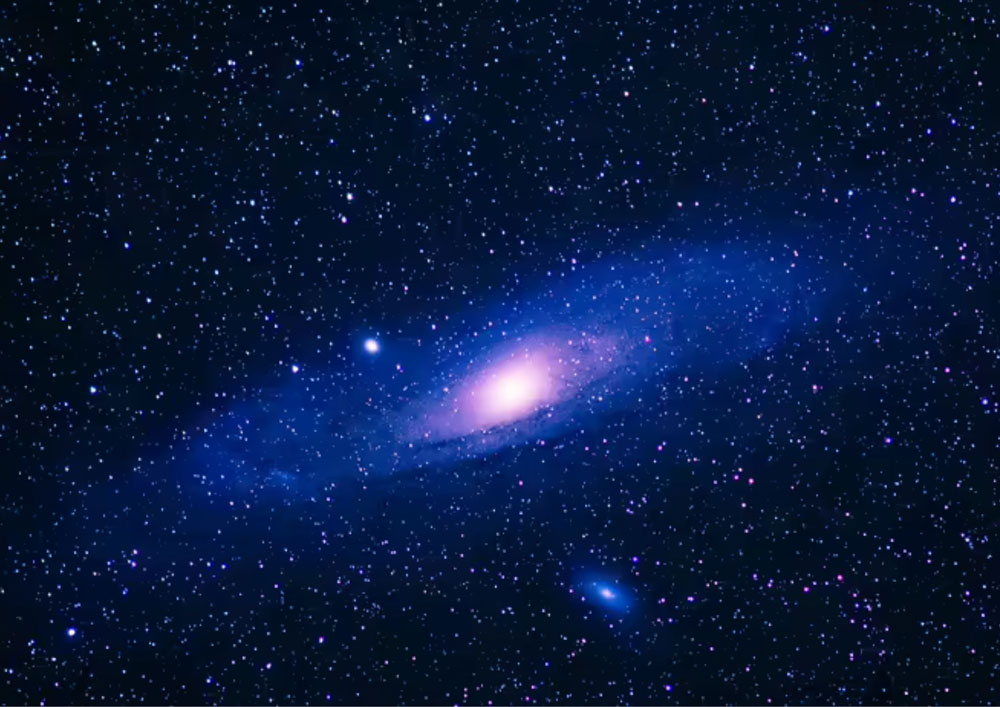
Some galaxies exist in relatively small groups, while others are found in enormous clusters containing hundreds or even thousands of galaxies. Our own Milky Way belongs to a smaller collection known as the Local Group, which also includes the Andromeda Galaxy and many smaller galaxies.
And galaxies do not simply sit peacefully beside one another. Gravity can bring them closer, distort their shapes and sometimes trigger dramatic changes. When galaxies interact, their gravitational fields can stretch their structures, disturb clouds of gas and dust, and influence the formation of new stars.
That raises a much bigger question: If galaxies have neighbors, what happens when they interact?
The Universe Has a Cosmic Web
The story becomes even more remarkable when astronomers zoom out further.
Galaxy groups and clusters are connected across immense distances by enormous structures known as filaments. These filaments form part of a vast cosmic web, with dense regions containing galaxies and clusters separated by enormous voids where relatively little matter exists.
From this perspective, the universe does not look like a random collection of galaxies floating independently through empty space. Instead, matter is arranged across a gigantic interconnected structure shaped by gravity and the distribution of dark matter.
The scale is difficult to imagine. A single galaxy such as the Milky Way is already enormous, yet it is only one component of a much larger network stretching across billions of light-years.
The more astronomers zoom out, the less isolated individual galaxies appear. The universe isn’t empty space with galaxies scattered randomly. It’s a gigantic interconnected structure.
How Galaxies Are Born—and Why They Change
Galaxies Have a History
Galaxies may look like enormous, permanent structures, but they are constantly changing. Many began taking shape relatively early in the history of the universe as gravity pulled together concentrations of gas, dark matter and other material.
Over billions of years, these systems continued to evolve. Clouds of gas collapsed to form new stars, while older stars eventually exhausted their fuel and died. Gas and dust moved through the galaxy, providing raw material for future generations of stars. The balance between these processes can gradually change a galaxy’s appearance and structure.
Galaxies can also influence one another. When two galaxies pass close enough, their gravitational forces can distort their shapes and trigger bursts of star formation. In more dramatic encounters, galaxies can merge into a single larger system.
So a galaxy is not a frozen snapshot in space. It has a history—and its current appearance is partly a record of everything that happened to it.
Some Galaxies Are Surprisingly Active
Not every galaxy is a relatively quiet collection of stars like the Milky Way appears to be from our perspective. Some contain extraordinarily energetic regions at their centers and are known as active galaxies.
At the heart of many galaxies lies a supermassive black hole. When large amounts of gas and other matter are drawn toward one of these black holes, the material can form a rapidly rotating accretion disk. Friction and extreme gravitational forces can heat the material to enormous temperatures, producing intense radiation.
In some active galaxies, this central region can outshine much of the rest of the galaxy.
That creates a striking cosmic paradox: a galaxy can look like a peaceful collection of stars from billions of light-years away while hiding one of the most energetic environments in the universe at its center. A galaxy can look peaceful from the outside while hiding an extraordinarily violent engine at its heart.
The Galaxy We Live In Is Only One Piece of the Puzzle
Look up at the night sky, and the Milky Way can appear like an enormous river of light stretching across the darkness. But that familiar glow represents only one galaxy—and our place within it is just one tiny part of a much larger universe.
Beyond the Milky Way are countless other galaxies, each with its own size, shape and history. Some are elegant spirals. Others are enormous ellipticals, irregular systems or galaxies shaped by violent interactions with their neighbors. Together, they form structures that extend across distances almost impossible to imagine.
That makes the most interesting question not simply: “How many galaxies are there?”
It is: “What does understanding galaxies tell us about the universe itself?”
By studying galaxies, astronomers can investigate some of the biggest questions in modern astronomy. Their movements reveal clues about gravity and dark matter. Their stars and clouds of gas show how stars are born and die. Their centers can reveal the behavior of supermassive black holes. And their evolution helps scientists understand how the universe itself has changed over billions of years.
Zoom out even further, and individual galaxies become part of something larger: the cosmic web, a vast network of filaments, clusters and enormous voids stretching across the universe.
The Milky Way may be our home, but it is only one piece of a much bigger cosmic story. The Milky Way may be our home, but it is only one galaxy in a universe filled with billions of other stories.

Galaxies are far more than beautiful collections of stars scattered across the night sky. They are evolving systems shaped by gravity, dark matter, star formation, black holes and interactions with other galaxies. The Milky Way is our home, but it is only one part of a much larger cosmic web. The more we learn about galaxies, the more clearly we see how connected everything in the universe really is. And perhaps the most humbling realization is that understanding our own galaxy means beginning to understand the universe that surrounds it.