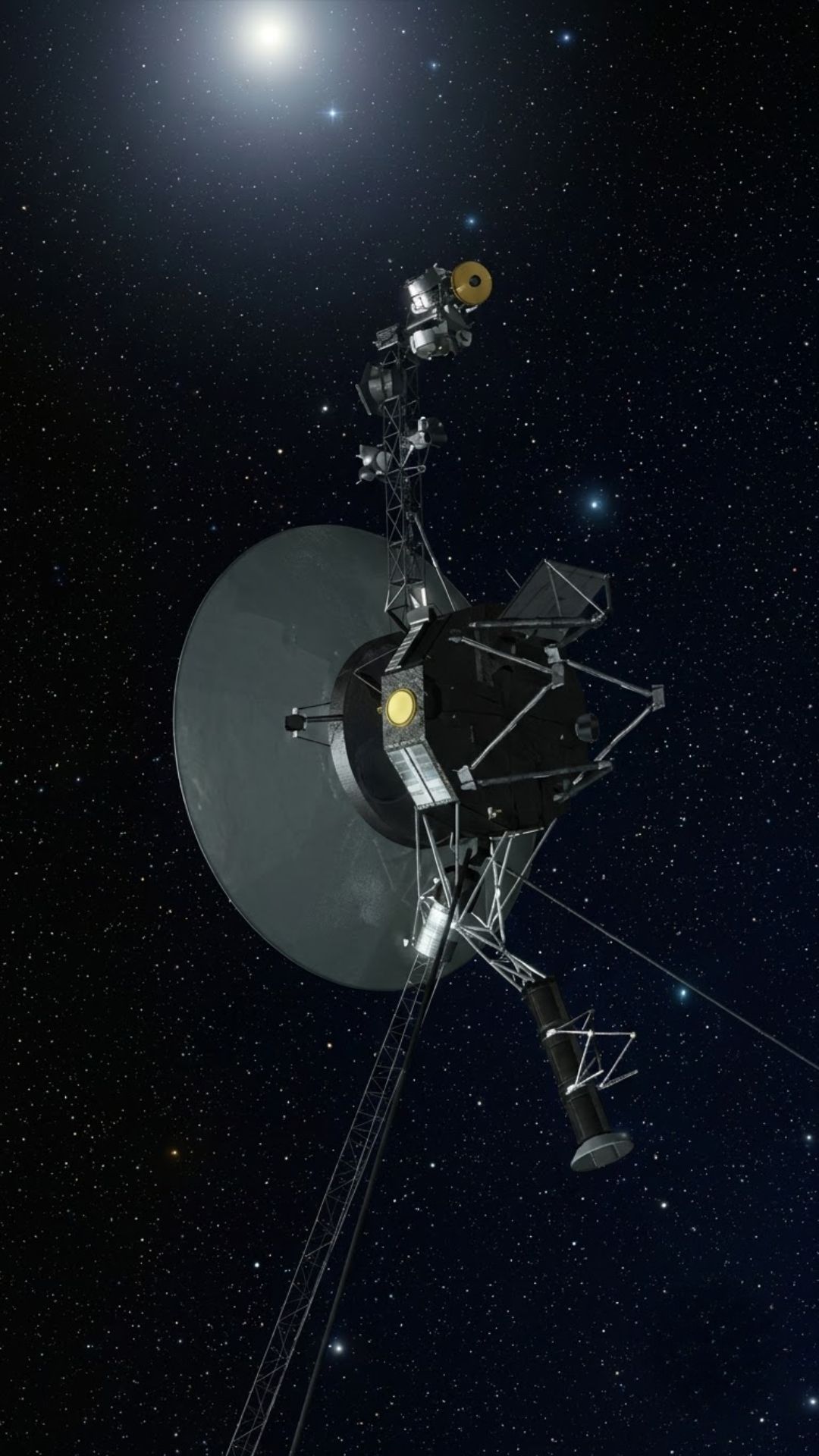
In 1977, NASA launched a small spacecraft toward the outer planets, never knowing that it would eventually travel farther from Earth than anything humans had ever built. Nearly 50 years later, Voyager 1 is still moving through interstellar space. On November 18, 2026, it will reach a distance no human-made object has ever reached before: one light-day from Earth. That sounds like a simple measurement, but it represents something extraordinary. Light can cross that distance in 24 hours. Voyager 1 has needed almost half a century to get there. And once it reaches that point, even a simple radio message to the spacecraft will become a journey measured in days.
A Spacecraft Launched In 1977 Is Still Out There
Voyager 1 lifted off from Cape Canaveral on September 5, 1977, aboard a Titan-Centaur rocket. Its original mission was not to travel forever into interstellar space. NASA had designed the spacecraft to explore Jupiter and Saturn, taking advantage of a rare alignment of the outer planets that allowed the Voyager spacecraft to visit multiple worlds.
Voyager 1 reached Jupiter in 1979 and Saturn in 1980, sending back remarkable images and scientific measurements. It discovered new moons, observed Jupiter’s atmosphere and rings, and made important observations of Saturn and its moon Titan. After completing its planetary encounters, however, the spacecraft did not stop. It continued outward, carrying its instruments into a region of space no human-made object had ever reached.
That unexpected second life became one of the greatest scientific adventures ever undertaken. Voyager 1 eventually crossed the heliopause on August 25, 2012, becoming the first human-made object to enter interstellar space. Almost 50 years after launch, it remains the most distant human-made object from Earth.
And now it is approaching another milestone that sounds almost impossible to imagine.
Ever wonder what happens to Voyager 1 in the distant future? Join us on an epic journey beyond our solar system! Discover the spacecraft’s historic mission, its incredible discoveries, and its lonely voyage into the deep cosmos. Watch the full story of humanity’s farthest traveler—a must-see for space lovers!
Voyager 1 Is About To Reach One Light-Day
On November 18, 2026, at 2:16:07 a.m. Pacific time, Voyager 1 is expected to be 16.094 billion miles, or 25.902 billion kilometers, from Earth. NASA calls that distance one light-day because it is approximately how far light travels through space in 24 hours. Voyager 1 will become the first human-made object to reach that distance from Earth.
The number is difficult to comprehend because people rarely think about distances in billions of miles. Even the distance from Earth to the Sun is only about 93 million miles. A light-day is therefore roughly 173 times the average distance between Earth and the Sun.
But the definition becomes much more striking when you reverse the question.
Instead of asking how far Voyager 1 is from Earth, ask how long it takes a signal traveling at the speed of light to reach it.
The answer will soon be about 24 hours.
A radio command sent from Earth will need roughly a day to reach Voyager 1. If the spacecraft responds immediately, the reply will need another day to return. A conversation that takes seconds on Earth would therefore require roughly two days simply because of the distance separating the two machines.
That is what a light-day really means. It is not merely a number. It is a measure of how long information itself needs to cross the distance.

Light Is So Fast That Scientists Use It As A Ruler
The reason astronomers use light to describe enormous distances is simple: light is extraordinarily fast.
Light travels at approximately 186,000 miles per second, or about 300,000 kilometers per second. In the time it takes to blink, light can travel thousands of miles. In one second, it could circle Earth roughly seven times. In one minute, it travels nearly 11 million miles.
Give it an entire day and the number becomes almost absurd: approximately 16.1 billion miles.
That distance is one light-day. A light-year is simply the same idea extended over an entire year, which is why astronomical distances become so enormous so quickly. NASA uses light-based measurements because ordinary miles and kilometers become cumbersome when discussing the spaces between planets, stars and galaxies.
There is another important detail hidden inside the measurement. A light-day is a distance, not a length of time.
The name comes from the fact that it is the distance light travels in one day. Scientists use similar terms for light-seconds, light-minutes and light-years because they provide a convenient way to describe distances across the universe.
Once Voyager 1 reaches one light-day, humanity will have sent something far enough away that even light itself will need an entire day to cross the gap.
Voyager Is Moving Fast. Light Is Simply In Another World
Voyager 1 is traveling at an extraordinary speed by human standards, but it is nowhere near the speed of light.
NASA estimates its current speed at roughly 38,000 miles per hour. That is fast enough to travel around Earth many times in a single day, but light moves about 186,000 miles every second.
This difference helps explain why Voyager has taken nearly five decades to reach one light-day.
The spacecraft is not racing toward that distance at anything resembling the speed of light. It has been gradually moving outward since its launch in 1977, first visiting the giant planets and then continuing into the outer reaches of the solar system and beyond.
The spacecraft’s journey is therefore less like a bullet crossing space and more like a tiny mechanical messenger slowly separating from its home.
It has spent decades traveling farther and farther away, while the signals connecting it to Earth continue to move at the speed of light.
That creates a strange relationship between the spacecraft and the people who operate it.
The farther Voyager travels, the longer it takes for every command to reach it and every piece of information to return.
The Journey Took Voyager Past The Edge Of The Sun’s Domain
Reaching interstellar space was another milestone that once seemed almost unimaginable.
The Sun does not simply sit at the center of empty space. It continuously releases a stream of charged particles called the solar wind, creating a vast protective region around the solar system known as the heliosphere. The boundary where that influence gives way to interstellar space is called the heliopause.
Voyager 1 crossed that boundary in August 2012, at a distance of roughly 122 astronomical units from the Sun. One astronomical unit is the average distance between Earth and the Sun. At the time, Voyager was roughly 11 billion miles from the Sun.
The spacecraft was therefore already unimaginably far away when it entered interstellar space. But the universe had another lesson waiting. Leaving the heliosphere did not mean Voyager had reached another star. It had simply crossed the outer boundary of the Sun’s enormous bubble. The nearest stars were still unimaginably farther away.

Voyager 1 Already Sent Us A Photograph Of Home
Perhaps the most emotional chapter of Voyager 1’s journey happened long before it reached interstellar space.
On February 14, 1990, NASA commanded Voyager 1 to turn its cameras back toward the planets it had left behind. The spacecraft photographed the solar system from billions of miles away, producing a series of images that became known as the “family portrait.”
One of those images showed Earth as an almost impossibly small point of light suspended in the darkness. It became known as the Pale Blue Dot.
The photograph was taken at a distance of about 3.7 billion miles from Earth, long before Voyager entered interstellar space. NASA later shut down Voyager 1’s cameras to conserve its limited power for the much longer scientific mission ahead.
The image became famous because of what it revealed. From billions of miles away, Earth was not visually dominant. It was tiny. Everything humanity had ever built, every city, war, empire, family and civilization existed on that barely visible point. And Voyager kept going.
The spacecraft that had photographed its home from the edge of the solar system continued traveling into darkness.
It Carries A Message From Earth
Voyager 1 is not traveling completely empty-handed.
Attached to the spacecraft is a 12-inch gold-plated copper record known as the Golden Record. NASA created it as a kind of time capsule containing sounds and images intended to represent the diversity of life and culture on Earth. It includes music, spoken greetings in numerous languages, natural sounds and photographs encoded onto the record.
The idea was never that someone would necessarily find Voyager.
The probability of another civilization discovering the spacecraft is extraordinarily small.
Instead, the Golden Record represents something more human.
When Voyager left Earth, scientists and engineers did not know how long the spacecraft would survive or how far it might travel. They nevertheless attached a small message from its home planet before sending it into the darkness.
Nearly five decades later, Voyager 1 is still carrying that message.
And it is now moving into a region of space where the distance from Earth can no longer be described comfortably in ordinary miles.
A Light-Day Is Still Close On The Cosmic Scale
The phrase “one light-day” sounds enormous because it is enormous by human standards.
But the universe has an unsettling way of making enormous things look small.
Neptune, the most distant major planet in our solar system, is on average about 2.8 billion miles from Earth. Light takes roughly four hours and 10 minutes to travel that distance. A light-day is nearly four times farther than that.
And even one light-day is tiny compared with the distances between stars.
The nearest star system to our Sun, Alpha Centauri, is more than four light-years away. A light-year is the distance light travels in an entire year, so four light-years dwarf a single light-day.
This is where Voyager’s story becomes almost humbling.
The spacecraft will soon reach a distance that sounds enormous to us. Yet even after nearly 50 years of travel, it will still have traveled only a microscopic distance compared with the scale of the galaxy. Voyager is very far from Earth. It is nowhere near another star.
Voyager 1 Is Growing Quiet
Voyager 1 was designed in an era when engineers had no expectation that the spacecraft would still be operating almost half a century later.
Its power supply is gradually weakening. NASA engineers have therefore had to make difficult decisions about which systems to shut down in order to preserve enough electricity for the instruments that remain useful. In April 2026, NASA announced that another instrument had been turned off to conserve power, leaving two science instruments operating at that time.
This makes the spacecraft’s current journey different from the mission imagined in 1977.
Voyager is no longer taking spectacular photographs of planets. It is not flying past new worlds.Instead, its remaining instruments are measuring the environment around it, collecting information about the interstellar medium and helping scientists understand what exists beyond the Sun’s protective bubble.
Every additional year is therefore significant. The spacecraft is operating on borrowed time, but it continues sending information across billions of miles of space. And every signal that reaches Earth has already traveled for hours. Soon, it will take almost a full day.
The First Light-Day Will Not Be The End
When Voyager 1 reaches one light-day from Earth on November 18, 2026, nothing dramatic will happen to the spacecraft. There will be no boundary in space. No wall. No sudden change in its instruments. The milestone exists because of the distance itself. Yet that is precisely why it matters.
For the first time, a human-made object will be so far from Earth that a beam of light needs a full 24 hours to travel from our planet to it. Voyager will have crossed a distance that is almost impossible to visualize, carrying decades of human engineering and a small message from Earth into interstellar space.
And Voyager 1 will keep moving.
NASA expects its scientific mission to continue only as long as enough power remains to operate the spacecraft and communicate with Earth. Eventually, the instruments will fall silent. The spacecraft will continue coasting, however, long after the last signal has been received.
Its journey will not end simply because we can no longer hear it. It will keep traveling.
The Spacecraft That Refused To Come Home
There is something almost poetic about Voyager 1’s trajectory.
It began as a planetary mission. It visited Jupiter and Saturn. It photographed the solar system from an unprecedented distance. It crossed the boundary of the Sun’s influence. It carried a message from Earth farther than any object humans had ever built.
And now, nearly 50 years after launch, it is approaching one light-day.
The number itself is difficult to comprehend, but the timeline may be even more astonishing.
A machine designed in the 1970s is still operating in interstellar space in 2026.
The engineers who launched it have aged or retired. Many of the people who watched its launch are now gone. The technology used to build it belongs to another era. Yet the spacecraft continues to travel through darkness, sending faint signals back toward the planet from which it came.
The farther Voyager goes, the longer those signals take to return. And eventually, there will be a moment when they stop coming altogether.
One Light-Day Is A Milestone. Voyager’s Real Journey Is Much Longer.
Voyager 1 will reach one light-day from Earth on November 18, 2026, becoming the first human-made object to reach that distance. It will have taken almost half a century to cross the gap that light can travel in just 24 hours.
That contrast may be the most remarkable part of the entire story. Light crosses 16 billion miles in a day. Voyager needed decades. Yet Voyager was never really racing against light.
It was carrying something farther than any machine had ever carried it before: evidence that humans could build something, launch it into the darkness and keep listening to it across an almost unimaginable distance.
The spacecraft may eventually fall silent, but it will continue moving long after that happens.
And somewhere beyond the edge of the Sun’s influence, a small machine built on Earth in 1977 will continue its journey through the galaxy.
Voyager 1 launched in 1977 for a mission to explore the outer planets. Nearly 50 years later, it is traveling through interstellar space and approaching a milestone no human-made object has ever reached: one light-day from Earth, about 16.1 billion miles away. When it arrives there on November 18, 2026, light itself will need a full day to cross the distance. Voyager will continue carrying its Golden Record, its fading instruments and its message from Earth into the darkness. Its journey is a reminder that even after humanity stops listening, the things we send into space can keep going.
This story is based primarily on NASA’s current Voyager mission information and its explanation of the one-light-day milestone. NASA’s material provides the distance, projected date, Voyager’s history, its entry into interstellar space, the Golden Record and the spacecraft’s continuing scientific mission. Source: https://science.nasa.gov/mission/voyager/voyager-1/voyager-1-what-is-a-light-day/