For decades, scientists have pursued one of the most ambitious ideas in modern energy: reproduce the nuclear fusion that powers the Sun and turn it into a virtually limitless source of electricity. The centerpiece is ITER, a multinational reactor being built in southern France with contributions from 34 countries. The project was once expected to reach fusion operations much sooner, but technical problems, redesigns, the pandemic and rising costs transformed it into a much longer and more expensive experiment. Yet just as ITER struggles, other fusion researchers are making breakthroughs that could change the race entirely.
The Dream Was To Build A Star On Earth
Nuclear fusion sounds almost impossibly simple. Inside stars, immense pressure and heat force light atomic nuclei together, creating heavier nuclei and releasing enormous amounts of energy. Scientists have spent decades trying to reproduce that process under controlled conditions on Earth.
The attraction is obvious. Fusion fuel is potentially abundant, the process itself does not produce carbon dioxide during operation, and a successful commercial reactor could provide steady power rather than depending on sunshine or wind. ITER describes fusion as an energy source worth pursuing because it could combine low-carbon operation with the potential for continuous generation.
But recreating the conditions inside a star is extraordinarily difficult.
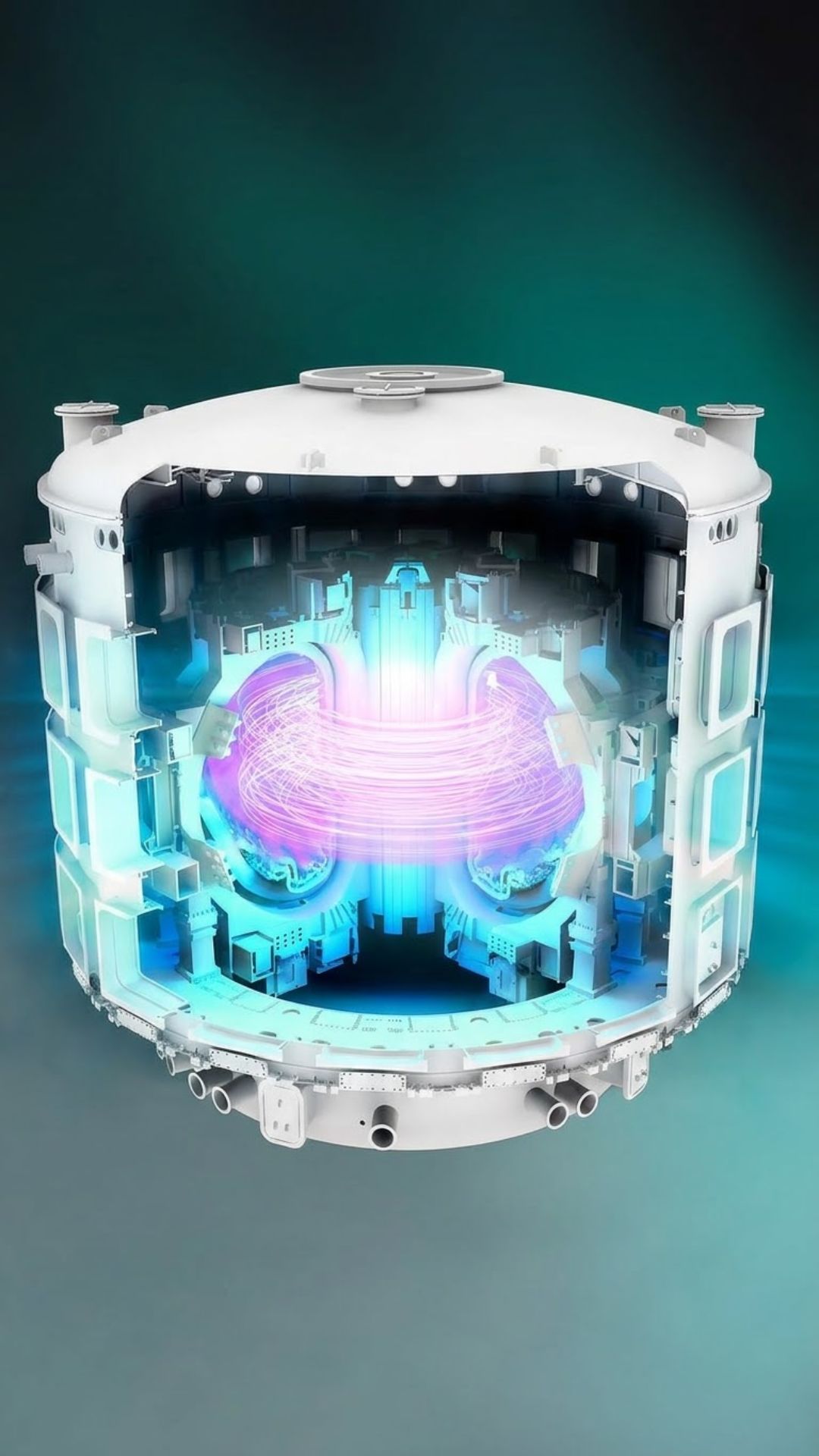
ITER is being built around a machine called a tokamak, a huge doughnut-shaped chamber designed to confine extremely hot plasma using powerful magnetic fields. The fuel is based on two hydrogen isotopes, deuterium and tritium, which must reach temperatures of millions of degrees Celsius before they can fuse.
The challenge is almost absurd: the plasma has to become hotter than the Sun’s core, while the reactor walls remain intact.
Have you ever wondered if humanity could recreate the sun’s power right here on Earth? Discover ITER, the world’s largest $22 billion fusion reactor. Don’t miss this inspiring journey into the search for a clean, limitless energy source!
ITER Started With A Much More Optimistic Schedule
The International Thermonuclear Experimental Reactor, or ITER, was conceived as a giant international testbed rather than a commercial power plant. The project brings together seven members—China, the European Union, India, Japan, South Korea, Russia and the United States—with 34 countries sharing costs and responsibilities.
When construction began in 2010, the project was expected to demonstrate energy-producing fusion reactions around 2020. The original cost estimate was about $6 billion.
Neither target held.
Technical difficulties accumulated as engineers dealt with components being manufactured across multiple countries, tight tolerances, nuclear-safety requirements and the unprecedented scale of the machine. Then the COVID-19 pandemic disrupted factories, shipping, inspections and the workforce.
By 2024, the situation had become serious enough that ITER needed a completely revised project baseline.
The new plan was not a cancellation. It was an attempt to build the machine in a more technically robust sequence and reduce the risks created by earlier delays and design decisions. The ITER Council approved the overall approach in November 2024.

Billions More And Years Further Into The Future
The scale of the delay is what made ITER such a powerful symbol of the difficulty of fusion engineering.
The Guardian reported in 2024 that the project’s budget had risen from its original estimate of roughly $6 billion to about $20 billion, with another $5 billion expected in the then-current projection. Under the updated plan, the key deuterium-tritium fusion phase moved to 2039.
ITER’s own updated schedule is more nuanced because the machine will operate in several stages. The revised baseline includes an initial research phase using hydrogen and deuterium-deuterium plasmas, followed by later stages. Full magnetic-energy operation is targeted for 2036, while deuterium-tritium operation is scheduled to begin in 2039.
That means the project has not simply been “pushed back 20 years.”
The experiment itself has been redesigned so that scientists can begin meaningful research before the machine reaches its ultimate fusion configuration.
That distinction matters because ITER is fundamentally a research facility. It is intended to demonstrate the physics and engineering needed for future fusion power plants, not to supply electricity directly to the grid.
Some Of The Hardest Problems Were Physical, Not Financial
One reason ITER has taken so long is that many of its components are effectively first-of-a-kind.
The reactor’s interior illustrates the problem. The original design called for beryllium to line the plasma-facing first wall, but engineers ultimately switched to tungsten. ITER says the updated approach incorporates more time for testing, commissioning and the new tungsten first-wall material.
There were also serious problems involving the vacuum vessel and thermal shields. ITER halted assembly for nearly two years after defects were identified, then restarted work in September 2024 after a repair strategy was established.
These are not cosmetic changes.
Inside a fusion reactor, components must withstand extreme heat, intense neutron bombardment and enormous mechanical and electromagnetic stresses. A part that is slightly wrong can become a major engineering problem when it forms part of a machine containing some of the most demanding operating conditions humans have ever attempted to create.
The lesson from ITER is therefore not simply that megaprojects are expensive. It is that fusion is genuinely hard.
Then Fusion Started Making Progress Elsewhere
Just as ITER was slowing down, other fusion programs were producing results that changed the conversation.
In the United States, the National Ignition Facility uses a completely different approach. Instead of containing plasma with a tokamak’s magnetic fields, its enormous laser system fires pulses at a tiny fusion target. In December 2022, NIF achieved the first laboratory fusion ignition in which the fusion fuel produced more energy than the laser energy delivered to the target.
The experiments have continued to improve.
On April 7, 2025, NIF produced a record 8.6 megajoules of fusion energy after delivering 2.08 megajoules of laser energy to the target. The experiment achieved a target gain of 4.13, exceeding its previous yield record.
This was an important scientific milestone, but it did not mean the United States had suddenly built a practical fusion power plant. NIF’s target chamber, lasers and supporting systems consume far more energy than the small target receives, and the facility’s purpose is high-energy-density research rather than commercial electricity generation.
Still, the result proved something important: fusion ignition was no longer merely a theoretical ambition.
Private Companies Are Trying A Different Strategy
Another major change is the growth of private fusion companies.
The Guardian noted in 2024 that companies such as Tokamak Energy and Commonwealth Fusion Systems were attempting to develop fusion systems more quickly and with different technologies than ITER. Their basic argument is that a smaller, more modern design may avoid some of the cost and complexity of a giant international project.
Commonwealth Fusion Systems continues to develop SPARC, a compact high-field tokamak intended to demonstrate net fusion energy and provide the basis for its proposed ARC power plant. In a July 2026 update, the company said SPARC assembly and testing were progressing and that it had published peer-reviewed work supporting the physics behind the future ARC design.
That creates a fascinating race. ITER represents decades of international planning and a massive scientific collaboration. Private companies are betting that newer superconducting magnets, improved materials, modern computing and more focused engineering can shorten the path to a working reactor.
But the private sector also carries its own risks. Some companies may move faster precisely because they are pursuing ambitious schedules, and experts have warned that not every commercial promise will necessarily be met.
So Is Fusion Actually Failing?
Not at all. In fact, the story is more interesting than that.
ITER has experienced major delays and cost increases, but its scientific purpose remains intact. The project has continued construction and assembly, and the ITER Council reported in June 2026 that the program was making progress under the updated Baseline 2024 plan.
At the same time, NIF has repeatedly achieved fusion ignition, private companies are developing new reactor concepts, and researchers are working on difficult problems such as producing and managing tritium—the hydrogen isotope required for future deuterium-tritium power reactors. ITER itself considers tritium breeding research an important part of the scientific work ahead.
The real problem is timing. Fusion may eventually work. The question is when it becomes practical, affordable and scalable enough to matter outside the laboratory.
The Race Is No Longer Just About Building ITER
That may be the biggest change in the fusion story. For years, ITER was the giant symbol of humanity’s attempt to reproduce the power of the stars. Now it is one contender in a much larger technological race.
The machine in France still has an important role. It is designed to answer questions that smaller experiments cannot easily answer, particularly about sustained fusion plasmas and the engineering of a reactor at enormous scale.
But the next breakthrough may come from somewhere else.
It could come from a private tokamak using stronger magnets. It could come from laser fusion. It could come from improved materials, better control systems or a solution to the tritium problem. Or it could take far longer than enthusiasts expect.
That uncertainty is precisely what makes fusion so fascinating.
Humanity is no longer asking whether we can make atoms fuse on Earth. We have already demonstrated that.
Now we are trying to figure out whether we can turn that violent burst of energy into something that runs reliably, repeatedly and economically.
The dream of fusion is not dead, but it has become much more complicated than the early promises suggested. ITER was designed to recreate the process that powers the stars on an unprecedented scale, yet its original schedule proved unrealistic and its projected cost soared. The updated program now aims for a more technically robust path toward deuterium-tritium operation in 2039, while other approaches are moving rapidly. The result is not the end of the fusion dream. It is a technological race in which the biggest question is no longer whether fusion can work, but who can make it practical first.
P.S. This article draws primarily on The Guardian’s investigation into ITER’s delays and rising costs, supplemented with current 2026 information from ITER, Lawrence Livermore National Laboratory and Commonwealth Fusion Systems. Source: https://www.theguardian.com/technology/article/2024/aug/03/is-the-dream-of-nuclear-fusion-dead-why-the-international-experimental-reactor-is-in-big-trouble