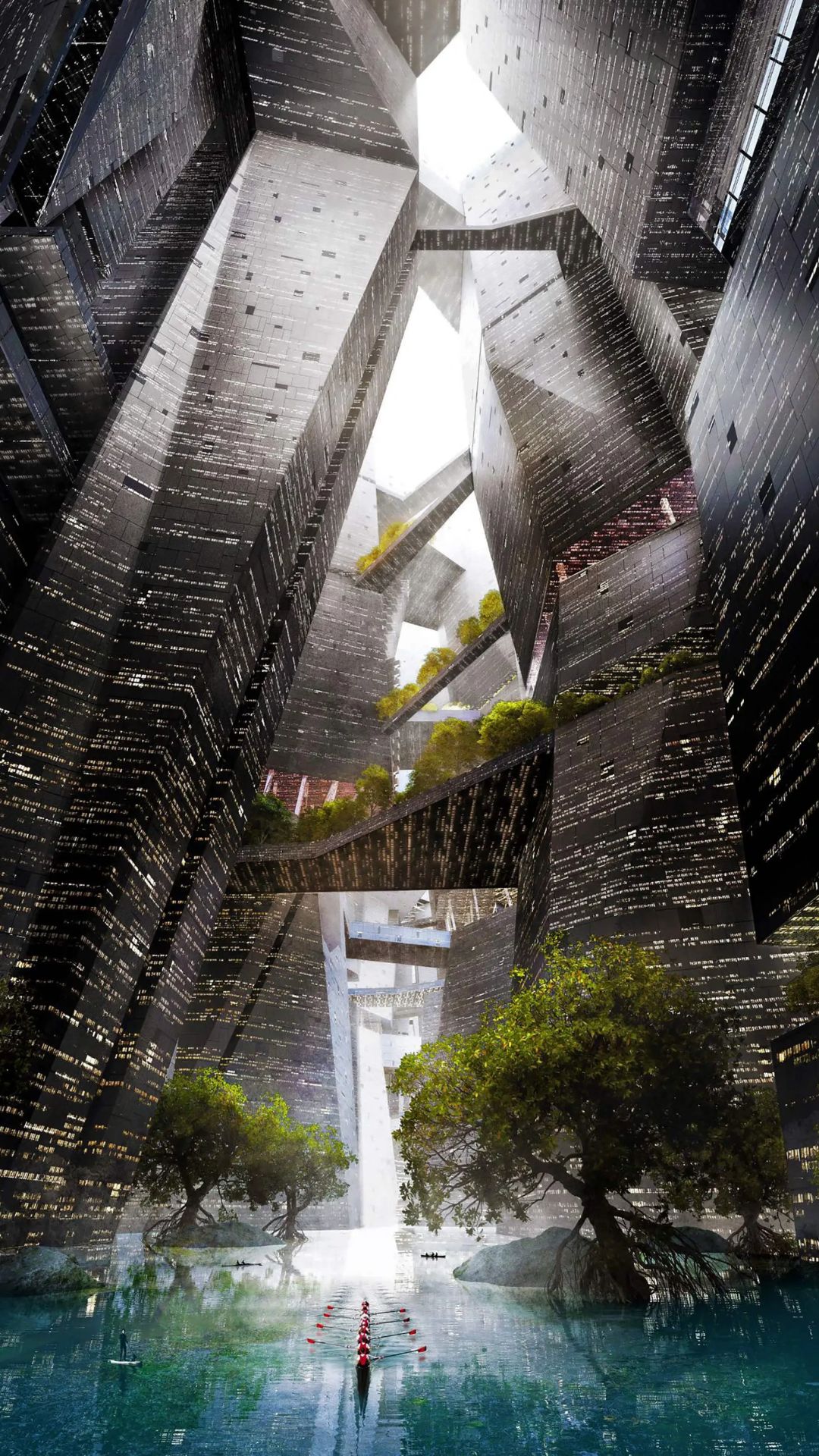
Saudi Arabia wanted to build a city unlike anything humanity had ever attempted: a 170-kilometer-long structure of mirrored glass, 500 meters high and designed to house 9 million people. The Line was supposed to eliminate conventional streets, minimize cars and compress an entire metropolis into a narrow band running through the desert. But when the futuristic renderings met the realities of construction, the dream began shrinking. Costs ballooned, designs ran into stubborn engineering problems, promised foreign investment failed to appear at the expected scale, and a first phase originally planned at 20 modules was reduced to just three. At least $50 billion has already been spent.
The City That Was Supposed To Rewrite Urban Life
The Line is the centerpiece of Neom, the vast development project championed by Saudi Crown Prince Mohammed bin Salman as part of the country’s effort to diversify its economy beyond oil. The idea was radically different from the way most cities have grown: instead of spreading outward across the landscape, the city would rise vertically inside a continuous structure only 200 meters wide.
The original concept was considerably more conventional. Los Angeles architecture firm Morphosis had proposed a settlement roughly 2 kilometers wide, stretching from the Red Sea toward the mountains and connected by rail. In late 2020, however, Mohammed bin Salman pushed for something far more extreme, suggesting that the 2-kilometer width should essentially become two giant towers.

The resulting vision was extraordinary even by Saudi Arabia’s standards. The Line would run for 170 kilometers, stand 500 meters high and be covered in mirrored glass, with homes, offices, hospitals, universities, shops and public spaces stacked vertically inside it. Residents were promised access to essential services within five minutes, while high-speed rail would connect the length of the city without conventional roads or cars.
On a computer screen, it looked like the future. Then engineers had to figure out how to build it.
Ever wondered why the world’s largest megaproject is struggling? We’ve dived deep into the internal documents and satellite imagery behind Saudi Arabia’s ambitious Neom project. Discover the reality behind the vision and why construction has hit a standstill. Read our full investigation now to uncover the hidden financial truth!
Then Physics Entered The Conversation
One of the most spectacular ideas was the proposed “hidden marina,” where giant cruise ships would enter a deepwater harbor carved into the desert. Suspended above it would be a 30-story glass-and-steel building hanging from an enormous structure, almost like a chandelier over the water. A 45,000-seat football stadium was planned even higher, around 350 meters above sea level.
But architects working on the design began questioning whether the chandelier structure could actually behave as planned. One architect warned that a building suspended hundreds of meters in the air would move in the wind and could begin to behave like a pendulum. As the movement increased, he feared the structure could eventually break away and crash into the marina below.
Then came an even more revealing question: what happens when somebody flushes a toilet in an upside-down building? According to the architect’s account, engineers proposed using hundreds of shuttle vehicles and retractable bridges to collect and move sewage. The problem sounded almost comical, but it exposed a serious issue with the project: futuristic architecture still had to obey gravity.
The Line was designed to escape many conventions of traditional cities. It could not escape physics.
The Materials Needed Were Almost Unimaginable
The bigger the design became, the more difficult the supply chain looked.
The Line was divided into 800-meter modules, and each module was expected to require roughly 3.5 million tonnes of structural steel, 5.5 million cubic meters of concrete and 3.5 million tonnes of reinforcement steel. One former employee said producing the concrete for the first 20 modules would require more cement every year than France’s annual production.
The steel requirements were similarly enormous. A senior design manager estimated that the project could consume roughly 60 percent of the world’s annual green-steel production each year, potentially driving up prices simply because The Line would be demanding such a large share of global capacity. Each 800-meter module was estimated to represent about $48 billion in construction value.
Transporting all of that material was another problem. There was only one relatively small port about 80 kilometers from the main site, connected by a single dual carriageway. Under one construction scenario, enough material would have to arrive for a 40-foot shipping container to reach the site roughly every eight seconds, 24 hours a day, just to build 12 modules by 2030.
At that point, the question was no longer simply whether the buildings could be designed. It was whether the rest of the world could manufacture and deliver enough stuff to build them.

Everyday Life Became An Engineering Problem
The Line was supposed to make urban living simpler, but some of the planning documents revealed the opposite.
Natural light, for example, became difficult because many of the planned public spaces were deep inside the structure and far from direct sunlight. Designers concluded that gardens would have to be concentrated in particular sections where enough sun could reach them, while other areas would remain much darker.
Transportation created another strange compromise. One senior architect noticed that the high-speed railway stations had unusually small platforms and elevators and that the trains lacked luggage racks. When he asked why, he was told the station had not been sized for passengers bringing luggage from the airport. The proposed solution was for travelers to send their bags separately, with luggage collected from outside their homes eight hours before a flight.
Fire safety required an entirely different approach. Instead of simply evacuating people downward and out of the building, planners considered moving residents sideways into neighboring sections of the enormous structure. Water, sewage, mail delivery and rubbish collection all required bespoke systems because the city was being designed as a continuous vertical wall rather than a conventional neighborhood.
The technology was futuristic. The problems were not. People still needed sunlight, toilets, luggage collection and somewhere to go when there was a fire.

Even The Marina Needed Its Own Artificial Environment
The hidden marina created another contradiction.
It was supposed to be deep enough for enormous cruise ships, but its geography meant there would be little natural water circulation. Without artificial movement, engineers worried that the harbor could become stagnant and potentially hazardous. The proposed solution was a system of giant pumps running continuously, 24 hours a day, 365 days a year.
The same pattern kept appearing. A normal harbor uses currents and tides to move water. The Line’s marina would have to recreate that circulation mechanically. A conventional city lets sunlight reach streets and parks naturally. The Line would have to work around its own geometry. The project was not merely building a city. It was attempting to build an enormous machine that would reproduce the functions a normal city gets from geography for free.
From an $8.8 trillion dream to a $50 billion ghost town. How did the world’s most ambitious city project turn into a total nightmare? Watch the full story here!
Nature Was Another Problem The Renderings Could Not Remove
The Line also crosses a landscape that was already being used by wildlife.
According to the Financial Times, the structure would block migration routes used by several mammal species and intersect a major route used by millions of migratory birds traveling between Europe and Asia and their wintering grounds in Africa. Some of those species are endangered. In early 2024, conservation experts identified The Line as an emerging concern for global biodiversity.
The mirrored facade made the issue even more complicated. Designers considered putting patterns on the glass to make the surface more visible to birds, but ornithologists argued that visibility alone would not solve the problem. Birds migrating at altitude could still encounter a 500-meter-high wall stretching for kilometers, with no obvious way around it.
The project also carried human costs. The village of Qayal, near the proposed marina, was demolished, while human-rights observers reported prison sentences for members of the Huwaitat tribe who protested their eviction, including three people sentenced to death. These allegations have become part of the broader controversy surrounding Neom.
The desert was not an empty canvas.It already had people, animals and ecosystems.
Then The Price Of The Dream Exploded
Perhaps the biggest problem was money.
When Neom executives were briefed in late 2021, The Line’s budget was about $1.6 trillion. By the following spring, an updated internal estimate had risen to approximately $4.5 trillion, according to a person familiar with the figures cited by the Financial Times.
At the same time, Saudi Arabia had expected major foreign investment to help finance the wider Neom vision. According to people interviewed by the Financial Times, the large-scale foreign backing Riyadh had hoped to attract never materialized. Saudi Arabia’s Public Investment Fund was also facing greater pressure to produce returns and reconsider how its money was being distributed across competing giga-projects.
That created a difficult equation. The larger The Line became, the more capital it required. The more expensive it became, the more outside investment it needed. And the harder it was to persuade investors to commit to a project whose final economics were increasingly uncertain.
Billions Were Spent While The Plans Were Shrinking
Construction began before many of the final building designs were settled. Piling started in 2022, and the project eventually used about 6,000 massive piles across roughly 2 kilometers of desert. Around 60 piling rigs reportedly worked around the clock, installing about 60 to 65 piles a day. The foundation work cost several billion dollars.
Then the first phase began shrinking.
The original plan called for 20 modules to be completed by 2030. That figure fell to 12, then seven, then four, and finally three by the end of 2023. One construction manager interviewed by the Financial Times said that by the time the plan had fallen to three modules, the 6,000 piles already installed were of no immediate use. The reduction was not merely cosmetic.
Former employees estimated that roughly 300,000 to 500,000 residents, equivalent to about seven modules, were needed to create enough scale to make the project attractive to outside investors. Below that point, they said, the investment case became increasingly difficult.
The project had reached a strange situation: building less could make the economics worse, but building more required even more money.

Inside Neom, Some People Were Raising Questions
The Financial Times interviewed more than 20 people who had worked on The Line, including architects, engineers and former senior executives. Many spoke anonymously because they feared legal consequences. Their accounts described a project where ambitious deadlines and dramatic renderings sometimes came before the detailed work needed to prove that the vision was feasible.
In mid-2023, Neom launched an internal review known as Project Moon to examine rising costs and schedule delays. According to a senior executive quoted by the FT, the person leading the review encountered resistance and eventually left. Several former employees compared the working culture to Hans Christian Andersen’s The Emperor’s New Clothes, saying dissent could be ignored or punished and that changing direction became increasingly difficult.
Neom disputes the most negative descriptions of the project. It continues to describe The Line as a strategic priority and as a multi-generational development of unprecedented scale and complexity. That distinction matters.
The Line has not officially been declared a failure. But the version of The Line originally presented to the world has already been dramatically reduced.
What Is Actually Being Built?
The Line is not imaginary. Satellite imagery shows extensive excavation, tunneling, roads and foundation work across the desert. Work on a planned railway “spine” stretching toward the mountains has already produced major infrastructure, while construction of the enormous marina has involved the excavation of around 100 million cubic meters of earth, equivalent to roughly 40 Great Pyramids of Giza.
But the city shown in the original renderings is not what currently exists.
The first phase is now 2.4 kilometers rather than the full 170 kilometers. The airport and railway infrastructure connected to the project have also been affected by changing priorities, with construction on parts of the planned airport and “spine” now stopped.
That contrast is perhaps the most revealing image of the entire project. Thousands of enormous foundations sit in the desert, waiting to support a building that may look very different from the one originally promised. Billions have already been spent. The original city has become smaller.
The Problem Was Never Just One Thing
It would be easy to say The Line was simply too ambitious for engineers. But the Financial Times investigation suggests that the project’s troubles came from several directions at once.
The structure had to cope with wind and enormous loads. The city needed unconventional systems for water, sewage, transportation and fire safety. Wildlife migration created environmental conflicts. The supply chain needed extraordinary quantities of steel and concrete. Foreign investment did not arrive at the expected scale. Costs grew dramatically, and deadlines created pressure to build before the final design was fully resolved.
None of these challenges necessarily makes a mega-project impossible on its own.
Together, they reveal why building an entirely new city is fundamentally different from producing a spectacular architectural rendering.
A rendering has no sewage system. A rendering has no shipping bottleneck. A rendering does not need to evacuate 9 million people during a fire. And a rendering never has to send a $4.5 trillion bill to someone who actually has to pay it.
The $4.5 Trillion Question
The Line may still continue in a smaller form. Neom says the project remains a strategic priority and describes it as a development that could unfold over generations. The work already completed means this is not a simple abandoned scheme sitting untouched in the desert.
But the transformation is undeniable.
The dream began as a 170-kilometer city for 9 million people. The first phase was once supposed to include 20 modules. It was later reduced to 12, then seven, four and finally three. Meanwhile, the internal cost estimate rose from $1.6 trillion to roughly $4.5 trillion, while at least $50 billion had already been spent.
That does not prove that The Line can never be completed. It proves something more interesting. The original vision could not simply be transferred from a presentation screen into the real world unchanged. Reality demanded compromises. Physics demanded compromises. Nature demanded compromises. Money demanded the biggest compromises of all.
The Line was announced as a radical experiment in urban life: a 170-kilometer mirrored city, 500 meters high and designed to house 9 million people. But as the project moved from renderings to construction, engineers encountered problems involving structural movement, natural light, sewage, fire safety, transportation and water circulation, while conservation experts warned about the impact on wildlife migration. The project also required extraordinary quantities of steel, concrete and shipping capacity, and its internal cost estimate rose from about $1.6 trillion to roughly $4.5 trillion. At least $50 billion has already been spent, yet the first phase has been repeatedly reduced from 20 modules to just three. Neom still describes The Line as a strategic, multi-generational project, but its evolution already tells a remarkable story: the larger the dream became, the more aggressively reality forced it to shrink.
P.S. This story draws on the Financial Times investigation into The Line, including interviews with architects, engineers and former Neom executives, as well as reporting on the project’s changing design, costs and construction. Source: Financial Times — “End of The Line: how Saudi Arabia’s Neom dream unravelled.” – https://ig.ft.com/saudi-neom-line/