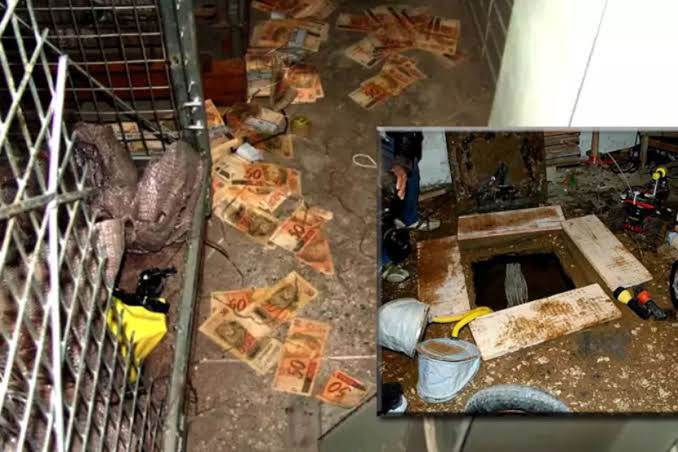
The thieves did not break into Brazil’s Central Bank through a door, window or roof. For three months, they quietly operated a fake gardening business just one block away while secretly digging underground toward the vault. Then, over a single weekend, they broke through the floor and disappeared with more than 150 million reais in cash. By Monday morning, the bank had no idea how the money had vanished—or how a tunnel built beneath a busy city had gone unnoticed for so long.
The Business That Wasn’t What It Seemed
On Monday morning, August 8, 2005, employees arriving at Brazil’s Central Bank in Fortaleza discovered that something was terribly wrong: a huge sum of cash had vanished from the vault. The robbery had actually been carried out over the weekend by a gang that had spent the previous three months posing as employees of a fake gardening business just one block away. By the time investigators understood what had happened, the thieves had escaped through an underground route they had secretly built beneath the city.
The operation began with an idea that depended as much on appearances as on the tunnel itself. The gang rented a small house just one block from the bank and established a fake gardening business called Grama Sintetica, or Astro Turf. The building was painted green, advertisements were placed around the neighborhood and a white van carrying the company’s logo was kept outside to make the business look legitimate.
Behind that ordinary-looking front, the real operation was taking shape. According to police, the men spent roughly three months preparing their route toward the bank. The existence of a genuine-looking business gave them a reason to be there every day and helped conceal the work taking place inside the property.
The deception was simple, but the objective was anything but. The group was not trying to get through a door or disable a guard. They were attempting to approach the bank from underneath.
Ever wonder how 25 people pulled off the most audacious bank heist in Brazilian history without breaking a single door? Dive into the gripping true story of the Central Bank tunnel robbery. From the meticulous three-month planning to the ultimate vanishing act, witness how one small mistake brought everything crashing down. Watch now!
The Tunnel Under the City
From a bedroom at the back of the rented house, the thieves dug an approximately 80-meter tunnel toward the bank’s vault. Police later found that the passage had lighting and had been reinforced, while an improvised ventilation system helped make the confined space usable during the excavation. The tunnel also passed beneath another part of downtown Fortaleza before reaching the Central Bank building.
The final obstacle was the vault itself. Police said the thieves broke through the floor of the safe and entered the area where large containers of Brazilian currency were stored. The scale of the work was remarkable because the entire operation had been carried out beneath an active urban neighborhood without immediately drawing attention to what was happening below.
When investigators later entered the tunnel, they found tools and signs of the months of excavation. Kneepads and gloves were discovered in the garden of the rented house, apparently left behind after the work was completed.
The tunnel was impressive, but the timing of the theft was just as important.

The Vault Was Emptying While Nobody Knew
The bank branch closed for the weekend, giving the thieves time to enter the vault without employees present. When workers returned on Monday morning, they found a circular opening in the vault floor, along with empty containers and discarded cans of energy drinks and juice left behind by the intruders.
The stolen money amounted to roughly 156 million reais, about £38 million at the exchange rate reported by The Guardian at the time. Police said the thieves had taken at least four containers holding used 50-real notes, a detail that could make the money more difficult to trace once it entered circulation.
Other reports gave an even clearer idea of the haul’s physical scale. Brazilian authorities estimated that the stolen cash weighed around 3.5 tons, illustrating just how much currency had been removed from the vault.
The theft was therefore not simply a case of criminals escaping with a few bags of cash. It was a carefully organized operation involving a fake company, months of preparation and an underground route that ended directly inside a secure facility. And there was another problem for the bank. Its security systems had not stopped them.
The Security Failure
After the robbery was discovered, investigators learned that the vault’s motion sensors and security cameras had not been functioning during the weekend. That meant the thieves were able to enter the vault without triggering the systems that were supposed to detect exactly this kind of intrusion.
The discovery immediately raised another question: was the security failure simply a coincidence, or had someone inside the bank helped the criminals? The Central Bank launched its own internal investigation to determine why the equipment was not operating and whether there had been any inside assistance. At that stage, however, investigators had not established that an insider was involved.
That uncertainty added another layer to the mystery. The thieves had already gone to extraordinary lengths to approach the vault without being seen, but their success also depended on a security system that failed to detect what was happening. By the time employees realized anything was wrong, the criminals were already gone.
The Manhunt Begins
Police immediately began searching for the group behind the robbery. Investigators questioned people living and working near the rented house, including witnesses who reported seeing several men connected with the property. The authorities also examined the fake business, the van and the tools left behind as they tried to reconstruct who had organized the operation.
The investigation gradually began producing arrests and money recoveries. By late September 2005, Brazilian federal police had recovered about 12.2 million reais and arrested five suspects. Officials said the total amount stolen had been approximately 164.8 million reais, a higher figure than the initial estimate reported immediately after the robbery.
By November, more arrests followed. Three additional suspects were reported detained, and police said some of those arrested had confessed to helping excavate the tunnel. Investigators were still searching for additional participants and had recovered only a fraction of the missing money.
The extraordinary thing about the case was that the hardest part of the crime had already been completed. The thieves had spent months building an apparently impossible route into the bank, escaped with an enormous amount of cash and disappeared before anyone knew the vault had been breached.
The Heist That Looked Like a Movie
What made the Fortaleza robbery so memorable was not simply the amount of money stolen. It was the strange contrast between the criminal operation and its surroundings. In the middle of a Brazilian city, a fake gardening business sat quietly near the Central Bank while an underground passage was being created beneath the streets.
Police themselves struggled to describe how audacious the operation was. Fortaleza civil police representative Sabrina Albuquerque told The Guardian that digging a tunnel of that scale was the kind of thing people expected to see in a movie. Yet this one was real, and by the time authorities understood what had happened, the thieves had already taken millions.
The case also showed how the most dramatic crimes do not always depend on speed or violence. This one depended on patience, deception and secrecy, with the criminals spending months preparing while appearing to do nothing more suspicious than run a small neighborhood business.
That is perhaps the most remarkable part of the story. The bank was only one block away. The thieves did not break through its front door. They built their own way in.

The 2005 Fortaleza bank heist became extraordinary because almost every part of it seemed impossible. A group of thieves created a fake business, spent months secretly preparing an underground route and eventually reached the vault of Brazil’s Central Bank without immediately being detected. They escaped with more than 150 million reais before the robbery was discovered, while the failure of cameras and motion sensors raised further questions about the bank’s security. Years later, the case still stands as a striking example of how patience, deception and planning can turn an ordinary-looking building into the cover for an extraordinary crime.
P.S. The Fortaleza bank heist was reported by The Guardian, which detailed the fake gardening business, the tunnel dug beneath the city and the millions taken from the Central Bank. Source: https://www.theguardian.com/world/2005/aug/10/brazil.tomphillips