In the American West, a gold-mining town without a saloon would have been unusual enough. Golden, Oregon, went even further: its founders also kept out dance halls and brothels, building the settlement around a strict Christian way of life. Yet after the miners and families eventually left, Golden acquired something its real residents never had—a cemetery filled with graves. There was only one problem. Nobody was buried there. The little graveyard had been built for a television Western, turning an already unusual mining town into one of Oregon’s strangest surviving ghost towns.

Gold Brought Miners To Coyote Creek
Gold fever reached southwestern Oregon in the early 1850s, when placer miners descended on Coyote Creek in what is now Josephine County. Temporary camps appeared around the workings, and the area stayed busy until major discoveries in neighboring Idaho drew miners away during the 1860s. When that excitement faded, many returned to the old Oregon diggings, and smaller settlements began appearing again.
One of those communities was known as Goldville. By the late 1870s, however, the nature of mining was changing. Hydraulic mining offered a more efficient way to work placer deposits, bringing another wave of prospectors into the region and giving the Coyote Creek district a second chance at prosperity.
Among the newcomers was Reverend William Ruble, who arrived with his wife, their sons and their families. The Rubles were Campbellites, also known as Disciples of Christ, and they were committed to a strict interpretation of Christianity. Rather than simply becoming another mining family, they began reshaping the entire community around their beliefs.
Ever wondered if you can actually find gold on the beach? Join Dave Turin as he explores Oregon’s famous Whiskey Run to uncover the secrets of finding the world’s hardest gold to pan!
The Preacher Who Started Building His Own Town
Over roughly a dozen years, Ruble acquired a large share of the area’s mines and claims and established mining businesses for his sons. William and his son Schuyler also developed the Ruble hydraulic elevator, a device intended to separate larger rocks from finer material during placer mining.
The family eventually turned its attention from the mines to the settlement itself. In 1890, Ruble and his sons founded Golden, building what they saw as a more orderly community on the old Goldville site. A post office followed in 1896, while the Rubles constructed a family home, a church, a school, a general store and other residences.
Golden was never a huge town. At its peak, roughly 200 people lived there, with several hundred more in the surrounding area. But its character was distinctive because the people who controlled the town had very clear ideas about how it should operate.
Those ideas were not necessarily shared by every miner who came looking for gold.
The Gold Town That Banned Saloons
Most prosperous mining camps of the era developed businesses that catered to miners’ appetite for entertainment. Golden did not.
Under the influence of the Campbellites, the town had no saloons and no brothels, and HistoryNet notes there is no record of Golden ever hosting a dance. Anyone looking for those activities had to travel several miles south to Placer, a community that welcomed the businesses Golden’s founders rejected.
It created a peculiar contrast. Men could come to Golden to work the mines, buy supplies, attend church and send their children to school, but the familiar nightlife of a Western mining town was deliberately kept outside the community.
Ruble’s effort was not simply about banning a few businesses. He and his family believed they were creating a more civilized settlement in a region they considered troubled by the excesses of frontier life.
For a time, the experiment worked. Golden survived for nearly three decades, even without the attractions that were common in other mining camps.
When The Gold Started To Disappear
Golden’s real weakness had nothing to do with its strict rules. It was the same problem that eventually destroyed countless mining towns across the West: the ore became less valuable.
The Ruble family gradually moved away. Reverend Ruble left in 1901, followed by his sons and their families, and he died in Salem in 1905. The town continued operating for a while, but its population steadily declined as mining became less profitable.
In 1906, the local school still reported three dozen students. That number would not last.
The post office closed in 1920, and although mining continued on a smaller scale into the middle of the 20th century, Golden increasingly became a place people left rather than a place they moved to. The community eventually faded into a ghost town, leaving behind only a handful of structures. And those surviving buildings still tell the story of what the Rubles were trying to build.

The Church That Outlasted The Town
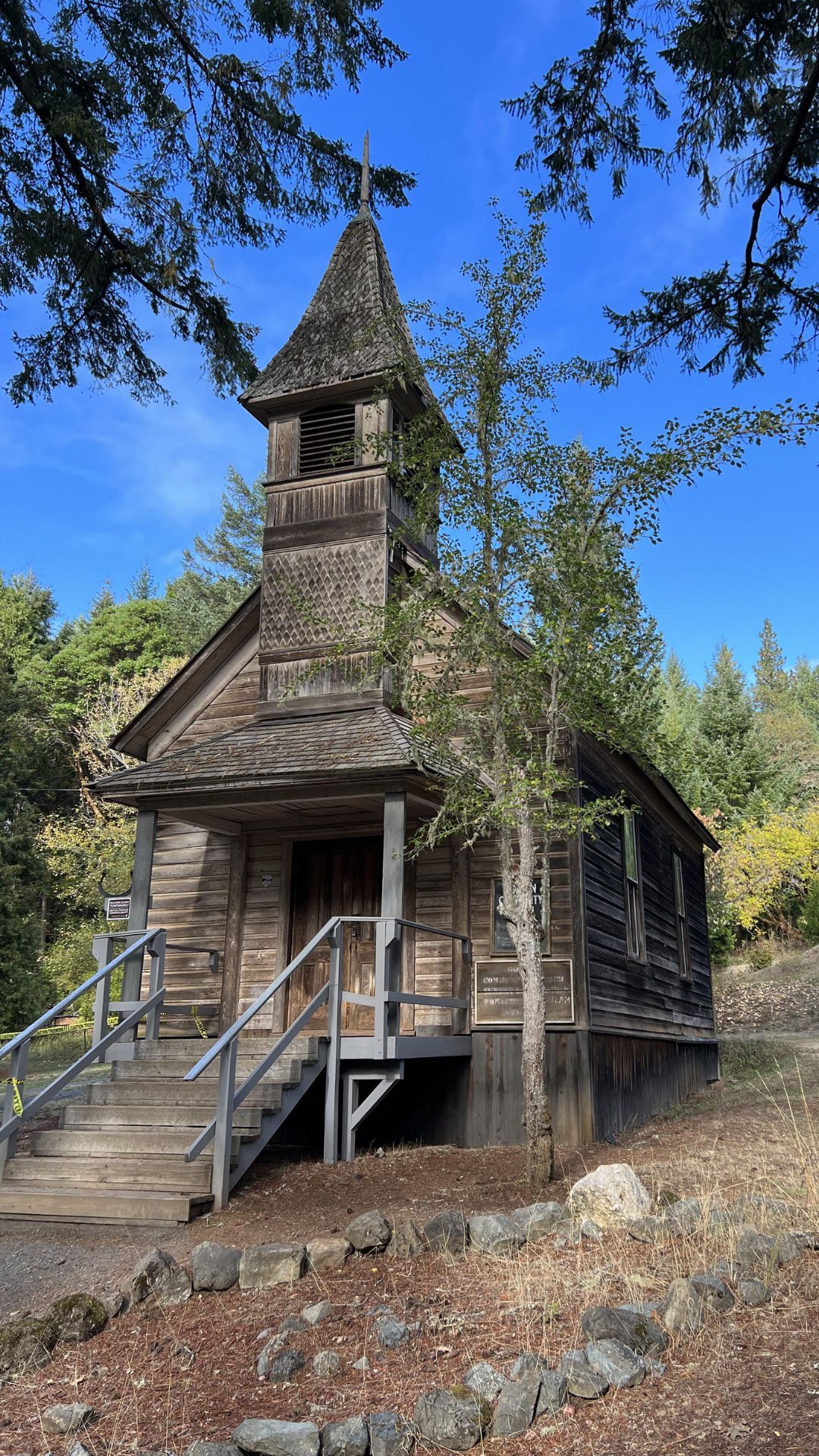
Today, Golden’s most recognizable survivor is its wooden church, built in 1892. The nearby Ruble family home dates from the same year, while a general store built in 1904 also remains. An outhouse and remnants of other buildings, including a carriage house, complete much of what is left of the settlement.
There are no working businesses in the town, but the church remains open to visitors. Surrounded by trees and old structures, it offers an unusually direct look at a mining community that was shaped as much by religion as by gold.
Then there is the cemetery.
At first glance, it looks exactly like the kind of place you would expect to find beside an abandoned Western town. Small grave markers sit in the clearing, weathered by time and surrounded by the remains of Golden.
But Golden’s supposed cemetery has a problem that becomes stranger the longer you think about it. Nobody is buried there.
The Cemetery That Came From Hollywood
The graveyard was not created by Golden’s original residents. It appeared decades later when the television Western Gunsmoke filmed an episode in the town in 1972.
The production needed a cemetery for one scene, so a fictional graveyard was created as part of the set. The production ended, but the markers remained. Over time, the fake cemetery became part of Golden’s landscape, looking old enough that visitors unfamiliar with its history could easily assume that actual residents of the mining town had been buried there.
Some visitors have even left coins and small objects on the markers, treating them like genuine graves.
The cemetery also became useful beyond that one television episode. Golden and its artificial graveyard were later used as a backdrop for other Western productions, adding another layer of Hollywood history to a place that had already accumulated more than a century of real history.
It is an odd fate for a ghost town: its most misleading feature was created not by the miners who lived there, but by actors who came generations later.
Golden Survived Because Someone Chose To Save It
By the 1990s, local residents were increasingly concerned about preserving what remained of Golden and the surrounding Coyote Creek area. The Golden Coyote Wetlands group was formed to help protect the town and its environment.
Today, Golden is owned by the Oregon Parks and Recreation Department. It has been designated a state heritage site and is listed on the National Register of Historic Places.
That protection matters because most ghost towns do not receive such a second chance. Buildings disappear, private property changes hands, roads cut through old sites, and what remains of a settlement can eventually vanish altogether.
Golden survived because enough people decided its unusual history was worth keeping intact.
A Ghost Town With A Story No One Could Have Planned
Golden began as a mining community built on the hope of striking wealth from Coyote Creek. But unlike many Western boomtowns, it was shaped by a family determined to create a strict religious settlement, one without saloons, dance halls or brothels.
Eventually the gold declined, the residents moved away and the town became a ghost town. Yet its story gained one final twist long after the miners were gone: a television crew built a cemetery that never held a single body.
Today the church, the Ruble house and the old general store are genuine pieces of Golden’s past. The cemetery is not.
That mixture of authentic history and Hollywood invention may be what makes Golden so memorable. It is a real mining town that survived into the present, but part of what visitors see there was created for television—and has somehow become part of the town’s story.
Golden, Oregon, was never a typical gold-mining town. Founded in 1890 by Reverend William Ruble and his family, the settlement was shaped by the strict beliefs of its Campbellite founders, who kept out saloons, brothels and even dances that were common in other mining communities. When the gold declined, Golden slowly emptied, leaving its church, family home and general store behind. Decades later, Hollywood added another unexpected chapter: a cemetery built for Gunsmoke in 1972. The graves look real, but no one was ever buried there. Today, both the historic town and its unlikely fake cemetery remain.
P.S. This story draws on HistoryNet’s account of Golden, Oregon, including its mining history, the Ruble family’s role, and the surprising story behind the town’s fictional cemetery. Source: https://historynet.com/golden-oregon-ghost-town/