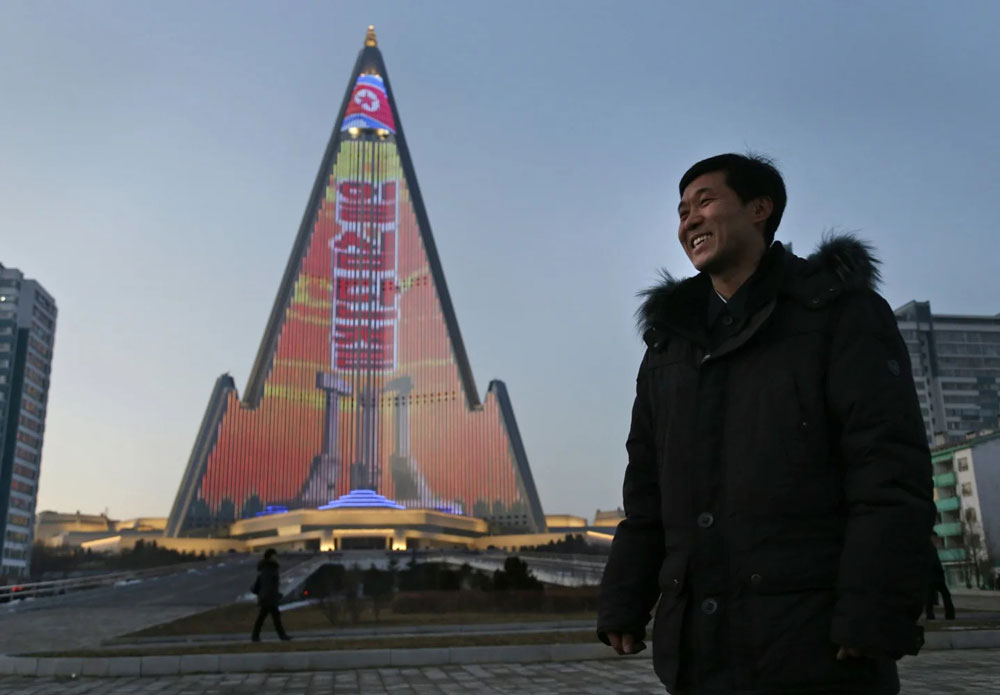
A 105-story hotel has dominated the skyline of Pyongyang since 1987. It was supposed to become a spectacular destination for international visitors, yet decades later it still has no public opening date and has never welcomed a guest. The strange part is what happened next: the building that was once seen as an enormous unfinished failure was transformed into something else entirely. At night, more than 100,000 LEDs can cover its facade with monuments, fireworks and political messages—while the hotel itself remains empty.
The Hotel That Rose Too High to Disappear
Construction of the Ryugyong Hotel began in 1987, when North Korea was pursuing ambitious projects designed to showcase Pyongyang on a grand scale. The building was planned as a huge pyramid-shaped hotel with 105 stories, and its size was intended to make it a landmark visible across the capital. From the beginning, the project was about far more than accommodation; the building itself was meant to make a statement.
But the project ran into serious economic problems in the early 1990s, and construction stopped. The enormous concrete structure remained standing over Pyongyang while the unfinished interior stayed unused. Instead of becoming a functioning hotel, it became a permanent part of the skyline—and, increasingly, a symbol of an ambition that had stalled.
The building was too massive to hide and too incomplete to fulfill its purpose. For years, that contradiction was essentially the whole story of the Ryugyong Hotel.

Three Decades, Still No Guests
For outsiders, the Ryugyong became famous precisely because it was not functioning as a hotel. AP described it as the world’s tallest unoccupied building, while noting that the structure had towered over the capital since 1987 without a guest ever checking in. At night, for years, the only visible light was the aircraft warning light at the top.
The building’s unfinished appearance made it an easy symbol of failure. Yet the story was more complicated than a structure simply being abandoned. Work eventually resumed on the exterior, and the building was given a glass-covered facade that dramatically changed its appearance from the outside. It looked increasingly like a completed skyscraper even though the basic question remained unanswered: when, exactly, would it operate as a hotel?
That distinction matters. A skyscraper can look finished from the street while still lacking the systems and infrastructure required to function as a working building. The Ryugyong’s exterior became more impressive, but its central purpose remained elusive.
Ever wonder why a massive 105-story skyscraper in North Korea has sat empty for over 30 years? Discover the fascinating, bizarre history behind the Ryugyong Hotel—the world’s tallest unoccupied building. Watch now to uncover why this ambitious architectural project became a multi-million dollar concrete husk. You won’t believe it!
The Empty Hotel Became a Giant Screen
Then the building acquired a new identity. Light designer Kim Yong Il and his team turned the facade into an enormous LED display, installing more than 100,000 lights that could operate for several hours each night. Instead of showing hotel advertisements or welcoming guests, the surface could display famous monuments, fireworks, party symbols and political slogans.
The transformation created one of the strangest contradictions in the entire story. The building itself did not have electricity inside, yet its exterior could glow across Pyongyang with elaborate nighttime displays. A structure designed to house people had become a giant surface for images instead.
The new lighting system also changed how the building was perceived. What had once looked dark and abandoned could suddenly appear active and imposing. The Ryugyong had not become the hotel it was supposed to be, but it had found another way to command attention.
In a sense, the building was finally doing something—just not what it had been built to do.

Why Was the Hotel Never Opened?
The reasons behind the Ryugyong’s failure were not simply architectural. The project was launched at a time when North Korea was pursuing major prestige developments, but the country soon faced severe economic difficulties that made a massive hotel project even harder to complete. AP also reported unresolved questions about the building’s structural soundness and pointed to the country’s limited electricity supply as another challenge.
There is also a fundamental difference between constructing a tower and operating a hotel. A functioning hotel requires reliable utilities, elevators, safety systems, kitchens, rooms, maintenance and a steady supply of guests. The Ryugyong had an extraordinary exterior presence, but that did not automatically translate into a working hospitality business.
That is what makes the building more interesting than a simple abandoned skyscraper. Its failure was not just that construction stopped. It was that the entire idea behind the structure—building a giant luxury hotel as a symbol of national ambition—proved much easier to imagine than to turn into a functioning reality.
The Building That Refused to Become a Hotel
By the time the Ryugyong had stood over Pyongyang for decades, its unfinished state had become part of its identity. AP reported that there was still no public date for its first guest, and the building remained unfinished even as its exterior was used for increasingly elaborate displays.
Yet the tower did not simply fade into irrelevance. Its size continued to make it impossible to ignore, while the LED displays gave it a second life as one of Pyongyang’s most visible landmarks. The building had effectively moved from one purpose to another without ever completing the first.
That is the real paradox of the Ryugyong Hotel. Most buildings are judged by whether they perform the job they were designed to perform. This one became famous because it did not. It spent decades becoming one of the most recognizable structures in its city while remaining unable to offer the most basic thing a hotel is supposed to provide: a room for a guest.
The Ryugyong therefore became something stranger than an abandoned building. It became a monument to the gap between ambition and reality.

The Ryugyong Hotel was supposed to turn Pyongyang into a destination for international visitors, rising 105 stories above the city after construction began in 1987. Economic problems halted the project, and decades later the building still had no public opening date or guests. Yet it found an unlikely second life when more than 100,000 LEDs transformed its facade into a giant nighttime display. The hotel never became what it was designed to be, but that failure made it one of the world’s strangest skyscrapers: a building that became famous not for what it accomplished, but for what it never did.
P.S. This article is based primarily on the Associated Press report on the Ryugyong Hotel, including its stalled construction, uncertain status and transformation into a giant LED display. Source: https://apnews.com/article/8e6a3919627844a58aa5cfa095515956