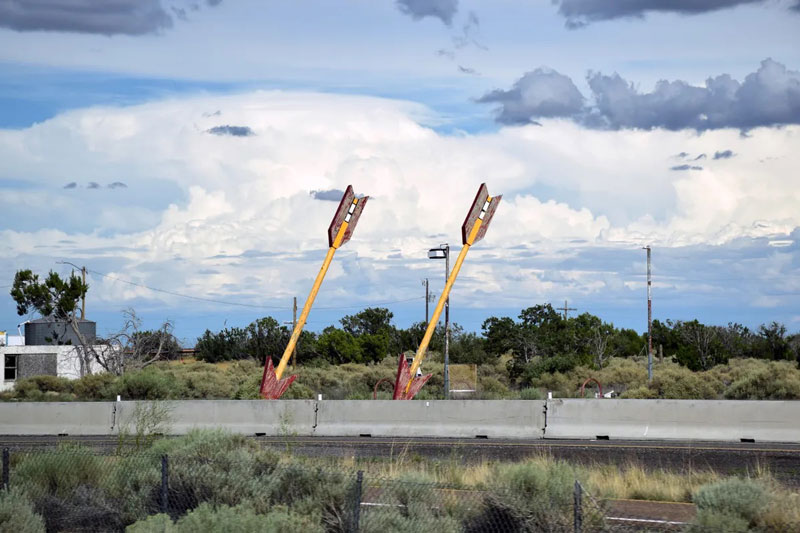
For decades, two enormous arrows stood beside Route 66 in Arizona, pointing travelers toward a roadside trading post in the middle of the desert. They were impossible to miss, and that was exactly the point. Twin Arrows was built around the rhythm of America’s great highway, giving motorists a place to stop for fuel, food and souvenirs as they crossed Arizona. But the road that created the business eventually changed. When Interstate 40 pulled traffic away from old Route 66, Twin Arrows lost the steady stream of travelers it depended on. Today, the ruins and giant arrows are all that remain of that roadside era.
The Giant Arrows Were Built To Catch Drivers’ Attention
Twin Arrows was designed around a simple idea: if travelers could see the attraction from the road, they might stop.
The roadside business developed along old U.S. Route 66 in eastern Arizona, a corridor that had already carried travelers along earlier transportation routes. By the middle of the 20th century, Route 66 had become one of America’s best-known highways, connecting Chicago with Los Angeles and carrying motorists through communities that depended heavily on passing traffic.
The two enormous arrows became the visual signature of the trading post. Each stood roughly 25 feet tall, making them large enough to be recognized by motorists approaching along the highway. In an era before digital maps, roadside apps and highway advertising networks, a giant landmark could be remarkably effective marketing.
Ever wonder where Forrest Gump created the iconic smiley face? Join me as we explore the abandoned Twin Arrows Trading Post on historic Route 66. Discover this fascinating film location, soak in the vintage vibes, and see the remnants of a classic movie scene. Watch now to relive the magic!
Twin Arrows Became A Classic Route 66 Roadside Stop
The location did not begin life as simply “Twin Arrows.” The trading post was originally known as Canyon Padre Trading Post before taking the Twin Arrows name and developing the giant-arrow identity that eventually became famous.
For travelers crossing Arizona, the stop offered the kinds of services that made long-distance road travel possible and enjoyable. Gasoline, food, souvenirs and other roadside necessities gave drivers a reason to pull over rather than simply continue through the desert.
This was the business model that helped hundreds of Route 66 communities grow. The highway itself was the customer pipeline. Every passing automobile represented a potential sale, whether the driver needed fuel, wanted something to eat or simply wanted to stop and look around.
Twin Arrows therefore depended on something that modern travelers rarely think about: traffic had to physically pass your front door.

The Trading Post Offered More Than Gas
The attraction of a Route 66 trading post was never limited to gasoline.
Places like Twin Arrows became part of the road-trip experience itself. Travelers could stop, stretch their legs, buy souvenirs and take photographs before continuing toward their next destination. The giant arrows functioned almost like an early roadside billboard, transforming an otherwise ordinary stretch of desert highway into a recognizable destination.
That visual strategy was particularly important in the pre-interstate era. Drivers had fewer ways to research stops before leaving home, and there were no smartphones telling them which restaurant or attraction was five miles ahead. A strange building, an enormous sign or an oversized roadside object could therefore become the reason to stop.
Twin Arrows understood that principle perfectly. The arrows did not merely point toward the business. They were the advertisement.
Then Interstate 40 Changed The Traffic
The biggest problem for Twin Arrows was not that travelers stopped wanting food, fuel or souvenirs. The problem was that the travelers stopped passing the trading post.
As Interstate 40 was built through Arizona, high-speed traffic increasingly moved away from sections of the old Route 66 corridor. Twin Arrows was one of the roadside businesses affected by that change. The new highway offered motorists a faster way across the region, but that efficiency came at a cost for businesses that depended on the old road.
This is one of the defining stories of Route 66. The same transportation network that created roadside businesses could eventually make them obsolete. Once motorists no longer had to pass directly in front of a trading post, the business lost the most valuable thing it had ever possessed: visibility to a constant stream of potential customers. Twin Arrows could survive changing tastes. It was much harder to survive a changing highway.
The Roadside Stop Was Eventually Abandoned
The decline did not happen overnight. The business continued operating after traffic patterns began changing, but the economic foundation had weakened.
According to the Library of Congress, the Twin Arrows Trading Post ultimately closed and was abandoned in 1995. What had once been a busy stop along one of America’s most famous highways became a collection of deteriorating buildings beside the old road.
The contrast is what makes the location so visually powerful today. The enormous arrows were designed to announce a thriving business to passing motorists. The buildings were designed for people who were constantly arriving and leaving. Once that movement disappeared, the structures no longer had the purpose for which they had been built. The desert remained. The highway remained. The business did not.
The Arrows Became The Last Symbol Of Twin Arrows
Today, the most recognizable survivors of Twin Arrows are the giant roadside arrows themselves. Photographs documented by Atlas Obscura show how dramatically the site has deteriorated, including images of a broken arrow and the remaining structures covered by weathering and graffiti.
Their survival gives the site an unusual quality. They were once advertisements for a place full of movement, noise and travelers. Now they stand beside the remnants of the business they were built to promote.
That makes Twin Arrows more than another abandoned building on old Route 66. It is a physical reminder of how transportation reshapes the landscape. A road can create a business, transform an empty stretch of desert into a destination and support an entire roadside culture. Then another road can arrive and quietly change everything.
The giant arrows were built to tell travelers where to stop. Today, they point toward a very different story: the moment America’s roadside culture began to move on.

Twin Arrows is more than an abandoned roadside stop on old Route 66. Its giant arrows, once designed to attract passing motorists, now stand as reminders of a time when America’s highways were built around roadside businesses and spontaneous stops. The arrival of Interstate 40 changed that rhythm by moving traffic away from the old road, leaving places like Twin Arrows behind. What remains today is a striking piece of roadside history: a forgotten trading post surrounded by desert, where two enormous arrows still mark the place that once depended on travelers stopping along Route 66.
The original history of Twin Arrows Trading Post is documented by Atlas Obscura, which details how the Route 66 landmark was built, became a popular roadside stop and eventually fell into decline after changing traffic patterns. The site also includes photographs showing what remains of the trading post today. Source: https://www.atlasobscura.com/places/twin-arrows-trading-post