Port Arthur is remembered today as one of Australia’s most famous convict sites, but its original purpose went far beyond locking people behind stone walls. Beginning in 1830, the settlement grew into a sprawling industrial operation where prisoners cut enormous trees, built ships, made bricks and operated workshops. Up to 50 men could work together hauling massive logs through the forest, earning the nickname “centipede gang.” Even more ambitious was a water-powered flour mill that was supposed to make the prison colony self-sufficient—but became a spectacular engineering failure instead.
It Was More Than a Prison
Port Arthur began in 1830 as a small timber station on Tasmania’s Tasman Peninsula. It quickly expanded because the colonial authorities wanted the site to serve two purposes at once: punish repeat offenders and make productive use of their labor. By the 1840s, more than 1,100 convicts were at Port Arthur, and the settlement had developed industries including shipbuilding, shoemaking, blacksmithing, timber production and brickmaking.
The prisoners were not simply sitting in cells. They were clearing forests, building infrastructure and producing materials needed throughout the settlement and beyond. The authorities hoped convict labor could eventually provide much of what Port Arthur needed to operate, reducing its dependence on supplies shipped from Hobart.
That ambition turned Port Arthur into something unusual for a penal settlement. It was simultaneously a prison, a workplace and a large-scale industrial project.
And nowhere was that more obvious than in the forests surrounding it.

The Men Who Became a “Centipede”
Discover the haunting history of Port Arthur, Australia’s most infamous penal colony. From the harsh realities of forced labor and shipbuilding to the psychological cruelty of the Separate Prison, explore how this remote site shaped a nation. Watch now to uncover the dark, complex, and iconic past of Tasmania.
Timber was one of Port Arthur’s most important industries and one of its hardest forms of labor. The trees were enormous compared with those commonly found today, and prisoners cut them using pitsaws before the timber was brought back toward the settlement for further processing.
The sawing itself required two men to work from opposite positions around a log. One, known as the “Top Dog,” stood above the timber, while the “Bottom Dog” worked down in the pit. The lower position was especially miserable, as sawdust filled the worker’s eyes and ears.
Once a log had been reduced to a rough beam, the work became even more physical. A gang of as many as 50 convicts would lift the timber onto their shoulders and carry it back to the settlement. The long line of men moving together with a huge log gave rise to the nickname “centipede gang.”

The image is difficult to miss: dozens of prisoners, their shoulders loaded with timber, moving as one human machine through the Tasmanian bush.
Eventually, technology changed the process. A steam-powered sawmill and iron tramways dramatically increased production, while log slides and covered sawpits reduced the need for the centipede gangs to carry timber by hand over long distances.
But the industrial expansion came with a price. By the middle of the 1850s, useful timber around the Cascades area had been heavily depleted, forcing operations back toward Port Arthur.

Prisoners Built Ships, Too
Timber was not the only resource Port Arthur tried to turn into an industry. Shipbuilding was introduced on a large scale in 1834, partly because authorities wanted selected prisoners to acquire trades that might help them after release. Only convicts considered well behaved and receptive to training were chosen for the dockyard.
At its peak, as many as 70 prisoners worked there. Most handled the heavy tasks of cutting and carrying timber, while skilled workers served as carpenters, blacksmiths, caulkers, coopers and shipwrights. The result was surprisingly ambitious for a penal settlement.
The Port Arthur dockyards launched 15 large ships and more than 140 smaller vessels, ranging from whale boats to rowboats and punts. Their work was regarded as durable and well crafted. One vessel, the 270-ton Lady Franklin, remained in service for more than 40 years. The yard also constructed the hull of the steamer Derwent and repaired ships traveling along Tasmania’s east coast.
For a time, the prison colony had managed something remarkable: it was producing ships strong enough to become part of the wider maritime economy.
But success created a problem of its own. As the colonial economy recovered, private shipbuilders did not want to compete with a government-run yard using convict labor. The pressure contributed to the large-scale shipbuilding operation being shut down in 1848.

Then They Tried to Make Their Own Flour
One of Port Arthur’s boldest projects began with a basic problem: feeding a growing prisoner population. A water-powered flour mill and granary had been proposed in 1839, and construction began in 1842 as the population on the peninsula expanded rapidly.
The scale of the plan was impressive. Engineer Alexander Clark oversaw construction of the mill and granary and designed the system that would supply water to a 30-foot, or roughly 10-meter, water wheel. The finished project included dams, a millrace, an underground aqueduct and an overhead water race. The building itself was completed in just a year and even contained a treadmill capable of accommodating up to 56 convicts.
The idea was simple: produce flour locally, supply the convict department and potentially create a surplus for export.
The engineering was anything but simple.

The Machine Became a Failure
When the project was completed in 1845, the elaborate water system proved much harder to operate than expected. Water was lost through seepage and evaporation, while the available supply was not large enough to keep the wheel running continuously.
The mill therefore operated only in short bursts. Water accumulated in the dam, the wheel used it quickly, and the operation stopped again. What had been designed as a major step toward self-sufficiency had become an expensive lesson in how difficult it was to control water over a complex system.
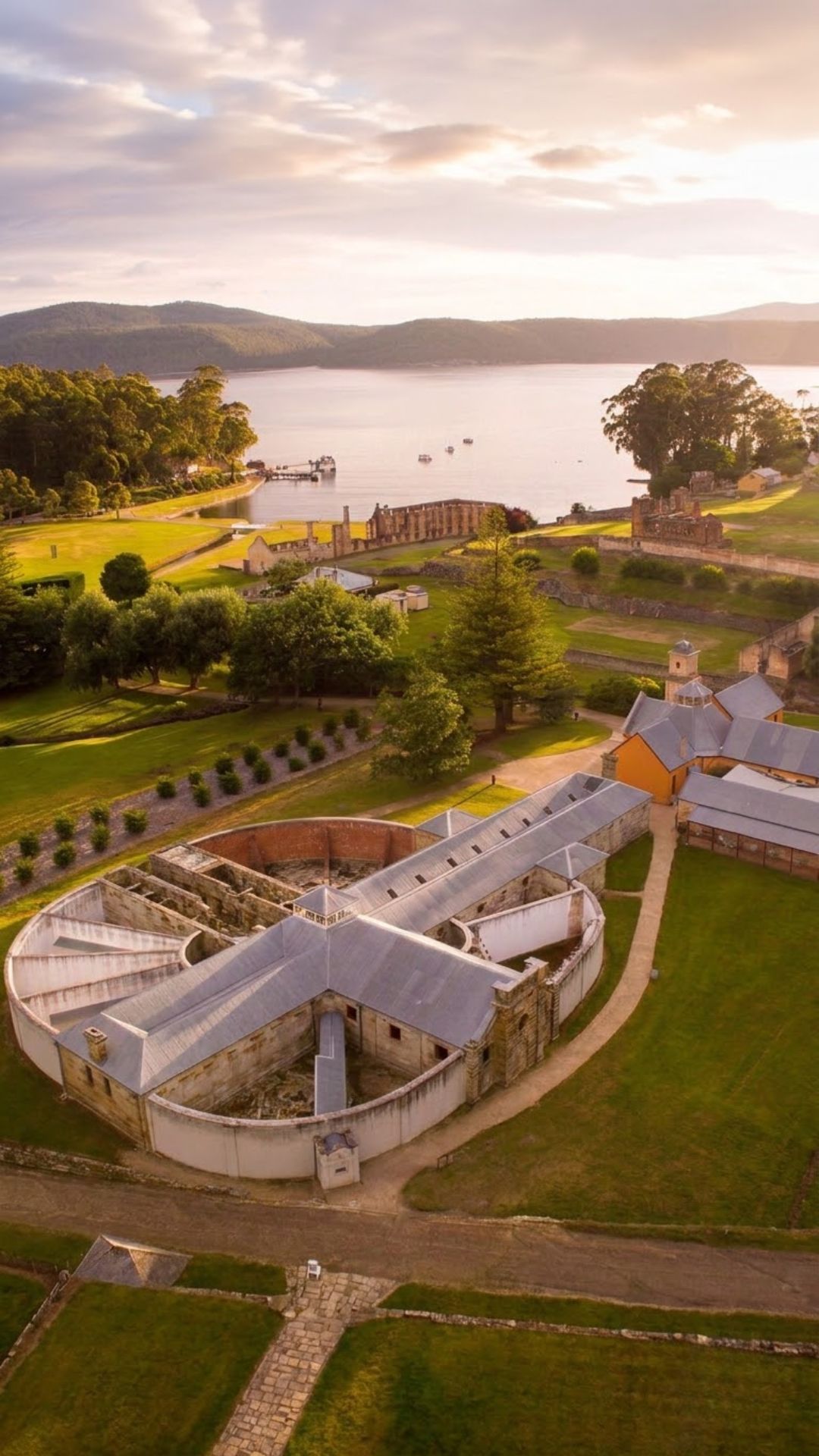
Within roughly a decade, the mill was gutted. Between 1854 and 1857, the building was converted into the Penitentiary, which eventually became one of Port Arthur’s most enduring landmarks.
There was something almost fitting about the outcome. A building created to help feed the prison colony could not make the system work—but the structure itself found another purpose within the prison.

The Industrial Prison Slowly Ran Out of Work
Port Arthur continued expanding through the 1850s and 1860s. Timber, farming and workshops remained important, and the old flour mill had become a penitentiary. An asylum was also built beginning in 1864 as the convict population aged and became increasingly infirm.
But the industrial model had limits. The forests that had supplied so much of the operation were being depleted, while many remaining prisoners were becoming too old or sick to perform the hardest work. The settlement that had once been busy with timber, workshops and agriculture gradually slowed down.
The last convict left Port Arthur in 1877.
The industrial prison had reached the end of its useful life.
The Prison Became a Tourist Attraction
That might have been the end of the story, but Port Arthur underwent another remarkable transformation. After the convict era ended, the settlement was renamed Carnarvon, and new residents moved into the area. Fires destroyed many historic buildings in 1895 and 1897, yet the community rebuilt itself with a post office, sporting clubs and other local institutions.
Then visitors began arriving for a very different reason. Tourists wanted to see the remains of the penal settlement and experience the place where convicts had once lived and worked. Guiding, accommodation and souvenir sales became part of the local economy, and by the 1920s and 1930s the area had several hotels and museums.
The place that had once depended on convict labor was now earning money from people coming to see its history.
In 1927, the name Port Arthur was officially restored. Today, the site is part of the Australian Convict Sites World Heritage property, which was inscribed on the UNESCO World Heritage List in 2010.

What Port Arthur Left Behind
Port Arthur’s ruins can make it look like a simple prison complex frozen in time. The history tells a much larger story.
It was a place where governments attempted to turn forced labor into an economic engine. Prisoners felled giant trees, moved timber in enormous gangs, built ships and worked in workshops. Engineers constructed ambitious water systems, only to discover that a mill designed to solve one of the colony’s biggest problems could barely operate.
The result was neither complete success nor simple failure. Some industries became highly productive. Others collapsed under economic or technical pressures. The prison itself eventually disappeared, while the structures left behind became the foundation of a completely different industry: heritage tourism.
That is what makes Port Arthur more interesting than an old prison. It was a vast experiment in punishment, labor and industrial development—and one that left physical evidence of both its achievements and its failures.

Port Arthur began as a timber station in 1830 and grew into an industrial prison powered by convict labor. Men cut enormous trees, hauled timber in gangs of up to 50 and built more than 150 vessels at the dockyards. Authorities also attempted something more ambitious: a water-powered flour mill designed to make the settlement more self-sufficient. The project failed because its complicated water system could not supply the mill reliably, and the building was eventually converted into the penitentiary. After the convict era ended, Port Arthur reinvented itself as a historic attraction—leaving behind a remarkable story of labor, engineering, ambition and failure.
P.S. This article is based on the official Port Arthur Historic Site history timeline, particularly its accounts of convict labor, timber production, shipbuilding, the failed flour mill and Port Arthur’s transformation after the convict era. Source: https://portarthur.org.au/history/history-timeline/