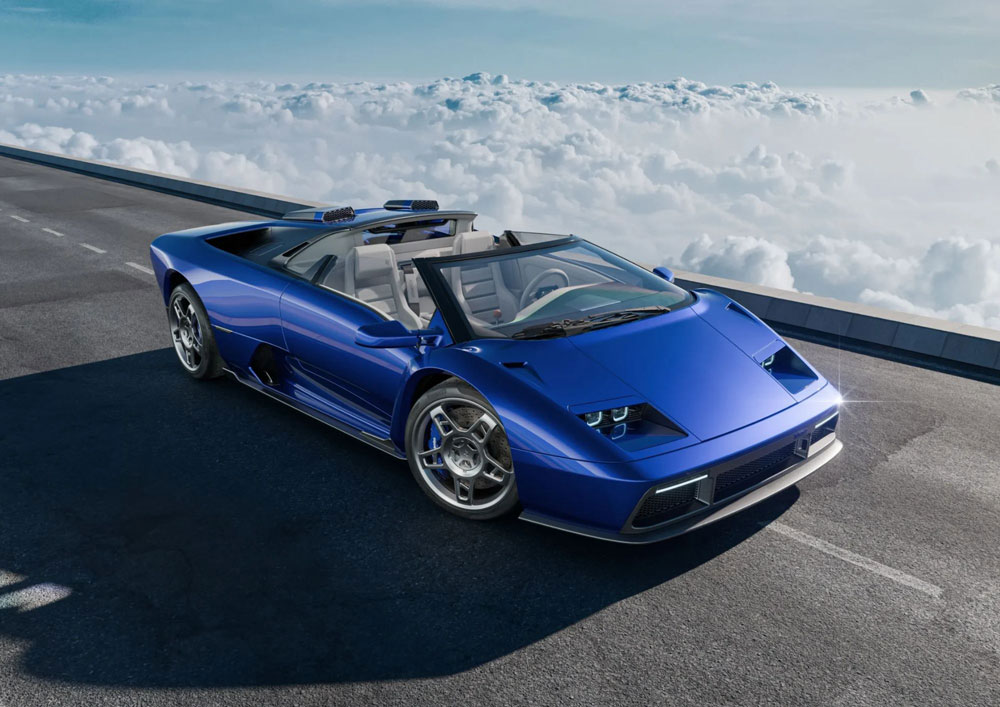
The Lamborghini Diablo was already one of the most dramatic supercars of the 1990s. Now Eccentrica has taken the legendary formula in an even more extreme direction with a V12 Roadster that removes the roof while retaining the character that made the original so special. Beneath the redesigned body sits a naturally aspirated 5.7-liter V12 producing 550 horsepower, paired with a six-speed gated manual transmission. With more than 3,500 new components developed for the project and only 19 examples planned, this is far more than a simple Diablo restoration.
Eccentrica Turned the Lamborghini Diablo Into a Roofless Roadster
The Eccentrica V12 Roadster starts with one of Lamborghini’s most recognizable creations: the Diablo.
But the goal was never simply to take an old Diablo, remove its roof and install a few modern components. Eccentrica approached the project as a complete reinterpretation of the 1990s supercar.
Removing the roof from a high-performance car creates an immediate engineering problem. The roof contributes significantly to the rigidity of a vehicle’s structure, so taking it away requires the chassis to be reinforced.
Eccentrica addressed that challenge with additional composite reinforcement and a redesigned body incorporating steel and carbon fiber. The company also reworked the car’s proportions and aerodynamic elements rather than simply preserving the original bodywork.
The result still unmistakably recalls the Diablo, but it has a wider, more aggressive stance and a distinctly modern appearance.
The transformation is so extensive that calling it a modified Diablo almost undersells the work involved.
Eccentrica says more than 3,500 individual components have been developed specifically for the project.
That means the Roadster is essentially a new interpretation of the classic rather than a conventional restoration.
And then there is the engine.

The 5.7-Liter V12 Still Has 550 Horsepower
For many enthusiasts, the most important thing about the Eccentrica is what remains underneath the redesigned body.
It still has a naturally aspirated V12.
The engine is based on the original Diablo’s 5.7-liter V12, but Eccentrica has extensively revised it. New camshafts, electronic throttle bodies, engine-management calibration and other technical changes help raise output to approximately 550 horsepower and 600 Nm of torque.
There is no turbocharger.
There is no hybrid motor providing instant electric torque.
Instead, the Roadster uses the kind of high-revving naturally aspirated V12 that has become increasingly rare in the modern supercar world.
Even more importantly, the engine is connected to a six-speed manual transmission.
The original Diablo used a five-speed manual gearbox, while Eccentrica developed a six-speed unit with revised ratios for its restomod.
That combination is increasingly unusual.
A naturally aspirated V12.
A manual gearbox.
Rear-wheel drive.
And an open-top body.
According to Eccentrica’s specifications and reporting on the project, the Roadster is capable of reaching approximately 335 km/h, or 208 mph.
For comparison, the Eccentrica V12 is not simply recreating the performance of an early-1990s Diablo. It is attempting to make the experience considerably faster and more usable.
Watch the video for a closer look at the Eccentrica V12 Roadster, including its aggressive open-top design, V12 engine and old-school manual driving experience.
More Than 3,500 New Parts Changed the Diablo
The biggest surprise may be how much of the car has actually been reworked.
Eccentrica’s project involves more than 3,500 new components, covering everything from the bodywork to the mechanical systems.
The chassis has been strengthened using composite materials, an especially important modification for the Roadster because removing the roof can reduce structural rigidity.
The suspension has also been substantially upgraded.
The car uses a double-wishbone setup with active dampers that allow the driver to select different suspension configurations. A front-axle lift system helps the car clear steep driveways, ramps and other obstacles that would otherwise threaten its low front end.
The brakes have been upgraded as well, with Brembo hardware, while Pirelli P Zero Trofeo R tires provide additional grip.
The wheels themselves are larger and lighter than those of the original car, helping the modernized Diablo cope with its additional performance.
Even the exhaust system has been redesigned.
Capristo developed a new exhaust intended to emphasize the sound of the naturally aspirated V12.
And that sound is part of the point.
The Eccentrica isn’t trying to make the Diablo feel like a modern electric supercar.
It is trying to preserve the drama of an old-school V12 while removing many of the limitations associated with a 1990s performance car.

It Keeps the Old-School Driving Experience
This may be the most important part of the entire project.
Modern supercars can be extraordinarily fast, but many have moved toward automated transmissions, turbocharged engines, hybrid assistance and increasingly sophisticated electronic controls.
Eccentrica went in a different direction.
The driver still has to operate a manual gearbox.
The V12 remains naturally aspirated.
And the car retains the mechanical character that enthusiasts associate with classic Italian supercars.
At the same time, Eccentrica has not simply preserved every inconvenience of a 1990s Diablo.
The restomod adds modern conveniences and engineering improvements, including power steering, electronic throttle control, upgraded suspension, active dampers and a front-axle lift system.
The interior follows the same philosophy.
It combines the minimalist atmosphere associated with 1990s supercars with modern materials and technology. The project incorporates carbon fiber, Alcantara and other premium materials, while modern digital instrumentation and a Marantz audio system bring the cabin into the present day.
This creates an interesting balance.
The car looks back to the 1990s.
But it does not require the driver to live entirely in the 1990s.
That is essentially the definition of a restomod: preserve the character of the original while improving the parts that modern engineering can make better.

Only 19 Will Be Built
The Eccentrica V12 is not intended to become a common sight on the road.
Production is limited to just 19 examples, and each car can be customized according to the owner’s preferences.
That exclusivity is central to the project.
Eccentrica isn’t competing with Lamborghini’s modern production cars on volume. It is creating a highly limited collector automobile based on a specific piece of Lamborghini history.
The price reflects that positioning.
The original Eccentrica V12 program has been reported at around €1.2 million, before accounting for the donor Diablo, although pricing for the Roadster is not publicly established in the sources reviewed here.
The development process also takes considerable time because each vehicle is effectively built as a bespoke project.
That makes the Eccentrica something closer to a coachbuilt interpretation of the Diablo than a conventional production car.
For collectors, that rarity may be as important as its performance.
There will never be thousands of these cars roaming the streets.
There will be 19.
And each one represents a different answer to the same question: what would happen if the Lamborghini Diablo were rebuilt for the modern era without losing its original soul?
Eccentrica’s answer is a machine with a 5.7-liter naturally aspirated V12, a manual gearbox, modern suspension and brakes, extensive carbon fiber and an open roof.
It is a strange combination of past and present.
The Diablo’s silhouette and mechanical heritage remain recognizable, but nearly every aspect of the driving experience has been reconsidered.
That is what makes the Roadster so interesting.
It does not attempt to replace the original Diablo.
It attempts to imagine what the Diablo might have become if its engineers had access to another three decades of technology while still being told to keep the V12 and manual gearbox.
And for enthusiasts who believe that some things should remain analog, that may be exactly the point.

The Eccentrica V12 Roadster takes one of the most recognizable supercars of the 1990s and gives it a radically modern interpretation. Removing the roof required major structural changes, while more than 3,500 new components transformed the original Diablo underneath and out. Yet Eccentrica deliberately kept the heart of the experience intact: a naturally aspirated 5.7-liter V12, a six-speed manual gearbox and the unmistakable character of an old-school Italian supercar. With only 19 examples planned, this isn’t simply a restored Diablo. It is a rare attempt to imagine how the legend might have evolved if it had been rebuilt for today