In 1939, General Motors unveiled a car that looked almost impossible: a Pontiac with a body you could see straight through. Built with transparent Plexiglass instead of conventional body panels, the unusual vehicle exposed its frame, engine and mechanical components for everyone to see. Created for the World’s Fair in New York, the strange Pontiac was never meant to become an ordinary production car. Instead, it offered visitors a glimpse of how new materials could transform the automobile—and became one of the most unusual concept cars ever built.
The Ghost Car Appeared at the 1939 World’s Fair
The Pontiac Ghost Car made its debut at General Motors’ Highways and Horizons pavilion during the 1939–40 World’s Fair in New York. The fair was a showcase for new technology, design and ideas about the future, making it a natural setting for such an unusual automobile.
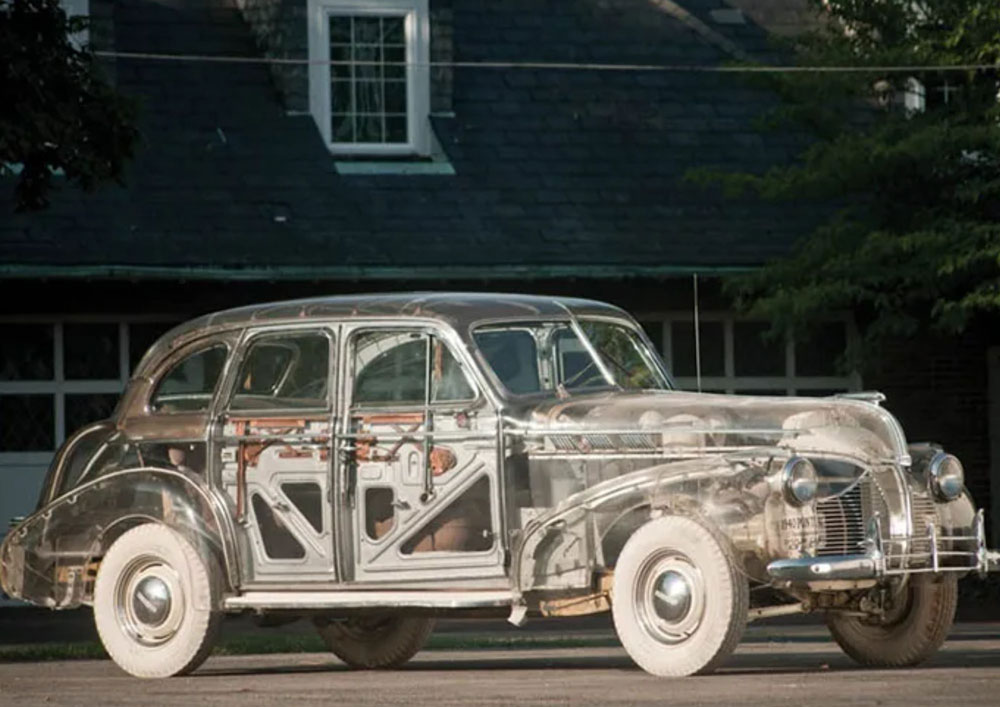
At first glance, the car looked familiar. Its proportions and basic shape came from a 1939 Pontiac Deluxe Six. But the conventional metal body had been replaced with transparent material, creating an effect unlike anything most visitors had ever seen.
Instead of hiding the machinery beneath the hood and body panels, the Ghost Car exposed it.
Visitors could look through the exterior and see the components that normally remained invisible. The car effectively turned its own construction into part of the display.
That was precisely what made it such an effective World’s Fair attraction. It was still recognizable as an automobile, but it presented the familiar machine in a completely unfamiliar way.
General Motors was not simply showing visitors another new model. It was demonstrating what could happen when automotive design was combined with a new material and a willingness to experiment.

Pontiac Built a Car You Could See Through
The foundation of the Ghost Car was a 1939 Pontiac Deluxe Six chassis. Instead of covering that chassis with the usual painted metal body, General Motors worked with Rohm & Haas to create a transparent version using Plexiglass.
Plexiglass was particularly important to the project because it offered something traditional automotive materials could not: transparency.
The partnership between an automobile manufacturer and a chemical company was therefore central to the concept. GM supplied the automotive expertise, while Rohm & Haas brought a recently developed material that could transform the appearance of the vehicle.
The result was almost surreal.
Through the clear body, people could see the frame and mechanical hardware that would normally be hidden. Components that were usually treated as purely functional suddenly became part of the visual design.
That gave the Ghost Car its famous nickname.
It looked less like a conventional automobile and more like a machine that had somehow lost its outer shell.
The transparency also changed the way people viewed the relationship between a car’s appearance and its engineering. A normal automobile presents a polished exterior to the world while concealing most of its mechanical complexity. The Ghost Car reversed that idea.
Its hidden machinery became the attraction.
The 1939 Pontiac Ghost Car was unlike anything most people had ever seen. Watch the video to take a closer look at the transparent automobile and the remarkable story behind this one-of-a-kind machine.
The Transparent Design Turned the Car Into a Mechanical Display
The most striking feature of the Ghost Car was not simply that its body was clear. It was what that transparency allowed people to see.
On an ordinary car, the body separates the viewer from the mechanical systems underneath. The engine, frame and suspension operate behind layers of metal, leaving most drivers concerned only with the finished exterior.
The Ghost Car removed much of that visual separation.
For visitors at the World’s Fair, the automobile effectively became a mechanical exhibit. They could see how the different parts were arranged inside the vehicle rather than simply seeing the finished shape from the outside.
That made the car educational as well as spectacular.
The design also demonstrated how a new material could change an established product. Plexiglass was not merely replacing metal for practical reasons. It was being used to create an entirely different visual experience.
The result was something that seemed futuristic even though the underlying automobile was based on an existing Pontiac.
This was part of the appeal of World’s Fair exhibits. They did not necessarily have to represent products that ordinary consumers would soon purchase. They could demonstrate possibilities.
The Ghost Car was one of those possibilities.
It suggested that the future of the automobile might involve more than faster engines or different body shapes. New materials could change how people interacted with the machine itself.

The Ghost Car Was Built to Imagine the Future
The timing of the Ghost Car was important.
The late 1930s were a period when American manufacturers were increasingly using design and technology to sell an image of modern life. Cars were becoming central to American culture, while companies competed to make their products look newer, more advanced and more exciting.
The World’s Fair provided an ideal stage for that competition.
Visitors came expecting to see things that looked different from everyday life. General Motors’ Highways and Horizons pavilion was designed around ideas about transportation and the future, and the transparent Pontiac fit perfectly into that environment.
The Ghost Car was not intended to replace conventional Pontiacs. Its value was in the idea it represented.
It allowed GM to demonstrate a material that most visitors had never encountered in this application and to turn an ordinary automobile chassis into something visually extraordinary.
That distinction is important when looking back at the car today.
It would be easy to judge the Ghost Car by asking whether transparent automobiles ever became mainstream. They did not. But that was not necessarily the point.
Concept cars often exist to explore ideas rather than predict exactly what consumers will drive decades later.
The Ghost Car demonstrated what happened when designers were willing to take a familiar object and approach it from an entirely different direction.
In 1939, that was enough to make it look like a glimpse of another era.

The 1939 Ghost Car Became a Piece of Automotive History
More than eight decades later, the Ghost Car remains memorable because its central idea is still immediately understandable.
Anyone looking at the photographs can see why people at the World’s Fair were fascinated. It is unmistakably a Pontiac, yet it appears almost like an automobile caught halfway between a finished product and an engineering model.
The car also represents a fascinating moment in American industrial history. A newly developed material was being combined with established automotive technology, not because the industry had suddenly discovered a better way to build ordinary cars, but because there was value in showing the public something they had never seen before.
That is what made the Ghost Car successful as a concept.
It did not need to become a production vehicle. It only needed to make people stop and look.
The transparent body exposed the machinery normally hidden from view, turning the automobile itself into an exhibit. What had previously been concealed became the centerpiece.
Today, the 1939 Pontiac Ghost Car stands as a reminder of an era when America’s major industrial companies used World’s Fairs to present bold visions of the future. It may not have predicted the automobile that would eventually dominate American roads, but it captured something just as important: the excitement of imagining what a machine could become.

The 1939 Pontiac Ghost Car never needed to become a mass-produced automobile to make its mark. Built on a 1939 Pontiac Deluxe Six chassis and fitted with a transparent Plexiglass body, it transformed a familiar machine into something almost otherworldly. At the World’s Fair, visitors could see the mechanical components normally hidden beneath the bodywork, turning the car itself into an exhibit. More than 80 years later, the Ghost Car remains fascinating for the same reason it captivated crowds in 1939: it made the future look visible.