Across America, some places seem frozen in another era: empty streets, abandoned buildings and industrial structures where communities once thrived. From gold-mining towns to forgotten factories and a historic prison, these places reveal stories of ambition, prosperity, disaster and decline. But there is a deeper question behind their abandoned walls: why did these places disappear, and why have some been preserved instead of forgotten? The answer reveals a fascinating side of American history that is still visible today.
The American Places Where Time Seems to Have Stopped
Imagine walking through an American town that once had everything a community needed: homes filled with families, stores along busy streets, schools full of children and workers heading to their jobs each morning. Today, the same streets may be nearly empty, with old buildings, weathered houses and abandoned structures standing where a thriving community once existed.
These places are part of what could be called “abandoned America”—communities and sites that once played an important role but were eventually left behind as industries disappeared, economies changed, disasters struck or social patterns shifted.
What happens to a place when the people who built it are gone?
That question is part of what makes America’s ghost towns and abandoned sites so fascinating. They can function like time capsules, preserving fragments of a country that no longer exists in quite the same form. An abandoned building can reveal how people once lived, while an old mine, factory or prison can tell the story of an entire industry or era.
Some of these places were built around gold and other valuable resources. Others grew around factories and industrial operations, while some were abandoned because of environmental disasters or changing economic conditions. A few have survived as historic sites, allowing visitors to see their remains legally and safely.
The stories that follow span mining towns, industrial ruins, former prisons and communities shaped by disaster. They are not invitations to trespass or explore dangerous structures, but a look at the places America chose to leave behind—and the stories they still have to tell.

Ghost Towns That Were Once Booming American Communities
Bodie, California: The Gold Rush Town Frozen in Time
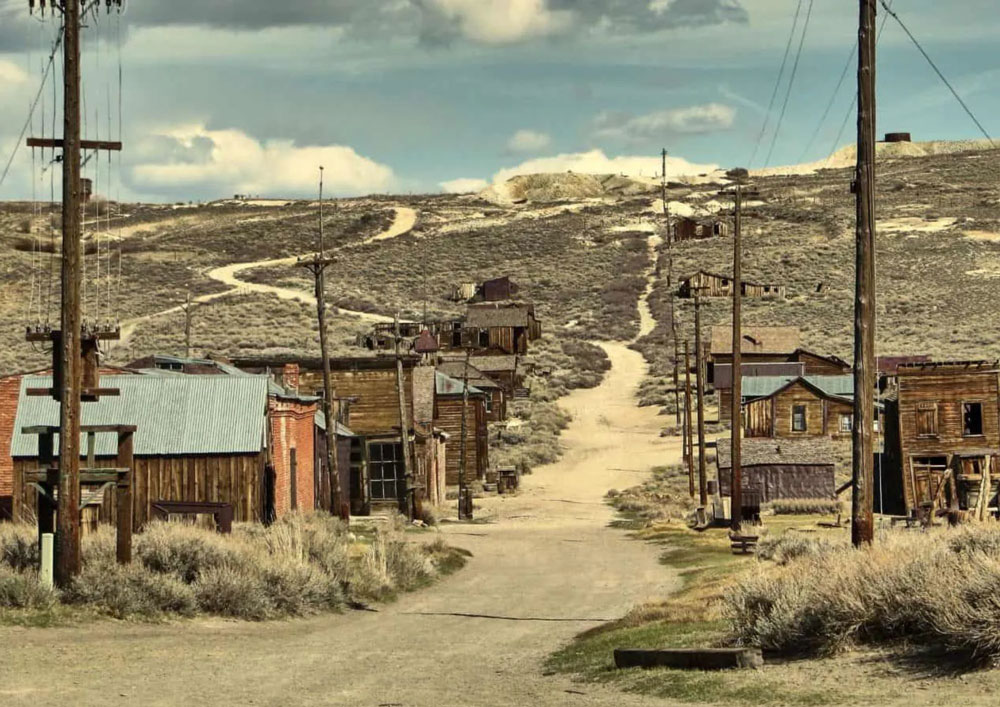
Bodie is one of the clearest examples of how quickly a mining boom could transform the American West. After gold was discovered in the area, a rich vein found in 1875 helped turn the small settlement into a booming community. By the late 1870s, thousands of people had arrived, and Bodie had grown into a town with roughly 2,000 buildings, including homes, stores, hotels, churches and saloons.
But the boom did not last. As mining declined, the population gradually disappeared. Fires destroyed much of the town, and commercial mining finally ended in 1942. Today, only a small portion of Bodie survives, preserved by California State Parks in what is known as “arrested decay.” Visitors can walk its deserted streets and look through windows at interiors that remain much as they were left.
What makes Bodie fascinating is that it feels less like a collection of ruins and more like a community that simply stopped moving.
Rhyolite, Nevada: A Town That Rose Almost as Fast as It Fell
Rhyolite tells an even more dramatic boom-and-bust story. Founded during a mining rush in the early 1900s, the town expanded rapidly as prospectors and businesses arrived in search of gold. At its height, Rhyolite had thousands of residents, along with stores, hotels, banks, restaurants, an opera house and multiple saloons.
But the town’s prosperity depended heavily on the mines. The financial panic of 1907 accelerated its decline as mines began closing and banks failed. By 1910, only 611 residents remained, and the Montgomery Shoshone mine closed the following year. By 1916, Rhyolite’s electricity had been switched off.
Today, pieces of the old town remain, including sections of a three-story bank, a jail, a train depot and the famous Bottle House. The ruins offer a striking reminder of just how quickly opportunity could build—and destroy—an American town.

Bannack and St. Elmo: Where the Old West Still Survives
Bannack, Montana, grew after a major gold discovery in 1862 and became Montana’s first territorial capital. Its population surged to more than 3,000 people within a year, but as the value of gold declined, the bustling community gradually emptied. More than 50 historic buildings still line its Main Street today, making Bannack one of Montana’s best-preserved ghost towns.
Colorado’s St. Elmo tells a similar story. Once supported by the state’s mining boom, it eventually became a quiet remnant of the frontier era. Today, preserved ghost towns such as St. Elmo allow visitors to see pieces of the communities created during America’s westward expansion.
Together, these towns reveal something more interesting than the usual ghost-story narrative. They show how the American West was built around risk, opportunity and the hope of finding something valuable underground. A town could appear almost overnight when fortunes seemed possible—and fade just as quickly when the reason for its existence disappeared.
What happens when an entire American community is left behind? Watch the video below and see some of the places where the past still remains:
When Industry, Disaster and Ambition Left Entire Places Behind
Centralia, Pennsylvania: The Town That Could No Longer Be Lived In
Centralia began as an ordinary Pennsylvania mining community, but an underground coal mine fire that started in May 1962 eventually transformed its future. The fire spread through abandoned mine workings beneath the town and continued burning for decades. As dangerous gases, ground instability and subsidence became serious concerns, residents were gradually relocated. Pennsylvania records show that 545 residences and businesses were acquired between 1985 and 1991, while Route 61 was eventually closed because of fire-related damage.
The story is more interesting than the image of a “ghost town.” Centralia demonstrates what happens when an industrial legacy becomes impossible to live with. A community that once depended on coal was gradually forced to give up the very ground beneath it.
Today, the area remains an important reminder of the long-term consequences that can follow industrial activity. And unlike some abandoned places, Centralia is not a destination for casual exploration: Pennsylvania officials warn that the affected area can contain dangerous gases and sudden ground collapse.
The question Centralia leaves behind is unsettling but important: what happens when a place becomes impossible to live in?
Kennecott, Alaska: The Mining Town Left Behind in the Wilderness
Deep inside Alaska’s Wrangell-St. Elias National Park and Preserve stands Kennecott, a former copper-mining community surrounded by an enormous wilderness. Between 1911 and 1938, the operation processed nearly $200 million worth of copper and supported hundreds of workers. But Kennecott was more than a mine. It was a self-contained company town with a hospital, general store, school, skating rink, recreation hall and even a dairy.
When the high-grade copper ore declined and operating costs increased, the company eventually closed the operation in 1938. The mining town was largely left behind, with many buildings and artifacts remaining where they had been.
That is what makes Kennecott so striking today. Industrial structures stand against an enormous Alaskan landscape, creating an unusual contrast between human ambition and nature.
The National Park Service now works to stabilize and preserve historic structures at the site, allowing visitors to experience the remains as part of America’s industrial and mining history.
Kennecott asks a different question from Centralia: what remains when the industry that once seemed unstoppable finally runs out of resources?
Sloss Furnaces, Alabama: When the Industry That Built a City Disappears
In Birmingham, Alabama, the remains of Sloss Furnaces tell a different kind of story. Rather than an abandoned town, this is an enormous industrial landscape—blast furnaces, machinery and structures that once helped make Birmingham an important center of iron production in the South.
The furnaces date to the late 19th century and became part of Birmingham’s rapid industrial expansion. Sloss was among the major pig-iron producers in the region, while Birmingham itself developed into a major center for iron and steel production. The furnaces continued operating until 1971, leaving behind an industrial complex that represents a significant chapter in America’s manufacturing history.
Today, Sloss Furnaces is recognized as a National Historic Landmark rather than simply being treated as a collection of abandoned ruins.
That distinction matters. The rusting machinery and towering furnaces are not merely remnants of a forgotten factory. They represent the workers, technology, investment and industrial ambition that helped build Birmingham.
And that leads to the larger question behind all three places: what happens when the industry that built a community disappears? Sometimes a town empties. Sometimes nature takes over. And sometimes the machinery remains, preserving the memory of an America that once depended on it.

The Places We Abandoned — But Chose to Remember
Eastern State Penitentiary in Philadelphia offers a different way to think about abandoned places. Opened in 1829, the prison was once considered an innovative experiment in American corrections, built around the idea that isolation and reflection could encourage prisoners to reform. When the penitentiary finally closed in 1971, the enormous complex was left largely empty and gradually fell into disrepair.
But Eastern State was not demolished. Instead, its deteriorating walls and cellblocks eventually became part of a historic site. Today, visitors can explore designated areas of the former prison and learn about its history through exhibits and audio tours. What was once an abandoned building became a place where Americans could examine how their society had approached punishment, reform and incarceration.
That transformation points to a larger story about abandoned places across the United States. Some disappear completely. Others become state parks, historic sites or preserved landmarks. Some are restored, while others are deliberately left in a state of decay. In certain cases, nature eventually takes over.
The decision is rarely just about an old building. It is also about deciding which parts of the past deserve to remain visible.
America’s abandoned places therefore follow a recurring pattern: boom, growth, decline, abandonment and, sometimes, preservation. What once represented progress may later become history. And sometimes, leaving the ruins standing is the best way to remember what came before.

Perhaps the most fascinating thing about abandoned places isn’t what happened when people left. It’s what these places still tell us about the people who once believed they would never have to leave. Their empty streets, aging buildings and forgotten machinery preserve more than history—they preserve the ambitions, struggles and everyday lives of the people who built them. In that sense, abandoned America is not truly empty. It is a reminder that even the places we leave behind can continue telling our story.