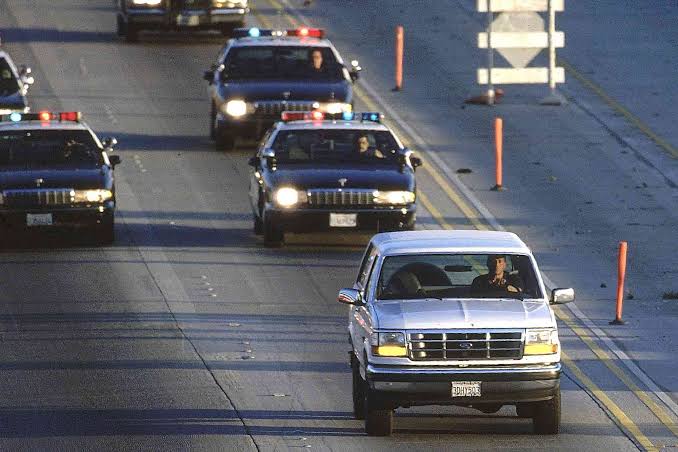
O.J. Simpson had once been one of the fastest men in America. In June 1994, police were hunting him as a suspect in the killings of his ex-wife Nicole Brown Simpson and Ron Goldman, and millions watched as he disappeared instead of surrendering. Then a white 1993 Ford Bronco appeared on a Los Angeles freeway with Simpson sitting in the back and police cars following close behind. For roughly an hour, America watched a football hero become the most famous fugitive on television.
Before the Murder Case, O.J. Was an American Sports Icon
Simpson’s fame was built long before the events of 1994. At the University of Southern California, he became one of college football’s biggest stars and won the 1968 Heisman Trophy before becoming the first overall pick in the 1969 NFL draft. With the Buffalo Bills, he developed into an elite running back and eventually finished his career with more than 11,000 rushing yards and four NFL rushing titles.
His most famous season came in 1973, when Simpson became the first NFL player to rush for more than 2,000 yards in a season. He finished with 2,003 yards in only 14 games, a remarkable achievement that turned him into a national sports figure. His fame then moved beyond football as he appeared in commercials, movies and television, becoming a familiar personality even to Americans who did not follow the NFL.
That background matters because Simpson was not an obscure figure when his life changed. He was already a celebrity whose face had been in American homes for years, which meant that when the criminal investigation began, the story immediately became much larger than a typical police case. The man at the center of it was someone millions of people already felt they knew.
Check out the incredible O.J Simpson chase for an unforgettable look into one of history’s most viral, high-stakes moments! Dive into dramatic police calls, shocking twists, and incredible archival footage that defined an era. You definitely don’t want to miss this wild story—watch the video now!
Why Police Wanted O.J. Simpson
On June 12, 1994, Nicole Brown Simpson and her friend Ronald Goldman were found murdered outside Nicole’s home in Brentwood, Los Angeles. Simpson had previously been married to Nicole, and the two had divorced in 1992 after a troubled relationship that included a 1989 no-contest plea by Simpson to a charge of spousal battery. Investigators quickly focused on him as a suspect in the double murder.
Police said the investigation produced substantial physical evidence connecting Simpson to the crime scene. His blood was found there, while blood from Nicole was later found at Simpson’s home; investigators also found other evidence, including a glove at the crime scene that corresponded to one found outside Simpson’s house. Simpson also had a wound on his hand, adding to the evidence investigators were examining.
By June 17, police had obtained a warrant for Simpson’s arrest. He had agreed to surrender, but when officers went to the home of his friend and lawyer Robert Kardashian to take him into custody, Simpson was gone. He had left with Al Cowlings, his longtime friend and former teammate, setting the stage for one of the most famous police pursuits in American history.

The White Ford Bronco Appeared on Television
Cowlings was driving his white 1993 Ford Bronco, while Simpson was sitting in the back. Police later learned where the vehicle was by tracing calls made from Simpson’s cellular phone. By that point, the situation had become more serious because Simpson was reportedly holding a gun to his own head and threatening suicide, according to police accounts. The LAPD therefore did not simply force the Bronco to stop; instead, officers followed as the SUV moved slowly through Los Angeles.
The pursuit was almost surreal. A fleet of black-and-white police cars followed the Bronco while helicopters hovered above, and television networks began carrying the event live. The vehicle traveled at only about 35 miles per hour, but the chase continued for roughly an hour and was watched by an estimated 90 million people. What should have been a police operation had become a nationwide television event.
The vehicle itself added another layer to the story because many viewers assumed it belonged to Simpson. It did not. Al Cowlings owned the Bronco and was driving it that night, while Simpson was the passenger sitting in the back seat. Yet the image of that particular white SUV became so closely associated with Simpson that the vehicle itself entered American pop culture.

How the Chase Finally Ended
The Bronco eventually reached Simpson’s Brentwood home. Rather than ending in a dramatic crash or armed confrontation, the pursuit ended after the vehicle pulled into the driveway and police negotiated with Simpson. He eventually stepped out and surrendered, bringing the nearly hour-long chase to an end. He was immediately arrested and booked on two murder charges.
Inside the vehicle, police found a travel bag containing Simpson’s passport, cash, a disguise kit with a fake moustache and beard, and a revolver. The details reinforced how extraordinary the situation had become: one of America’s most famous athletes had been sitting inside a family SUV while armed and apparently considering whether to take his own life as police followed him across Southern California.
The chase ended that night, but the case was only beginning. Three days later, Simpson appeared before a judge and pleaded not guilty, setting up a criminal trial that would eventually become one of the most watched courtroom spectacles in American history.
20 years later, the world still remembers that white Bronco. Relive the intensity of the most famous police chase in history. Watch now!
The Trial Changed the Story Again
Simpson’s 1995 trial lasted 252 days and became a media event unlike anything most Americans had seen before. Prosecutors presented physical and DNA evidence linking Simpson to the crime, while his defense team argued that the investigation had been compromised and that Simpson had been framed by dishonest and racist police officers. The defense’s strategy turned the trial into a much larger argument about race, policing and the credibility of the justice system.
The jury ultimately acquitted Simpson of the murders in October 1995. The verdict did not settle the public debate, however, and the case remained deeply divisive long after the courtroom proceedings ended. In a separate civil case in 1997, Simpson was found liable for the deaths and ordered to pay $33.5 million to the Brown and Goldman families.
The contrast was extraordinary. A man who had once been famous for running faster than nearly everyone on a football field had now become one of the most recognizable figures in American criminal-justice history. And for many people, the defining image was still not the courtroom. It was that white Bronco moving slowly down a California freeway.

The Ford Bronco Became Part of American History
The Bronco eventually developed a life of its own. Since Cowlings owned the vehicle, it initially belonged to him rather than Simpson, although the public continued to associate it almost entirely with the former football star. At one point, there were even plans to use the vehicle for commercial tours recreating the famous chase, but Cowlings ultimately did not allow that to happen.
The SUV was eventually preserved and later placed on display at the Alcatraz East Crime Museum in Pigeon Forge, Tennessee. A vehicle that had once been an ordinary 1993 Ford Bronco had become a historical artifact because of what happened inside it and what millions of people saw on television that night.
For Americans who remember the 1970s and 1980s, the contrast is especially striking. O.J. Simpson had once represented speed, athletic achievement and mainstream success; in June 1994, his name became inseparable from a double murder investigation, a police pursuit and a criminal trial watched across the country. The Bronco became the physical symbol of that transformation.

The Image That Never Went Away
Simpson died in 2024, but the television images from June 17, 1994 remain some of the most recognizable footage of the decade. The story began with a former football star whose career had made him famous and changed within days into a national criminal spectacle. The white Bronco did not cause that transformation, but it captured it perfectly: an American icon sitting in the back of a vehicle while police followed and millions watched.
That is ultimately why the Bronco chase still matters. It was not simply a police pursuit, and it was not simply the beginning of a famous trial. It was one of the first times modern television turned an unfolding police operation into a shared national experience, with Americans across the country watching the same strange scene at almost the same moment.
The football records remain part of O.J. Simpson’s legacy, and the legal history of the murder case remains heavily debated. But when people think of June 1994, one image often comes back first: a white 1993 Ford Bronco moving slowly along a Los Angeles freeway, surrounded by police cars and followed from the sky by television helicopters.
O.J. Simpson’s story began with extraordinary success on the football field and ended as one of the most complicated and controversial chapters in modern American history. Police wanted him after his ex-wife Nicole Brown Simpson and Ronald Goldman were murdered, but instead of surrendering immediately, Simpson left with Al Cowlings in a white 1993 Ford Bronco and triggered a live television spectacle watched by millions. He eventually surrendered peacefully, was acquitted in the criminal trial, and was later found liable in a civil case. Yet decades later, the image that remains most vivid is still that white Bronco—and the moment America watched a sports legend disappear behind the police tape.
For years, O.J. Simpson was known first as a football superstar, long before his name became associated with one of the most watched criminal cases in America. The story here looks back at that dramatic transformation and the unforgettable moments that made him one of the defining sports figures of the 1990s. Sources: https://edition.cnn.com/2026/08/16/sport/oj-simpson-1990s-decade-in-sports