James Harrison was not a doctor, scientist, or medical researcher. He was an ordinary Australian man who began donating blood after surviving major surgery as a teenager—and eventually became one of the most extraordinary blood donors in medical history. For more than 60 years, Harrison gave blood and plasma 1,173 times, but the real mystery was what his body carried in its plasma. Doctors discovered a rare antibody that could be used to make Anti-D, a medication that protects unborn babies from a potentially fatal blood disorder. By the time he retired at 81, his donations had contributed to an estimated 2.4 million doses.
The Boy Who Promised To Give Back
Harrison’s story began long before anyone knew there was anything unusual about his blood. At just 14 years old, he underwent major chest surgery in Australia and needed more than a dozen units of donated blood to survive. He later remembered waking in the hospital and realizing that strangers had given him the blood that kept him alive.
That experience stayed with him. Harrison reportedly promised himself that once he was old enough, he would become a blood donor himself. Four years later, in 1954, he began donating at the age of 18, despite being uncomfortable around needles.
He would eventually spend roughly six decades keeping that promise.
At first, there was nothing particularly remarkable about his donations. He was simply another regular donor showing up for appointments. But more than a decade later, doctors discovered that Harrison’s plasma contained something unusually valuable.
Discover the incredible story of the man with the “most valuable blood on Earth.” One man’s decision to donate saved over 2 million babies—find out how his simple act of kindness changed the world forever.
Something Rare Was Hidden In His Plasma
The discovery involved an antibody known as Anti-D. To understand why it mattered, it helps to understand a problem that can occur when a mother has RhD-negative blood and her baby has RhD-positive blood.
During pregnancy or childbirth, fetal blood can sometimes enter the mother’s bloodstream. Her immune system may then recognize the RhD-positive red blood cells as foreign and begin producing antibodies against them. In a later pregnancy with another RhD-positive baby, those antibodies can cross the placenta and attack the baby’s red blood cells, causing a condition known as haemolytic disease of the fetus and newborn.
Before effective prevention became available, the condition could cause severe anemia, brain damage, stillbirth, or death.
Australian researchers discovered in the 1960s that an injection containing RhD immunoglobulin could prevent a mother’s immune system from becoming sensitized in this way. The treatment eventually became known as Anti-D, and Harrison happened to possess the rare combination of blood characteristics that made his plasma especially useful for producing it.
That meant his regular visits to a donor center were no longer simply about helping an unknown patient somewhere in a hospital. His plasma had become part of a medical program protecting unborn children.

The Man Whose Arm Became A Medical Resource
Once Harrison joined Australia’s emerging Anti-D program, he switched from ordinary blood donations to plasma donations. Plasma can be collected more frequently than whole blood because much of the donated fluid is returned to the donor during the process. Harrison kept coming back. Again and again.
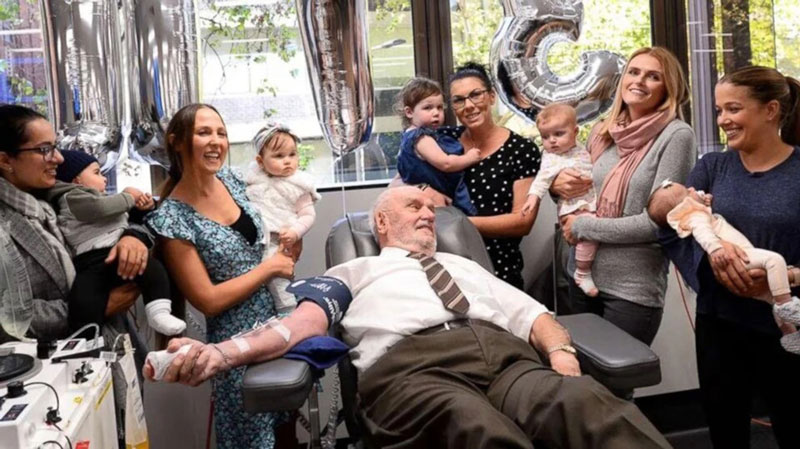
According to Australian Red Cross Lifeblood, he donated 1,173 times over more than 60 years and never lost interest in the work. His remarkable consistency eventually earned him the nickname “The Man with the Golden Arm.”
There was something particularly fitting about the nickname. Harrison’s value was not in the amount of blood he could give on any single visit, but in the unusual antibody his body produced and his extraordinary willingness to keep donating it.
Lifeblood says more than three million doses of Anti-D containing Harrison’s plasma had been issued to Australian mothers by the time he retired. His contribution also helped Australia become the first country to achieve self-sufficiency in its Anti-D supply.
Millions Of Babies Were Connected To His Donations
The number associated with Harrison is staggering: about 2.4 million babies.
Lifeblood estimated his contribution by examining Australian birth data, the number of women receiving Anti-D, and the historical risk of death from haemolytic disease. In other words, the figure does not mean doctors could identify 2.4 million individual babies whose lives were saved by one particular donation. It is an estimate of the enormous impact of the Anti-D program that his plasma helped supply.
That distinction matters, but it does not make the achievement less remarkable.
Every dose represented another opportunity to prevent a dangerous immune reaction during pregnancy. And unlike many medical breakthroughs, this one depended not only on laboratories and researchers but also on people willing to sit in a donor chair regularly for years.
Harrison’s own daughter eventually received Anti-D during pregnancy, bringing the story full circle. The man who had spent decades helping strangers had a direct connection to the treatment within his own family.
He Kept Donating Until The Rules Stopped Him
By 2018, Harrison was 81 years old and had been donating for more than six decades. He still wanted to continue, but Australian blood-donation rules meant he had reached the age at which he needed to retire.
On May 11, 2018, he made his 1,173rd and final donation.
There was no dramatic medical crisis behind his retirement. He simply reached the upper age limit for donors, while Lifeblood determined that stopping was the appropriate decision for his health.
Even then, Harrison’s attitude remained remarkably modest. He said he hoped someone would eventually break his donation record, because that would mean another person was just as dedicated to the cause.
He was awarded the Medal of the Order of Australia in 1999 for his contribution. Yet the most important part of his legacy was something much harder to see: millions of pregnancies in which a dangerous blood incompatibility was prevented before it could harm a child.

What Happened To The “Golden Arm” Afterward?
Harrison died peacefully on February 17, 2025, at the age of 88. By then, his story had become internationally known, but the medical community was also thinking about something beyond the record he had set.
His antibody was rare. Only a relatively small number of donors possess Anti-D antibodies at the strength needed for the program, which means the supply has always depended on a limited group of people.
That raises an obvious question: what happens when people like Harrison can no longer donate?
Researchers at the Walter and Eliza Hall Institute of Medical Research, working with Australian Red Cross Lifeblood, have been studying ways to reproduce the valuable Anti-D antibody in the laboratory. The project has been informally described as “James in a Jar” because of the hope that the antibody responsible for Harrison’s extraordinary contribution could one day be produced without relying entirely on donors with the same rare biology.
That would be the ultimate continuation of his legacy: taking something unusual that existed naturally in one man’s blood and finding a way to make it available more widely.
A Remarkable Legacy Hidden In An Ordinary Man
James Harrison spent most of his life doing something that millions of people around the world are asked to do: donate blood. What made his story extraordinary was not that he set out to become famous, but that doctors discovered his plasma contained a rare antibody with an important medical use.
His journey began with receiving blood as a teenager. He then spent more than 60 years giving back, eventually making 1,173 donations and helping supply the Anti-D treatment used to protect babies from a dangerous blood disorder.
Harrison never personally knew the overwhelming majority of the children connected to his donations. He simply kept returning to the donor chair.
That may be the most remarkable part of the story. His greatest contribution came not from one dramatic act, but from doing the same simple thing over and over again—until an ordinary promise made at 14 became a legacy measured in millions of lives.
James Harrison’s story is remarkable precisely because he never intended to become a medical legend. After receiving more than a dozen units of blood during major surgery at age 14, he promised to donate when he was old enough, and he kept that promise for more than six decades. Doctors eventually discovered that his plasma contained a rare antibody used to produce Anti-D, helping prevent haemolytic disease in unborn babies. He made 1,173 donations before retiring in 2018 at age 81, and his contribution was estimated to have supported enough Anti-D to protect roughly 2.4 million babies. Harrison died in 2025, but researchers are now working to reproduce the antibody he carried naturally.
P.S. Australian Red Cross Lifeblood’s James Harrison profile and retirement records; AABB’s 2025 memorial for Harrison; Australian Red Cross Lifeblood statement on his death and ongoing “James in a Jar” research. Source: https://www.historicmysteries.com/science/the-man-with-the-golden-arm-how-james-harrison-saved-2-4-million-babies/40038/