The late 1970s were a difficult time for American automakers. Fuel shortages, rising gasoline prices and stricter emissions regulations were forcing Detroit to rethink the traditional American automobile. Yet Oldsmobile continued to offer something many buyers still wanted: spacious interiors, soft rides, formal styling and powerful engines. Its advertising from the period reveals a fascinating moment when the classic American sedan was becoming more efficient without completely giving up its old identity.
Oldsmobile Built Its Reputation on Big, Comfortable Cars
Oldsmobile had been producing automobiles since the early 1900s, but the brand’s modern identity took shape in 1949 with the Oldsmobile 88.
The 88 combined a relatively light body with Oldsmobile’s new high-displacement Rocket V8. At a time when many family cars were equipped with smaller engines, the combination gave the 88 an unusual mixture of practicality and performance. It later became an important early influence on the development of the American muscle-car concept.
During the 1950s and 1960s, Oldsmobile expanded its lineup.
The Cutlass arrived as a sporty intermediate in 1961. The Ninety-Eight occupied the top of the range as the division’s flagship, while the Delta 88 became one of its major volume sellers.
By the end of the 1960s, Oldsmobile had become one of America’s best-selling automotive brands. Its cars represented something distinctly American: generous dimensions, comfortable seats, smooth rides and plenty of engine power.
But the world was changing.
The formula that had worked so well for Detroit was about to face its biggest challenge in decades.
Want to see these classic Oldsmobiles in action? Watch the video to take a closer look at the cars, styling and features that made these 1970s American automobiles so memorable.
The 1970s Forced Oldsmobile to Rethink the American Car
The 1973 oil embargo sent fuel prices higher and made fuel economy much more important to American buyers. At the same time, increasingly strict federal emissions regulations affected engines across the automotive industry.
Suddenly, the giant American car had a problem.
Customers still wanted comfort and space, but they were becoming increasingly concerned about how much fuel their cars consumed.
Oldsmobile’s response was not simply to abandon the traditional American sedan.
Instead, the company tried to make it smaller and lighter without making it feel smaller.
The biggest change came in 1977, when General Motors downsized its entire B-body platform. The new Delta 88 was nearly 900 pounds lighter than its predecessor while actually gaining rear-seat legroom and headroom.
That was an impressive engineering compromise.
From the outside, the American sedan was getting smaller.
From inside, Oldsmobile wanted passengers to feel as though nothing had been lost.
And the company’s advertising made that message very clear.
The new Delta 88 was presented as a family car that put passengers first, with generous space, a large trunk and a smoother ride.
Oldsmobile was essentially telling Americans: You don’t have to give up the big-car experience just because the world is demanding better fuel economy.

The Delta 88 Was Designed Around the Family
The 1978 Delta 88 was one of the clearest examples of this strategy.
Oldsmobile’s advertising presented the car as a family vehicle designed around the people inside it.
The company highlighted generous headroom and legroom, along with 20 cubic feet of trunk space. The suspension was also engineered with the help of computers to select spring and shock-absorption combinations intended to provide a comfortable ride.
But fuel economy was now impossible to ignore.
The advertising quoted EPA estimates of 25 mpg highway, 17 mpg city and 20 mpg combined for the standard 231 V6 with automatic transmission.
That combination was significant.
Only a few years earlier, fuel economy had rarely been the centerpiece of an American luxury sedan advertisement.
Now it was part of the sales pitch.
The message was no longer simply: “Look how big and powerful this car is.”
It had become: “Look how comfortable this car is—and look at what it can do with fuel.”
That was the new reality of the American automobile market.
Oldsmobile Tried to Make Luxury More Affordable
The same strategy appeared in the Omega Brougham.
The 1977 Omega Brougham was advertised at $3,914, with Oldsmobile positioning it as an alternative to more expensive European luxury cars. The company emphasized room, comfort and fuel economy while highlighting features such as bucket seats, sports mirrors and special wheels.
The following year, the 1978 Omega Brougham was advertised at $4,482.
It had the formal sedan styling that buyers associated with more expensive automobiles, along with brushed-knit seats and other comfort-oriented features.
But Oldsmobile also emphasized economy. With the standard 231 V6 and manual transmission, the advertisement quoted EPA estimates of 28 mpg highway, 16 mpg city and 19 mpg combined.
The idea was clever. Instead of telling customers that the era of affordable luxury was ending, Oldsmobile suggested that luxury could still be practical.
You could have the appearance and comfort of a more expensive car without paying a European luxury-car price.
It was an appealing proposition at a time when American consumers were becoming increasingly careful about both purchase price and fuel consumption.

The Toronado Took a Different Approach
Oldsmobile’s answer to the changing market wasn’t limited to traditional rear-wheel-drive sedans.
The 1977 Toronado represented a different interpretation of personal luxury. Its major technological selling point was front-wheel drive.
Oldsmobile’s advertising emphasized the traction advantages of placing the engine’s weight over the driven wheels, particularly on wet or snow-covered roads. The company presented front-wheel drive as a system that could help pull the car through difficult conditions rather than push it from behind.
But the Toronado was still unmistakably a luxury automobile.
The interior featured a soft, “loose-cushion” appearance, while an available electrically operated Astro-roof added another touch of extravagance.
That combination reflected Oldsmobile’s broader philosophy during the period.
Technology did not have to mean abandoning luxury. Instead, technology could be used to make luxury feel more sophisticated. The Toronado therefore occupied an interesting position between traditional American excess and the increasingly technology-focused automotive market.
The Cutlass Showed How Oldsmobile Was Adapting
The Cutlass occupied another important position in the lineup.
A 1977 advertisement promoted the Omega and Cutlass as cars that offered attractive styling while still delivering relatively good fuel economy.
The advertised Cutlass price was $4,811, with EPA estimates of 25 mpg highway and 17 mpg city for the specified 231 V6 and available automatic transmission.
But Oldsmobile didn’t want buyers to think of the Cutlass as merely an economy car.
The advertising emphasized its styling and comfort.
The following year’s Cutlass Supreme Brougham pushed the luxury message even further.
It featured velour upholstery, increased headroom and legroom, a redesigned suspension and a formal exterior shape. The advertisement also emphasized maneuverability in city traffic—an important point for a car that still carried the visual character of a traditional American luxury automobile.
And once again, fuel economy appeared prominently. The 1978 Cutlass Supreme Brougham was advertised with EPA estimates of 27 mpg highway, 19 mpg city and 22 mpg combined with the available 260 V8 and automatic transmission.
That combination would have been difficult to imagine as a central selling point for a large American car only a few years earlier.

The 98 Regency Was Oldsmobile’s Definition of Luxury
At the top of the range sat the Oldsmobile 98 Regency.
This was where Oldsmobile made its strongest argument that traditional American luxury still had a future.
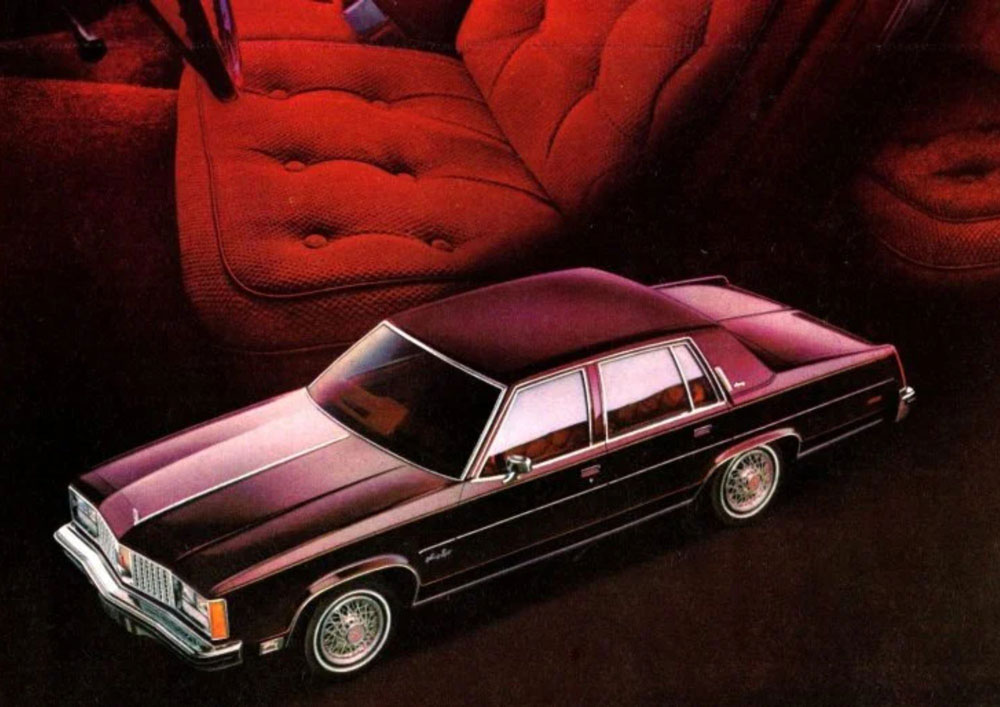
The 1977 98 Regency was described as a car that combined “logic and luxury.” Its interior featured crushed velour seats with a loose-pillow appearance, a quiet cabin and a computer-engineered suspension designed to provide a smooth ride.
Yet the company also acknowledged the changing priorities of the customer.
The Regency’s standard automatic transmission and 350 V8 were advertised with EPA estimates of 21 mpg highway and 16 mpg city.
The company also emphasized improved maneuverability, luggage space, headroom and rear-seat legroom.
The 1978 model continued the same formula.
It retained the formal exterior styling and limousine-like interior while offering soft velour seats, generous passenger space and a smooth ride. Its standard 350 V8 was advertised with EPA estimates of 22 mpg highway, 15 mpg city and 17 mpg combined.
The advertising was almost philosophical. Oldsmobile wasn’t asking customers to choose between luxury and practicality. It was arguing that they could have both. The 1979 Regency continued that message by emphasizing plushness, elegance and value.

The Late-70s Oldsmobiles Captured the End of an Era
Looking at these cars together reveals something larger than a collection of vintage advertisements.
They capture a transition in American automotive history.
The old formula was still there: big cars, comfortable interiors, V8 engines and formal styling.
But new concerns had entered the conversation: fuel economy, weight reduction, emissions and maneuverability.
Oldsmobile was trying to bridge those two worlds.
The 1977 Delta 88 is perhaps the clearest example. GM had significantly reduced the car’s weight, yet Oldsmobile could advertise increased rear-seat space.
The Cutlass and Omega demonstrated that buyers could have attractive styling and comfort without necessarily buying the largest car in the lineup.
The Toronado showed that front-wheel drive and personal luxury could coexist. And the 98 Regency demonstrated that even the flagship could become more economical without abandoning its traditional identity.
This was not the end of the American luxury sedan. But it was close to the end of an era in which the full-size American family car could dominate both the road and the showroom.
Oldsmobile continued producing sedans throughout the 1980s and 1990s. Eventually, however, General Motors discontinued the Oldsmobile brand in 2004.
That makes these late-1970s cars especially interesting today.
They represent one of the final moments when the traditional American sedan still carried enormous cultural significance while simultaneously being forced to adapt to a completely different economic environment.
The late-1970s Oldsmobiles captured a turning point in American automotive history. Models like the Delta 88, Cutlass, Toronado and 98 Regency still offered the space, comfort, V8 power and luxury that defined the classic American car, but they were also adapting to rising fuel costs, stricter regulations and changing consumer expectations. Oldsmobile was trying to preserve the traditional American driving experience while making its cars better suited to a changing world.