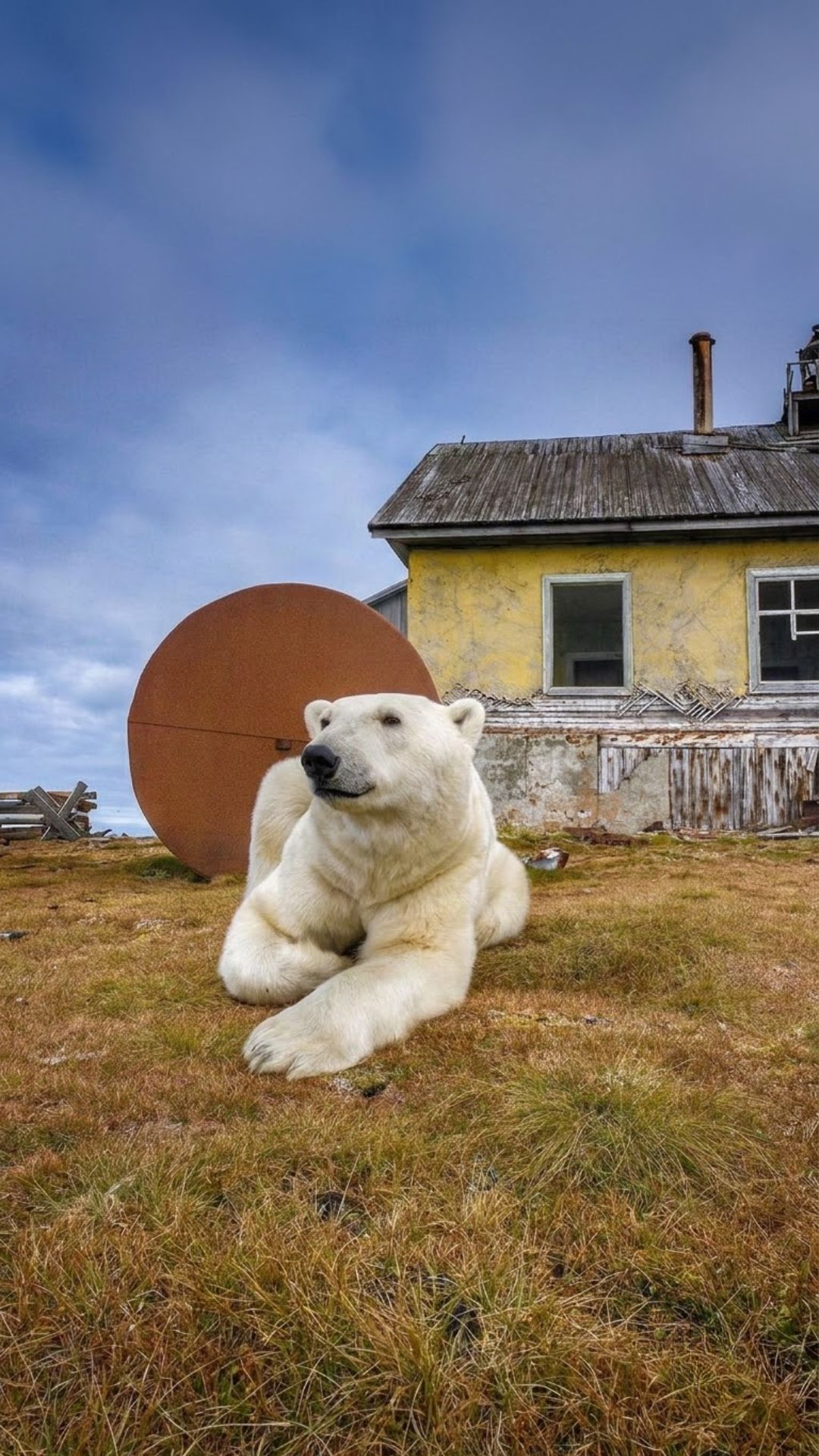
More than 30 years ago, scientists left an isolated weather station on Kolyuchin Island in Russia’s far northeast, leaving behind empty buildings on a rocky Arctic landscape. Then, decades later, photographers looking toward the abandoned settlement noticed something moving inside the windows. Polar bears had discovered the deserted structures and were using them as shelter. In 2021, wildlife photographer Dmitry Kokh photographed around 20 bears around the station, including animals appearing inside the old buildings. In 2025, new drone footage showed polar bears still using the abandoned site.
The Weather Station Was Abandoned After The Soviet Era
Kolyuchin Island sits in the Chukchi Sea, about 11 kilometers from the northern coast of Russia’s Chukotka Peninsula, facing Alaska across the Bering Strait. The island is remote, rocky and largely uninhabited, making it an unlikely place to encounter anything resembling an ordinary human settlement.
But during the Soviet era, the island was home to a polar weather station. The station eventually closed in 1992, after which the settlement was left exposed to the Arctic elements. Buildings, equipment and old fuel barrels remained scattered across the site while the people who had once worked there were gone.
For decades, the structures simply stood empty. Then the Arctic landscape acquired some very different residents.
Ever wonder what happens to abandoned towns? Discover how a group of polar bears moved into a deserted research station in Russia! This fascinating footage, captured by a drone, shows these wild creatures making themselves at home. Watch the full story now to see these bears in their unique habitat!
Then A Photographer Saw Movement Inside The Empty Buildings
In September 2021, wildlife photographer Dmitry Kokh was traveling along the Chukotka coast on an expedition toward Wrangel Island when bad weather forced his boat to seek shelter near Kolyuchin Island. From the water, the abandoned buildings looked deserted. Then someone noticed movement in the windows.
Through binoculars, the shapes became recognizable as polar bears. Kokh eventually counted around 20 bears in view, most of them males, while females with cubs remained closer to the shoreline. Because landing on the island was considered too dangerous in the stormy conditions, he photographed the animals from a drone equipped with low-noise propellers.
The resulting photographs created an extraordinary contrast: enormous white bears standing in doorways and windows of buildings that had once been occupied by Soviet scientists.

Around 20 Polar Bears Were Roaming The Island
The unusual scene was not simply a matter of bears wandering past an abandoned building. Some of the animals were clearly exploring the structures, moving through windows and doorways and using parts of the old settlement as shelter.
Polar bears are naturally curious animals, and Russian biologist Anatoly Kochnev, who had extensive experience studying bears in Chukotka and Kolyuchin, offered a straightforward explanation for their interest in the buildings. According to Kokh’s account, the bears were curious about accessible rooms and openings, while the structures could also provide protection from people.
The buildings therefore offered something the surrounding landscape could not: enclosed spaces that blocked some of the wind and weather while giving the bears a place to investigate and rest.
That helps explain one of the most striking details in the photographs. The bears were not simply standing beside the ruins. Some appeared to have discovered that an abandoned human building could still be useful.
The Bears Found Shelter Inside The Old Houses
The idea became even more striking when another photographer documented the location years later.
In September 2025, Vadim Makhorov filmed polar bears moving around the abandoned research station with a drone. The Associated Press reported that the bears were using one of the deserted buildings as shelter, while Reuters described footage showing them exploring and inhabiting the scattered structures of the former station.
That does not mean the bears had literally transformed the entire settlement into a permanent colony. Their presence can vary with conditions, food availability and the movement of sea ice. But the repeated observations show that the abandoned buildings can provide something valuable when the animals are on the island.
It also creates an unusual reversal of the original purpose of the site. Humans once built these structures to observe and measure the Arctic environment. Decades after the scientists left, the buildings were being used by one of the Arctic’s most recognizable animals.

Why Polar Bears Were Using Human Buildings
There is an important detail behind the 2021 photographs: bears were unusually concentrated on Kolyuchin Island at that time.
Kokh reported that floating sea ice remained near the island during the summer, allowing bears to remain in the area instead of moving farther north with the retreating ice. He also noted that such concentrations were unusual; after leaving Kolyuchin, his expedition encountered far fewer bears farther north on Wrangel Island.
The buildings then became an opportunistic resource. A polar bear does not need to understand what a weather station was or why humans built it. If an empty structure provides shelter from wind and rain, an accessible opening offers an interesting space to investigate, or the surrounding settlement provides a useful place to rest, the building simply becomes part of the landscape.
The result is one of those rare wildlife scenes in which an object designed entirely for human purposes becomes useful to another species.
Nature Quietly Reclaimed The Abandoned Station
Kolyuchin’s abandoned weather station is fascinating because almost nothing about the scene was planned. The Soviet-era settlement was built for people, used for decades, and then left behind. The buildings remained while the human activity disappeared.
The polar bears arrived much later and found their own uses for what was left.
Photographs from Kolyuchin therefore capture more than an unusual encounter with wildlife. They show how quickly the meaning of a place can change when people stop using it. A weather station can become a shelter. A doorway can become a resting place. An empty building can become part of an Arctic animal’s environment.
More than three decades after the station closed, the buildings are still standing—and the animals have found a reason to use them.
The abandoned weather station on Kolyuchin Island is fascinating because its story did not end when the people left. Decades later, polar bears found their own uses for the empty buildings, turning windows, doorways and forgotten rooms into unexpected shelters. The photographs capture a rare moment when human infrastructure and Arctic wildlife overlap in an almost surreal landscape. What was once a place built to observe the Arctic eventually became part of the environment itself, showing how quickly nature can give an abandoned human structure an entirely new purpose.
The remarkable images of polar bears exploring the abandoned station were captured by photographers visiting Kolyuchin Island. The original report provides more details about the station, the bears and how the unusual encounter was documented. Source: https://trendingamerican.com/polar-bears-abandoned-weather-station-kolyuchin-island/