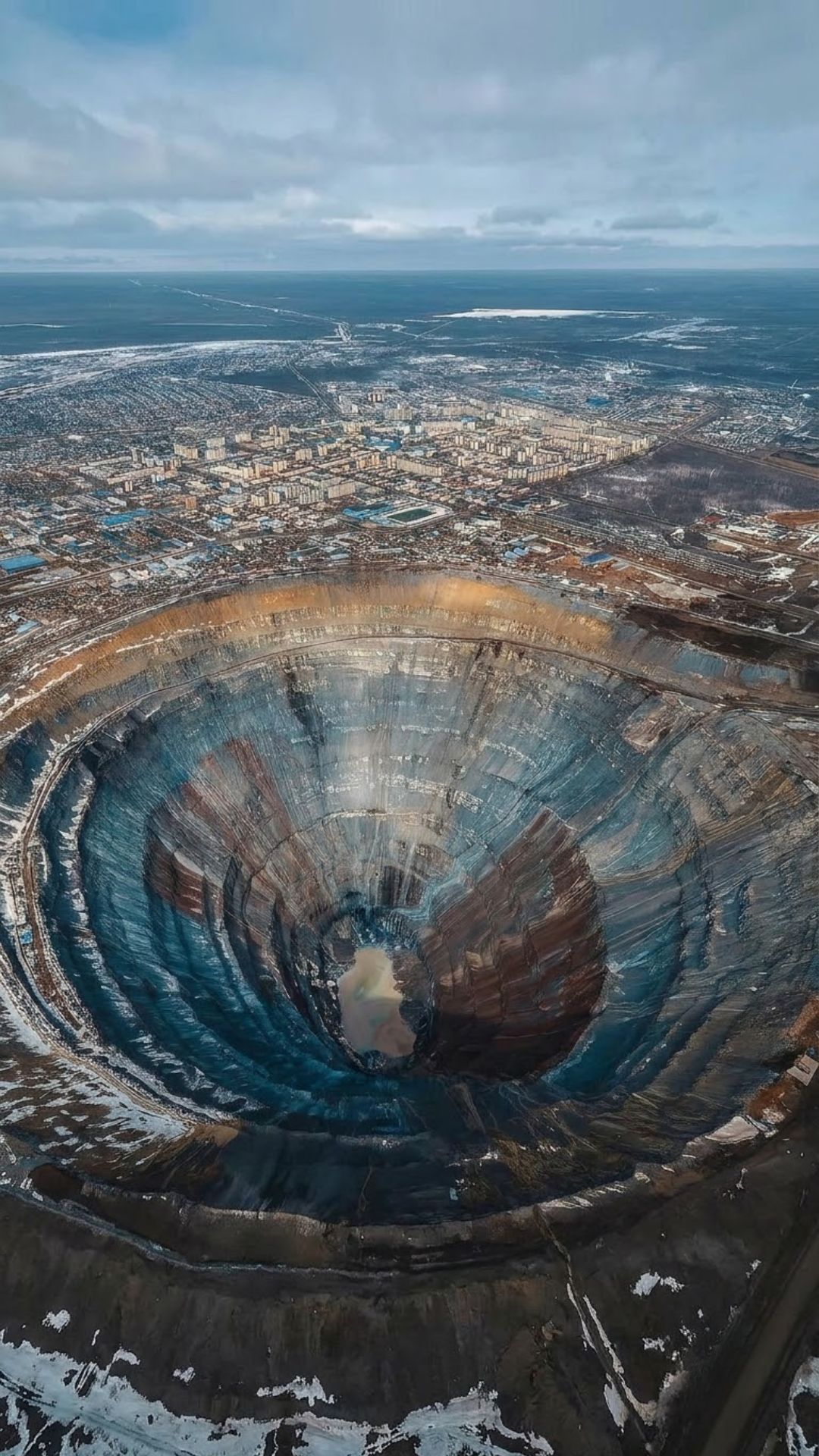
Seen from space, the Mir diamond mine looks almost unreal: a gigantic circular excavation carved into the middle of Siberia, where the surrounding landscape stretches for miles. The pit is about 1.2 kilometers across and more than 525 meters deep, making it one of the largest open-pit mines in the world. Yet the reason for creating this enormous scar was surprisingly simple. Beneath the frozen Siberian ground was a deposit of diamonds, discovered in 1955 and eventually mined for more than 200 million carats.
The Search For Diamonds Began In One Of The Harshest Places On Earth
The Mir story began in 1955, when Soviet geologists discovered a diamond-bearing kimberlite pipe in Siberia. Kimberlite is important because these volcanic rocks can carry diamonds from deep inside Earth toward the surface. Finding such a deposit can therefore transform an otherwise remote geological site into an enormously valuable mining operation.
But knowing that diamonds were there was very different from actually getting them out. The deposit was located in a remote part of Siberia, far from the industrial centers where machinery, workers and supplies were readily available. The challenge was not simply geological. Engineers had to create an industrial operation capable of working in an environment where the climate and distance made almost every part of the project more difficult.
The decision to pursue the deposit reflected how strategically valuable diamonds could be. Rather than abandoning a difficult discovery because of its location, the Soviet Union invested in turning the remote site into a major mine. What followed was decades of excavation that would eventually transform the surrounding landscape on a scale large enough to be visible from orbit.
Ever wondered how a $5,000,000 diamond stash looks in person? Journey deep into the heart of Siberia to explore the world’s largest diamond mine. From dangerous underground tunnels to the secret final sorting process, witness the intense reality of the diamond industry. Don’t miss this incredible, exclusive, high-stakes documentary short!
The Ground Was Turned Into A Giant Open Pit
At first, the most direct way to reach the diamond-bearing rock was to remove the material above it. That meant gradually cutting deeper and wider into the ground. Over the years, the excavation grew into an enormous open pit measuring roughly 1,200 meters across and more than 525 meters deep.
Those numbers are difficult to visualize until they are compared with something familiar. A 525-meter vertical drop is more than half a kilometer from the surface to the bottom. Across the top, the mine stretches for more than a kilometer, creating a vast bowl in a landscape that otherwise appears comparatively open and undeveloped.
The deeper the excavation became, however, the more complicated the operation became. Open-pit mining requires enormous quantities of rock and soil to be removed, transported and processed. Eventually, simply continuing to enlarge the surface pit was no longer the only practical way to reach the deposit. Mir’s history therefore moved from the spectacular open excavation into a less visible world beneath the surface.

More Than 200 Million Carats Came Out Of The Ground
The extraordinary scale of Mir becomes easier to understand when its production is considered. According to NASA’s Jet Propulsion Laboratory, the mine produced more than 200 million carats of diamonds through both open-pit and later underground mining. The largest diamond associated with the mine weighed 342 carats.
A number like 200 million carats can sound almost abstract, but it represents decades of industrial extraction from a single geological deposit. The diamonds were not simply lying in the ground waiting to be collected. They were locked inside rock, meaning enormous amounts of material had to be excavated, transported and processed before the valuable stones could be separated.
That is what makes the mine more interesting than a simple record of size. The giant hole visible today is essentially the physical footprint of an enormous search. Every expansion of the pit represented more rock being removed in the hope that the geological formation would continue to yield diamonds.

At Some Point, The Mine Had To Go Underground
The Mir mine eventually demonstrated one of the basic problems of deep open-pit mining: the deeper the target becomes, the harder it is to keep reaching it economically from the surface. Instead of continuing to make the enormous pit indefinitely deeper and wider, mining operations also moved underground.
This changed the character of the operation. From above, the most dramatic evidence of Mir is the giant circular pit. Underground, however, the search continued through tunnels and workings hidden beneath the Siberian surface. The mine’s production therefore came from two very different environments: an excavation visible from space and a subterranean network that cannot be seen in the satellite image.
That transition also reveals why the spectacular photograph can be misleading. The huge pit is not the entire mine. It is the most visible part of a much longer industrial story in which miners continued following the diamond-bearing geology after surface excavation had reached its practical limits. NASA specifically notes that Mir was worked through both pit mining and later underground mining.

The Mine Became A Mark Visible From Space
The most striking modern view of Mir does not come from the bottom of the pit. It comes from hundreds of kilometers above Earth.
NASA’s Terra satellite photographed the mine on July 16, 2019, using ASTER, an instrument capable of observing Earth’s surface across 14 spectral bands, from visible light through thermal infrared. The image covers an area of roughly 17 by 17.7 kilometers, placing the enormous mine within the much larger Siberian landscape.
From that altitude, the reason the mine is so compelling becomes obvious. A project that began with geologists identifying a diamond-bearing geological formation in 1955 had ultimately created a feature large enough to stand out dramatically in satellite imagery.
There is something almost poetic about that contrast. The diamonds themselves were hidden deep underground, invisible to anyone looking across the original landscape. The excavation created to reach them became the opposite: an enormous human-made feature that could be seen from space.

Mir Shows How Valuable Resources Can Reshape The Earth
The Mir mine is ultimately a story about the extraordinary lengths humans can go to reach something buried beneath the surface. A geological discovery in 1955 led to decades of mining in one of the world’s harshest environments, first through a giant open pit and later through underground workings. The result was more than 200 million carats of diamonds and an excavation more than half a kilometer deep.
Today, NASA’s satellite image puts the entire story into perspective. What looks like a strange circular feature in the Siberian wilderness is actually the visible record of decades of geological exploration, engineering and industrial effort. The diamonds were hidden underground, but the enormous price of reaching them was written across the surface of Earth for everyone to see.
The satellite image that inspired this story was captured by NASA’s Terra satellite and published by NASA’s Jet Propulsion Laboratory. You can view the original image and the full technical details below. Source: https://www.jpl.nasa.gov/images/pia25856-mir-diamond-mine-siberia/