Deep in the tropical forests of southern Malaysia lies the legend of a city that may have disappeared more completely than almost any other ancient settlement. Kota Gelanggi was said to be a powerful place of black stone, old enough to have belonged to the great civilizations of Southeast Asia. In the early 2000s, a researcher believed satellite and aerial images had finally revealed where it might be. Then an official expedition went into the jungle—and came back without finding the city.
A Lost City Hidden Beneath the Trees
The story of Kota Gelanggi begins with something that sounds almost impossible today: an ancient city that was supposed to be known from historical traditions, yet whose physical remains could not be confidently located.
The name appears in Malay historical tradition, including the Sejarah Melayu, which describes a settlement on the upper Johor River associated with a fortress made of black stone. The place has also been connected with names such as Klang Kiu and Kota Batu Hitam, or “Black Stone Fort.” Over time, these references helped create the image of a powerful settlement hidden somewhere in the forests of what is now southern Malaysia.
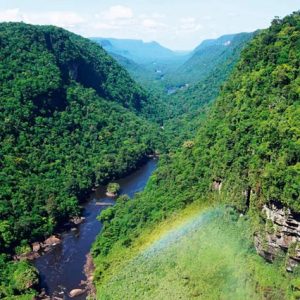
The legend became even more intriguing because some accounts placed Kota Gelanggi in a region that was difficult to penetrate. Dense tropical forest could quickly reclaim abandoned settlements, leaving little visible from the ground after centuries. In a place where vegetation can cover old earthworks and stonework, the idea of a forgotten city disappearing beneath the canopy was not completely impossible.
That possibility might have remained little more than folklore. Then one researcher began looking at the landscape from above.

The Man Who Thought He Found It
In 2004, independent researcher Raimy Che-Ross published a paper examining the old accounts of Kota Gelanggi and possible clues to its location. His research combined textual evidence with what he described as an excursion into “aerial archaeology.”
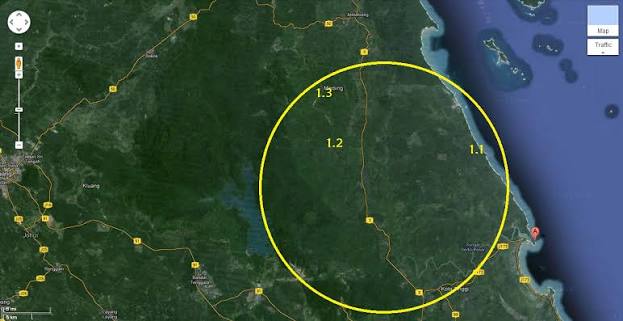
Che-Ross focused on an area of forest around Sungai Madek and Sungai Lenggiu near the Linggiu Reservoir in Johor. Aerial photographs and remote-sensing imagery appeared to show unusual vegetation patterns and geometric features beneath the forest canopy. To Che-Ross, those patterns were potentially consistent with man-made structures rather than entirely natural formations.
The possible site covered an enormous area—about 140 square kilometers, or roughly 54 square miles. That figure should not be misunderstood as the confirmed size of an ancient city; it referred to the wider forest area in which the suspected archaeological features were identified. But even so, the scale of the proposed site was extraordinary.
The possibility immediately attracted attention in Malaysia. If the evidence could be confirmed, the discovery could potentially become one of the country’s most important archaeological finds.
There was now only one way to find out. Someone had to go into the jungle.
Ever wondered about the world’s most mysterious, inaccessible locations? From the ancient ruins of Kota Gelanggi to forbidden alien-like landscapes, this video explores 10 impossible-to-reach places found on Google Earth. Join me on this thrilling journey to discover the planet’s best-kept secrets. Watch now to see these hidden wonders!
The Jungle Search
In 2005, Malaysian authorities organized research into the claim. A team involving the Department of Museums and Antiquities and researchers from several institutions examined the area identified through aerial and satellite imagery. The investigation was a serious attempt to determine whether the supposed lost city had a physical presence on the ground.
The environment itself presented a formidable obstacle. Dense tropical vegetation can conceal old earthworks, foundations and other traces of human activity, particularly when centuries have passed without maintenance.
That meant researchers were not simply looking for a skyline or a row of recognizable buildings. They were looking for earthworks, foundations, walls, ceramics, stone structures or other archaeological evidence that could connect the landscape to the historical accounts of Kota Gelanggi.
And this was where the mystery took its most important turn. The expedition did not find the lost city.
A government-appointed team conducted a month-long study in July 2005 and reported finding no trace of the fabled settlement. Later statements from Malaysian officials were more cautious than a simple declaration that the legend was false: they said research conducted up to that point had not found evidence for the city.
For a story that had suddenly seemed close to a historic breakthrough, it was a remarkably anticlimactic result. But it did not end the mystery.
The People Who Said They Had Seen It
One reason Kota Gelanggi refused to disappear from the conversation was testimony from local Orang Asli elders.
According to accounts of the story, three senior Orang Asli headmen associated with the Linggiu Dam region maintained that the city existed. One, Tuk Batin Abdul Rahman, described seeing a large structure he believed to be part of the lost settlement. He recalled a fort roughly 40 feet square with openings resembling windows and said he had encountered it while moving through the area decades earlier.
That kind of testimony is intriguing, but it is not the same thing as archaeological proof. Memory can preserve valuable knowledge about landscapes, especially in communities with long local traditions, but a remembered structure still needs to be independently documented and dated before it can establish the existence of a particular ancient city.
There were other clues, too. Artifacts found downstream from the alleged location have been cited as evidence that the broader region was once connected to ancient trade. But artifacts proving ancient human activity in the surrounding area do not automatically prove that Kota Gelanggi itself was located there.
This distinction is crucial. The question was never whether people lived and traded somewhere in ancient Johor. The real question was whether this particular lost city existed where researchers believed it did.
Was Kota Gelanggi Part of Srivijaya?
If the city did exist, its possible importance becomes much greater.
One prominent theory connects Kota Gelanggi to Srivijaya, the powerful maritime kingdom that dominated large parts of Southeast Asia for centuries. Srivijaya was deeply involved in long-distance trade and became an important center of Buddhist learning, linking the Malay world with India and China.
That has led some writers and researchers to suggest that Kota Gelanggi could have been an important early center of the kingdom—or even an early capital. If that identification were ever conclusively demonstrated, it would matter far beyond one forgotten settlement in the Malaysian jungle. It could change how historians understand the development of early states in the Malay Peninsula.
There is tantalizing material behind some of these theories.
The story points to an 11th-century Sanskrit manuscript preserved in Nepal, the Astasahasrikaprajnaparamita, which contains an illustration of a temple associated with “Java,” a historical geographical term that could encompass parts of the wider Malay world. R. C. Jamieson, a keeper of Sanskrit manuscripts at Cambridge, reportedly suggested that the unidentified temple might possibly have been Kota Gelanggi, while emphasizing the extraordinary significance such an identification would have if it proved correct.
But again, possibility is not proof.
The same problem appears in old descriptions of a place said to have contained a huge, tiered stupa-like structure surrounded by hundreds of graves. Such accounts are fascinating clues, yet they cannot establish the precise identity or location of the settlement without physical evidence tying them together.
And there is an even bigger problem. Some earlier archaeologists came to a very different conclusion about the supposed “black stone fort.”

The Theory That the City Was Never There
H.G. Quaritch Wales investigated the Johor River region in the 1930s. His research ultimately led him to conclude that there was no black-stone fort at the location he examined and no ancient city of the period there. More intriguingly, he suggested that the legend itself might have moved from one place to another over time.
According to this interpretation, Kota Gelanggi may not represent a single lost metropolis waiting to be uncovered. Instead, the story could have been attached to different locations as populations moved and traditions traveled across the Malay Peninsula.
That idea dramatically changes the mystery. Instead of asking: “Where did the city go?” we might need to ask: “Was there ever one city called Kota Gelanggi in the first place?”
There is another complication. The name Kota Gelanggi is also associated with a real cave complex in Pahang, creating a geographical overlap between a tangible place and the legend of a lost city supposedly located in Johor. Modern discussions therefore have to be careful not to treat every reference to “Kota Gelanggi” as evidence for the same site.
This is what makes the case so compelling. Every piece of evidence seems to open another question.
The City That May Still Be Lost
Kota Gelanggi survives because none of the competing explanations has completely erased the others.
There are ancient written references. There are old stories about a black-stone fortress. There are claims from local people who say they saw ruins. There are archaeological remains and artifacts showing that the wider region had connections to ancient trade. There are aerial images that were interpreted as possible signs of buried structures. And then there is the strongest problem of all: a government-backed search failed to find the city itself.
That does not prove the city never existed. But neither does it prove that it is still buried beneath the forest.
At this point, the most honest answer is that Kota Gelanggi remains an unresolved historical claim rather than a confirmed lost city. The available evidence can support the idea that the legend has deep roots and that ancient settlement existed in the broader region, but it does not establish that a vast Srivijayan city matching the legend lies beneath the Johor jungle.
And perhaps that is exactly why the story has lasted so long. A ruined city gives historians something to excavate. A city that nobody can prove existed gives everyone a reason to keep looking.
Somewhere beneath Malaysia’s forests, there may be nothing more than rock, roots and the remains of ordinary ancient settlements. Or there may be something still waiting to be found. Kota Gelanggi has survived for centuries not because archaeologists have proved that the lost city is real, but because the evidence refuses to produce a clean ending. The legend, the old manuscripts, the aerial imagery, the local testimony and the failed search all point in different directions. For now, the jungle is keeping its answer. And that makes Kota Gelanggi one of Southeast Asia’s most intriguing lost-city mysteries.
This story draws on Historic Mysteries’ account of the Kota Gelanggi legend, Raimy Che-Ross’s aerial-archaeology research, the 2005 government investigation and the competing historical interpretations of the supposed lost city. Souce: https://www.historicmysteries.com/unexplained-mysteries/kota-gelanggi-lost-city-malaysia/39982/