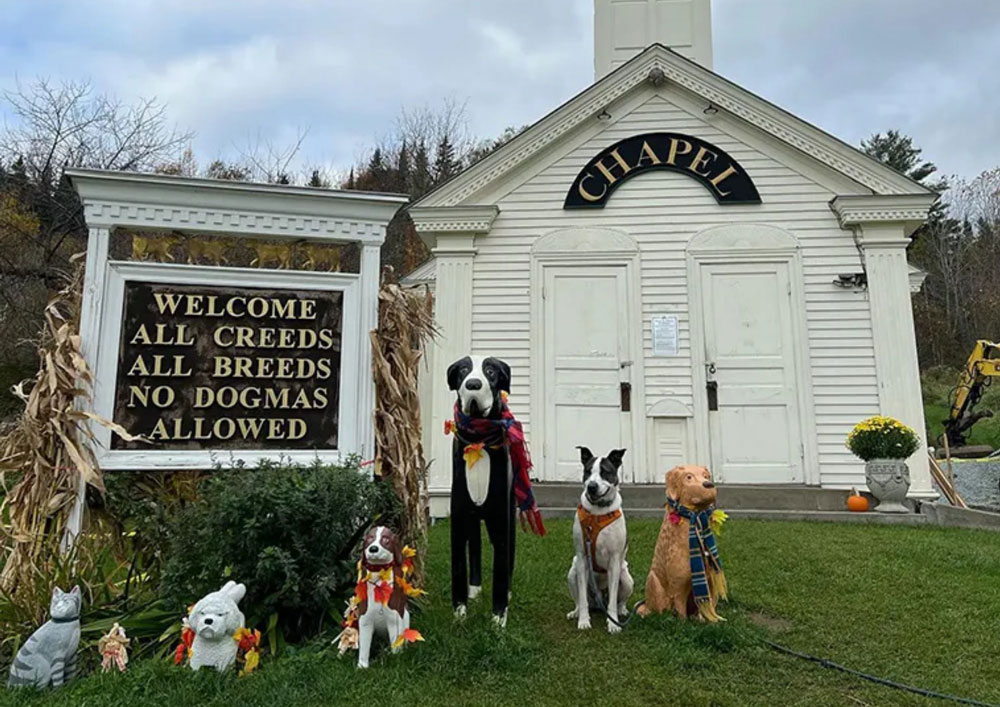
In the hills of Vermont, an artist named Stephen Huneck built something most people would never expect: a chapel dedicated to dogs. Inspired by his own deep bond with his Labrador, Sally, and shaped by a near-death experience that changed his outlook on life, the Dog Chapel became a place where people could celebrate the animals that stood beside them and remember those they had lost. What began as one man’s tribute eventually became a lasting monument to man’s best friend.
The Man Who Built a Chapel for Man’s Best Friend
In the hills of northern Vermont, there is a small white chapel that looks as though it belongs in an old New England village. It has a steeple, stained-glass windows, wooden pews and a quiet setting surrounded by fields and forests. But this is not an ordinary church. It was built around something much more personal: the bond between people and their dogs.
The man behind it was artist Stephen Huneck. After suffering a severe illness that left him in a coma and facing a long recovery, Huneck returned to his art with a renewed appreciation for life. His dogs, particularly his Labrador Sally, became central to both his personal life and his creative work. Eventually, that affection led him to create something few people would have imagined: a chapel dedicated to dogs and the people who love them.
The result was the Dog Chapel at Dog Mountain, a place where visitors can remember dogs that have passed away, celebrate the animals still beside them and reflect on one of the oldest relationships between humans and animals. What kind of love makes a man build a chapel for a dog?

A Chapel Built Around the Bond Between Humans and Dogs
Huneck and his wife, Gwen, established Dog Mountain on a large property in Vermont, creating a place where dogs could run freely across fields and trails. At the center of the property stood the Dog Chapel, a building deliberately designed to resemble a traditional New England country church despite its unusual purpose.
The exterior has white siding and a steeple, while the interior reveals what makes the building so different. Dog sculptures and artwork appear throughout the chapel, stained-glass windows feature canine imagery, and even the entrance accommodates four-legged visitors. The result is part church, part art installation and part memorial, but it never feels like a conventional museum.
Instead, the chapel was designed around the idea that the relationship between a person and a dog can be meaningful enough to deserve its own place of remembrance. Visitors do not come simply to look at Huneck’s artwork. Many arrive carrying memories of animals that were part of their families for years. The chapel wasn’t built just for dogs. It was built for the people who loved them.

The Walls Are Filled With Dogs Who Are No Longer There
One of the most moving parts of Dog Chapel is not something Huneck carved or painted himself. It is the collection of photographs, handwritten notes and personal memories left behind by visitors who have lost their dogs. Over time, the walls have become covered with reminders of animals that are no longer alive but remain deeply connected to the people who loved them.
The stories are different, but the emotion behind them is remarkably familiar. For many owners, a dog was present through years of ordinary routines and major changes alike: waiting at the door when they came home, staying beside them during difficult periods, growing older with them and becoming part of the rhythm of everyday family life. When that relationship ends, the loss can feel much larger than the death of a pet.
That is what gives the chapel its unusual emotional weight. The photographs and messages are not simply records of animals; they are records of relationships. Each one represents a period of someone’s life that was shared with a dog, and the walls gradually turned into a collective memorial created by thousands of strangers.
In that sense, the chapel gives physical form to something that is usually difficult to explain. People can visit, find a photograph, leave a message and acknowledge that the relationship they had with their dog mattered. You don’t build a memorial like this for an animal you considered disposable.
After a near-death experience, artist Stephen Huneck created Dog Mountain, a 150-acre retreat in northern Vermont. At its heart is Dog Chapel, a place where people can remember the dogs they loved and lost, creating a bittersweet tribute to the enduring bond between humans and their pets.
The Artist Who Turned His Own Dogs Into a Legacy
Sally and the World of Stephen Huneck
Dogs were not simply an inspiration for Huneck’s chapel. They were central to his artistic career. His Labrador Sally became one of the most recognizable figures in his work, appearing in woodcuts, carvings and children’s books. Huneck created an entire artistic world around Sally, transforming everyday experiences between humans and dogs into stories and images that appealed to both children and adults.
That makes the Dog Chapel particularly personal. Huneck was not an artist who happened to choose dogs as an interesting subject. His work grew out of his own relationship with them, and his experiences with Sally became part of the creative identity that defined his career.
His serious illness also changed his perspective. After a period in which his life was in danger and his recovery required him to relearn basic abilities, Huneck returned to his work with a different appreciation for the people and animals around him. The chapel became one of the clearest expressions of that outlook.
A Place That Outlived Its Creator
Stephen Huneck died in 2010, followed by his wife Gwen in 2013, but the world they created did not disappear with them. Dog Mountain continues to preserve Huneck’s artwork and welcome visitors and their dogs, while the Friends of Dog Mountain organization works to maintain the property and continue his legacy.
That gives the chapel another layer of meaning. Huneck originally created a place to express his own love for dogs, but it eventually became something much larger than a personal monument. Every visitor who leaves a photograph or memory adds another story to the building, allowing the chapel to evolve long after its creator is gone. He built the chapel for his dogs. The world turned it into a memorial for all of them.

Why a Dog Chapel Says So Much About Man’s Best Friend
At first, the idea of a chapel for dogs might sound unusual. A small church in the Vermont countryside filled with dog sculptures, stained-glass windows and memorial photographs is certainly not something most people expect to encounter. But the longer you consider the relationship between humans and dogs, the less strange the idea becomes.
Dogs have lived alongside humans for thousands of years. They have hunted with us, guarded our homes, worked beside us and followed us across continents. They have served as working animals, companions and, in modern households, members of the family. Their relationship with humans is unusual because it is built largely around companionship, loyalty and trust.
A dog does not care about your job title, your income or your reputation. It does not know whether you had a successful day or a terrible one. It simply knows the familiar person who comes through the door. That uncomplicated loyalty may be one reason humans have developed such an unusually strong emotional connection with dogs.
When a dog dies, what disappears is therefore not merely an animal. For many people, it is a familiar presence that has been woven into the structure of everyday life for years. Dog Chapel gives that loss a physical place, allowing people to stop, remember and acknowledge that the relationship mattered.
Perhaps that is the most meaningful thing Stephen Huneck left behind. He did not build a monument to dogs because he believed they were human. He built one because he understood how deeply humans can love them.
And after generations of people calling dogs “man’s best friend,” Dog Chapel offers a quiet explanation for why the phrase has endured. Some of the most loyal friends we’ll ever have don’t speak a word.

Dog Chapel may look unusual at first, but its message is remarkably simple. Stephen Huneck created it from a deeply personal understanding of what dogs can mean to people, and over time, it became a place where countless owners could remember the animals that shared their lives. The chapel is not really about worshipping dogs; it is about recognizing loyalty, companionship and loss. In a quiet corner of Vermont, Huneck created something that captures why, for so many people, a dog is never simply a pet.