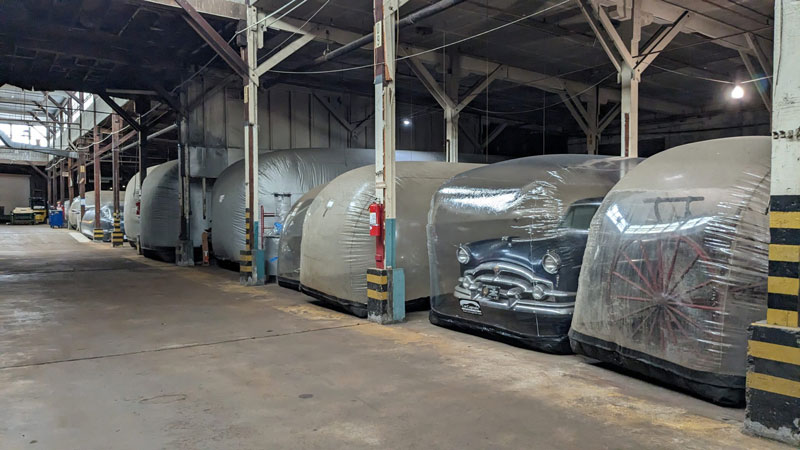
Inside an unassuming warehouse in Detroit, dozens of historic automobiles sit sealed inside transparent bubbles, protected from the elements and largely hidden from public view. The collection belongs to the Detroit Historical Society and includes experimental cars, military vehicles, prototypes and automobiles connected to some of the biggest names in American automotive history. Among them are a 1935 Stout Scarab, an early Mustang prototype, Lee Iacocca’s personal Lincoln and concept cars that never reached production. Together, they tell a much bigger story about how Detroit helped shape the American automobile.
The Cars Are Hidden Inside A Warehouse In Detroit
The collection is housed in a large storage facility in southwest Detroit rather than inside a conventional automobile museum. The current facility covers about 75,000 square feet and contains roughly 250,000 individual artifacts belonging to the Detroit Historical Society. The largest section is a World War II-era building where Detroit-connected cars and carriages from more than a century of history are stored.
The unusual part is how many of the automobiles are preserved. Instead of simply being parked on a warehouse floor, the vehicles are enclosed in large, transparent, airtight bubbles. The protective enclosures help shield the cars from environmental conditions while allowing the collection to remain visible. Earlier reporting described roughly 50 vehicles stored this way, while more recent coverage shows the collection continuing to include rare automobiles alongside thousands of other Detroit artifacts.
The result looks less like a traditional museum and more like a time capsule. Rows of historic vehicles sit quietly inside their individual protective enclosures, surrounded by objects ranging from old fire trucks and carriages to engineering drawings, industrial equipment and pieces of demolished Detroit landmarks.
Go behind the scenes for an exclusive tour of the Detroit Historical Society’s secret vault! Discover ultra-rare automotive legends, from the 1913 Bi-Autogo to priceless Cobra prototypes, all preserved in climate-controlled capsules. Join Tom Cotter for this fascinating, deep-dive look into automotive history you normally can’t see. Watch now!
One Of The Stars Is A 1935 Stout Scarab
Among the most unusual cars in the collection is the 1935 Stout Scarab, an early vehicle that looks surprisingly modern for its time. Designed by William Bushnell Stout, an aviation pioneer and former Ford executive, the Scarab was conceived around the idea of making the automobile more useful as a mobile interior space rather than simply a machine built around a conventional engine layout.
The Scarab is often described as an early minivan concept, decades before the American minivan became a familiar family vehicle. Its unusual proportions and interior-focused design show that some engineers were already questioning the traditional shape of the automobile in the 1930s.
The Detroit collection also preserves engineering drawings associated with the Scarab. These documents are striking because they reveal that the story of an automobile does not end with the finished machine. The sketches, technical plans and correspondence preserved alongside the vehicles show how designers imagined, refined and sometimes abandoned their ideas before a car ever reached a showroom.

The Collection Holds Cars That Never Became Production Models
Some of the most interesting vehicles in the warehouse were never intended to become ordinary showroom cars. They were prototypes and concept vehicles created to test designs, demonstrate ideas or gauge how the public might respond to something new.
One example is the 1963 Mustang II prototype, built just months before the production Mustang was introduced in April 1964. The prototype helped bridge the gap between Ford’s earlier Mustang I concept and the production car that would soon become one of America’s most recognizable automobiles. After appearing at auto shows, the prototype eventually made its way into the Detroit Historical Museum’s collection.
The warehouse also contains the 1963 Ford Cougar II and the 1965 Ford Bordinat Cobra, both built on Shelby Cobra platforms. These cars represent a period when American automakers were experimenting aggressively with styling, performance and new forms before deciding which ideas were worth turning into production vehicles.
That makes the collection different from a showroom filled only with successful cars. Some of the most valuable objects are precisely the ones that show what Detroit tried—and then decided not to build.

Some Cars Belonged To Detroit’s Most Important Figures
Other vehicles are significant because of the people associated with them. The collection includes automobiles connected to figures such as Henry Leland and Lee Iacocca, giving visitors a physical connection to some of the personalities who shaped Detroit’s automotive industry.
One example is a Lincoln associated with Iacocca, who played major roles in the development of both the Ford Mustang and Chrysler’s minivan program. The collection also contains a 1984 Plymouth Voyager, an early Chrysler minivan that represents another important chapter in his career and in the history of the American family car.
There are also vehicles connected to earlier generations of Detroit’s automobile industry, including Henry Leland’s personal car and the Osceola Coupe, an experimental vehicle associated with Cadillac’s early development. These automobiles are valuable not simply because they are old, but because they preserve relationships between people, companies and engineering decisions that helped build Detroit’s reputation as the center of American automobile manufacturing.

The Collection Goes Far Beyond Cars
The automobiles may be the most visually impressive objects, but they represent only part of what is hidden inside the facility.
The Detroit Historical Society’s collection includes approximately 250,000 individual artifacts, ranging from everyday objects to highly specialized pieces of industrial history. Alongside the cars are antique fire trucks, carriages, military vehicles, engineering equipment, old signs, furniture, clothing and pieces connected to famous Detroit landmarks.
There are also technical artifacts that reveal how automobiles were actually designed and manufactured. The collection includes old machinery, vehicle components, battery equipment, welding tools and engineering drawings. Some documents are almost as fascinating as the cars themselves because they preserve the thought process behind machines that later became part of everyday American life.
This is particularly important for Detroit. The city’s automotive history is often told through famous finished products—the Model T, the Mustang, the Cadillac, the Chrysler minivan. But industrial history is also made up of prototypes that failed, designs that disappeared, machines that never reached production and ideas that were eventually replaced. The warehouse preserves many of those forgotten steps.

A Hidden Garage Has Become A Time Capsule Of Detroit
For decades, the collection remained largely out of sight because the Detroit Historical Society did not have enough public exhibition space to display everything. Earlier reporting described the cars as being stored at Historic Fort Wayne, with protective bubbles used to safeguard them inside the warehouse. More recent coverage shows that the broader artifact collection remains an enormous behind-the-scenes archive of Detroit’s past.
That makes the collection unusual even by museum standards. A conventional automobile museum presents vehicles as finished historical objects. Here, the cars are surrounded by the paperwork, tools, components and cultural artifacts that explain where they came from and why they mattered.
Inside the clear bubbles, a visitor can see more than old automobiles. There are experiments from another era of engineering, personal vehicles belonging to influential figures, military machines, prototypes that never reached production and designs that anticipated trends decades before they became mainstream.
Detroit built much of America’s automobile culture on factory floors. In this quiet warehouse, another part of that history has been preserved—one bubble at a time.

Take a closer look at Detroit’s hidden “bubble car” collection — swipe through the photos to see some of the rarest vehicles preserved inside the warehouse:


Detroit’s hidden automobile collection is remarkable because it preserves far more than rare cars. Inside a Southwest Detroit warehouse, experimental vehicles, prototypes, military machines and automobiles connected to major figures in American automotive history survive alongside thousands of other artifacts. The transparent protective bubbles make the collection look almost futuristic, but their purpose is simple: preserve pieces of Detroit’s industrial past for the future. For anyone interested in American cars, the warehouse offers something a conventional museum cannot—a glimpse into the ideas and machines that shaped Detroit before many became history.
The story of Detroit’s “bubble cars” is part of the much larger collection maintained by the Detroit Historical Society. Recent coverage offers a rare look inside the facility and the historic vehicles preserved there. Source: https://www.theautopian.com/i-saw-detroits-secret-collection-of-priceless-cars-stored-in-bubbles-and-it-was-astonishing/