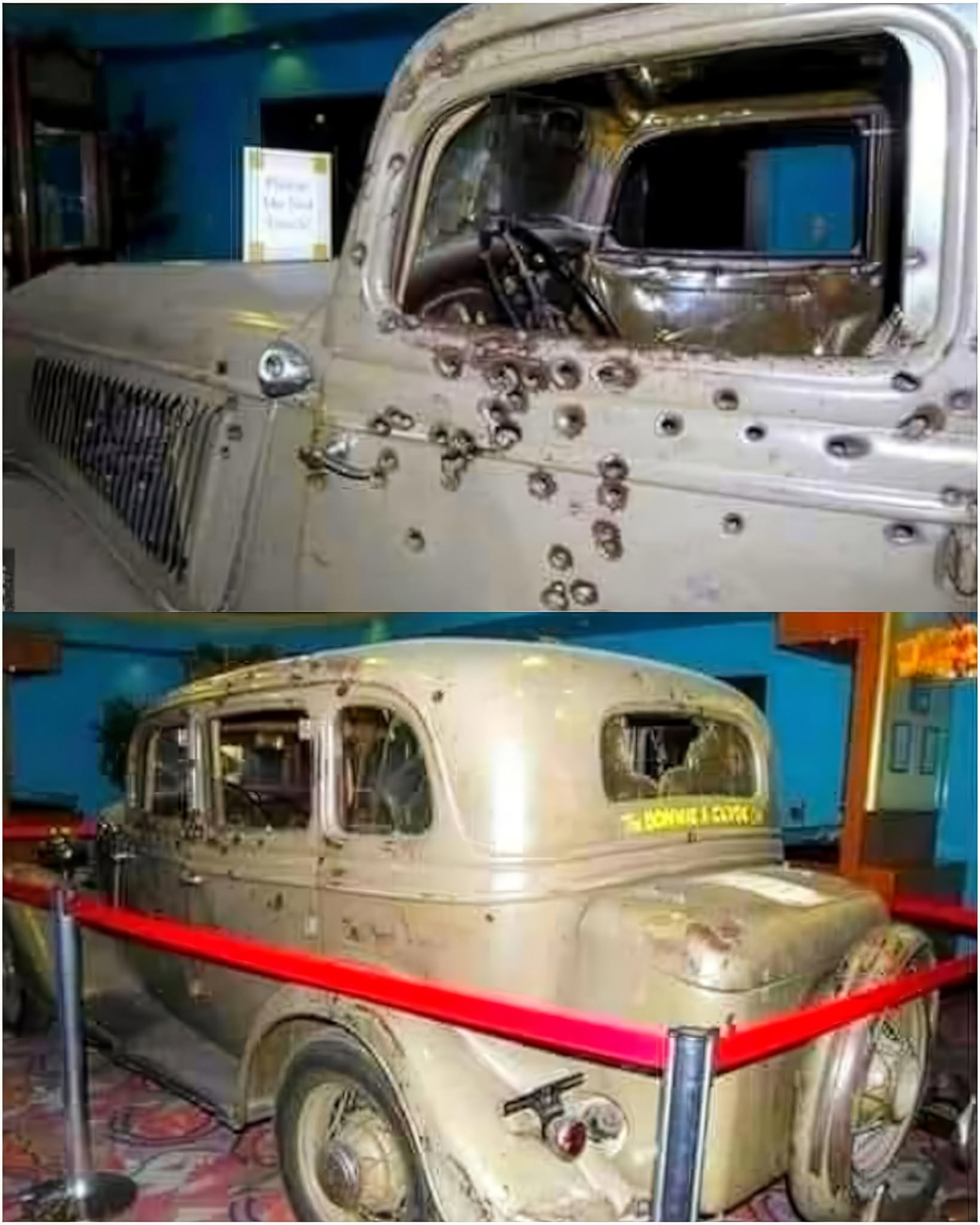
In May 1934, Bonnie Parker and Clyde Barrow were trapped on a Louisiana road and killed in a storm of gunfire. Nearly 120 bullets tore through the Ford V8 they were driving. The two fugitives died almost instantly, but their car survived—and began a second life of its own. Today, nearly a century later, the bullet-riddled Ford remains one of America’s most unsettling automotive relics, preserved as a physical reminder of a crime spree that helped create one of the country’s most enduring legends.
The Car at the Center of America’s Most Famous Outlaw Story
Bonnie and Clyde were not killed in an armored vehicle, a specially built getaway car or some exotic machine designed for a criminal gang.
They died in a stolen Ford.
But it was exactly the kind of Ford Clyde Barrow wanted.

The car was a 1934 Ford Model 40 B Fordor Deluxe, a four-door sedan powered by Ford’s revolutionary 3.6-liter Flathead V8. It used a three-speed sliding-mesh manual transmission and represented something important for its time: V8 power available in a mass-produced American car.
That mattered enormously to Clyde.
During the early 1930s, the Barrow Gang moved quickly across state lines, robbing banks, stores and other targets while trying to stay ahead of law enforcement. Clyde believed the Ford V8 gave them a major advantage because it could outrun many police vehicles of the era.
According to the account of the car’s history, Clyde was so impressed with Ford’s V8 that he even wrote Henry Ford a letter praising the car.
For an outlaw constantly trying to escape, the Ford was not simply transportation.
It was part of the strategy.

Why the Ford V8 Was So Important
This 1934 Ford was supposed to be Bonnie and Clyde’s escape machine. Instead, it became the place where one of America’s most notorious crime stories ended. Take a closer look at the bullet-riddled getaway car—and see why this battered Ford remains one of the most famous automobiles in American history.
The 1932 Ford V8 had already changed the American auto industry by bringing a V8 engine to the mass market at a price far below that of many luxury manufacturers.
By 1934, Ford’s Flathead V8 remained a powerful selling point.
Its appeal was simple: ordinary buyers could get a car with the kind of engine architecture once associated with more expensive automobiles.
For Bonnie and Clyde, the advantage was more immediate.
Speed could mean distance.
Distance could mean crossing a county line.
And crossing a county or state line could make pursuit more complicated in an era before modern communications, GPS tracking and centralized police databases.
The Barrow Gang became notorious partly because of violence and partly because of mobility. They did not remain in one place long enough to become easy targets.
The Ford V8 helped make that possible.
But in May 1934, the same kind of mobility that had kept them alive for so long finally ran out.

Nearly 120 Bullets
On May 23, 1934, lawmen finally caught up with Bonnie and Clyde near Gibsland, Louisiana.
What happened next was not a chase.
It was an ambush.
The officers opened fire on the 1934 Ford, killing Bonnie and Clyde inside the car almost immediately. Historic Vehicles estimates that nearly 120 bullets struck the vehicle.
The result transformed an ordinary Ford sedan into something instantly recognizable.
Its body panels were torn and perforated.
Its windows were shattered.
The interior became permanently associated with the deaths of the two fugitives.
For Bonnie and Clyde, the Ford had been an escape machine.
After the ambush, it became evidence.
Then it became an attraction.

The Car Outlived Its Owners
That may be the strangest part of Ford’s story.
Bonnie and Clyde were dead.
Their crime spree was over.
But the car continued moving through American culture.
Public fascination with the bullet-riddled Ford turned it into a popular attraction. Over time, the “death car” became part of a much larger industry built around the memory of Bonnie and Clyde. Their weapons, clothing and other possessions became highly sought-after memorabilia.
The car itself was especially powerful because it was not merely associated with the story.
It had been physically present at its end.
The holes were real.
The damage was real.
And the vehicle had survived the two people who had made it famous.

Where Is Bonnie and Clyde’s Death Car Today?
The authentic 1934 Ford remains on display at the Primm Valley Resort & Casino in Primm, Nevada.
The vehicle is accompanied by documentation intended to establish its authenticity, along with other artifacts connected to the ambush, including clothing associated with Clyde Barrow.
Its survival has also created a predictable problem.
There are other cars around the United States presented as Bonnie and Clyde vehicles. Some are replicas or deliberately fabricated look-alikes. At least one is connected to the 1967 film Bonnie and Clyde, starring Warren Beatty and Faye Dunaway.
But the real car remains valuable for one reason that replicas can never reproduce.
It was there.
Nearly a century later, visitors can still stand in front of the same Ford V8 that carried Bonnie and Clyde through the final moments of their lives.

The Outlaws Became a Legend. The Reality Was Much Darker
The image of Bonnie and Clyde has changed repeatedly over the decades.
Movies, songs and popular culture turned them into romantic figures: two young lovers running from the law during the Great Depression.
That image has always obscured something important.
They were not harmless rebels.
The Barrow Gang carried out robberies across multiple states and killed members of law enforcement and civilians during its crime spree. Their ability to move quickly—and their willingness to use violence—made them particularly dangerous.
Their story unfolded against the devastation of the Great Depression, when distrust of banks, government institutions and authority was widespread. In that environment, Bonnie and Clyde acquired something resembling an outlaw celebrity status, with some people viewing them through a distorted Robin Hood lens.
But there was no Robin Hood ending.
There was only a road in Louisiana, six waiting lawmen and nearly 120 bullets.

More Than a Car
Bonnie and Clyde became symbols.
Their story became films.
Their faces became icons.
But the Ford remains something different.
It cannot romanticize what happened.
It is still covered in the physical damage left by the gunfire that ended their lives.
That may be why the car continues to fascinate people.
A movie can turn Bonnie and Clyde into glamorous fugitives. A photograph can make them look fearless. A legend can slowly transform criminals into folk heroes.
But the car tells a simpler story.
Two people who had spent years outrunning the law eventually stopped.
And the Ford V8 they trusted to keep them moving survived to prove it.

Bonnie and Clyde spent years believing that speed could keep them alive. Their Ford V8 carried them across state lines, through police pursuits and into one of the most infamous crime sprees in American history. But on a quiet road in Louisiana, the car finally stopped—and their story ended in a storm of gunfire. Nearly a century later, the bullet-riddled Ford remains behind, not as a symbol of freedom, but as a physical reminder that even the fastest escape eventually runs out of road.