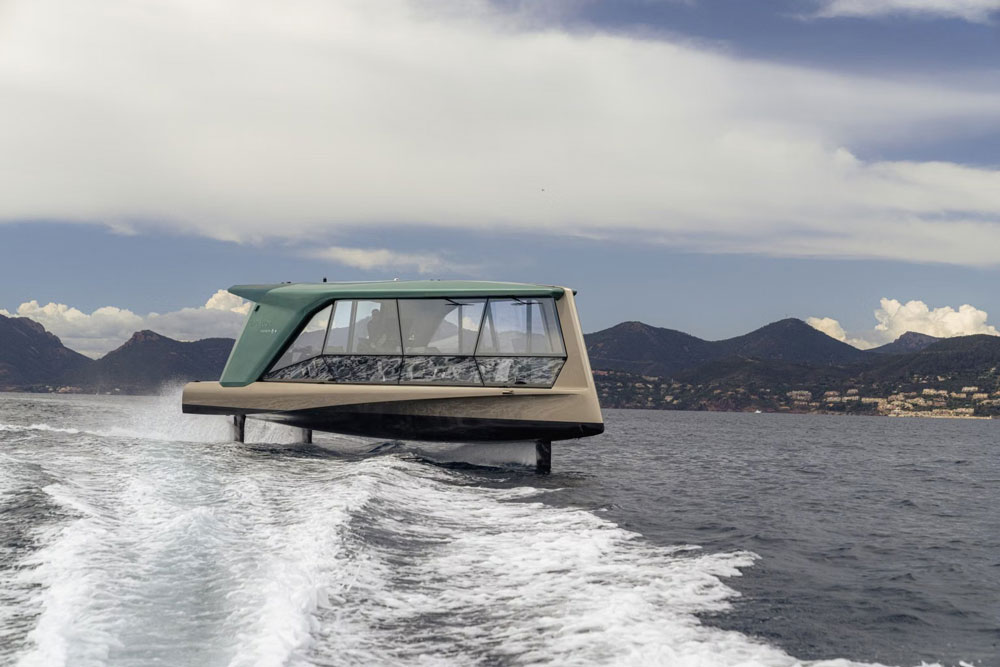
BMW built a boat that can lift its own hull out of the water—and that strange trick may be the real reason it can travel so fast on electric power. THE ICON reaches up to 30 knots, or about 55 km/h, while using far less energy than a conventional hull, thanks to underwater hydrofoils that carry the boat above the surface. But how do you make a 13-meter luxury boat “fly” while carrying batteries instead of a huge engine?
The Trick Is Hidden Under the Water
THE ICON does not behave like a conventional boat. Instead of relying entirely on a hull dragging through the water, it uses hydrofoils—underwater wing-like structures that generate lift as the craft moves forward. Once the system is operating, the hull rises above the surface while the foils remain underwater.
That small change has a major consequence: there is much less hull in direct contact with the water. BMW says the hydrofoil system can reduce energy requirements by up to 80% compared with a conventional hull, while also reducing the vibrations, shocks and wake normally associated with faster boats.
This is the key engineering idea behind THE ICON. Rather than simply installing a larger battery and accepting a heavier vessel, the designers tried to make the boat itself more efficient first, allowing the electric drivetrain to do more with the energy it carries.
It looks like a luxury yacht—but once it reaches speed, the hull actually rises above the water. Watch the video to see BMW and TYDE’s THE ICON in action and get a closer look at the futuristic hydrofoil system that makes this “flying yacht” possible.
Six BMW i3 Batteries Power the Boat
The propulsion system uses two electric motors rated at 100 kW each, drawing energy from six batteries supplied by BMW i. Together, the batteries provide 240 kWh of energy. BMW says the boat has a range of more than 50 nautical miles, or roughly 100 kilometers.
THE ICON has an operating speed of around 24 knots, while its maximum speed reaches 30 knots, or about 55 km/h. For a battery-electric watercraft of this size, that combination of speed and range is exactly the problem the project was designed to address.
The hydrofoils also change what passengers experience. Because the hull is lifted above much of the wave action, BMW says the ride is smoother, with almost no vibrations or shocks, while the electric drivetrain operates with very little noise.

BMW Did Not Just Build a Faster Electric Boat
THE ICON is also a design exercise in what luxury on the water might look like when the machinery underneath becomes quieter and cleaner. Designworks gave the craft a very flat hull and a central structural element supporting a transparent, prism-like upper section, with large glass surfaces replacing conventional side sections.
That shape is not simply cosmetic. Because the hydrofoil system allows the hull to glide above the surface with less movement, the designers could open up the sides of the vessel and give passengers broad views of the water around them. The rear section is about 4.5 meters wide, creating a large entrance into the lounge.
Inside, the emphasis is deliberately closer to a luxury lounge than a traditional boat cabin. Rotating seats are arranged for conversation, a tablet-based infotainment system is built into the passenger experience, and the command station replaces a conventional collection of nautical instruments with a BMW-style digital interface.

It Even Has a BMW-Style Cockpit
The central helm combines a conventional ship’s wheel with a distinctly automotive-style digital system. At its center is a 32-inch 6K touchscreen running BMW Operating System 8, with functions such as range information and weather reports accessible through voice commands.
The thinking is familiar to anyone who has watched automotive technology move from physical gauges to digital displays. BMW essentially brought its philosophy of human-machine interaction from the road onto the water, rather than designing the control system as a traditional collection of marine instruments.
Even the sound was treated as part of the engineering experience. BMW worked with composer Hans Zimmer on the vessel’s sound concept, while a Dolby Atmos system provides the onboard audio environment. The aim was to make the quieter electric drivetrain feel intentional rather than simply silent.
This Is More Than a Boat With BMW Badges
BMW developed THE ICON with boat maker TYDE and had its Designworks studios handle the design. The project was unveiled at Cannes in May 2023 and, importantly, BMW described the vessel shown there as production-ready rather than merely a design study.
The broader ambition is to apply the same thinking to marine transportation: use lightweight design, hydrofoil technology and electric propulsion together rather than treating electrification as nothing more than swapping an engine for batteries. BMW says the platform is intended to be adaptable to different customer and commercial applications.
That is what makes THE ICON interesting even to someone who has no intention of owning a luxury boat. The project is essentially an experiment in how far engineering can compensate for the limitations of batteries. Instead of asking how many batteries can be put into a boat, BMW and TYDE asked a more useful question: how much energy can the boat be designed not to need?

THE ICON is interesting because the breakthrough is not simply that BMW put electric motors on a boat. The real idea is the combination of hydrofoils, lightweight design and BMW i battery technology: lift the hull, reduce resistance and let a relatively compact electric power system deliver useful speed and range. With two 100 kW motors, 240 kWh of battery capacity, a top speed of 30 knots and a claimed range of more than 50 nautical miles, THE ICON shows how marine design can borrow from yacht racing and automotive technology to rethink what an electric boat can be.