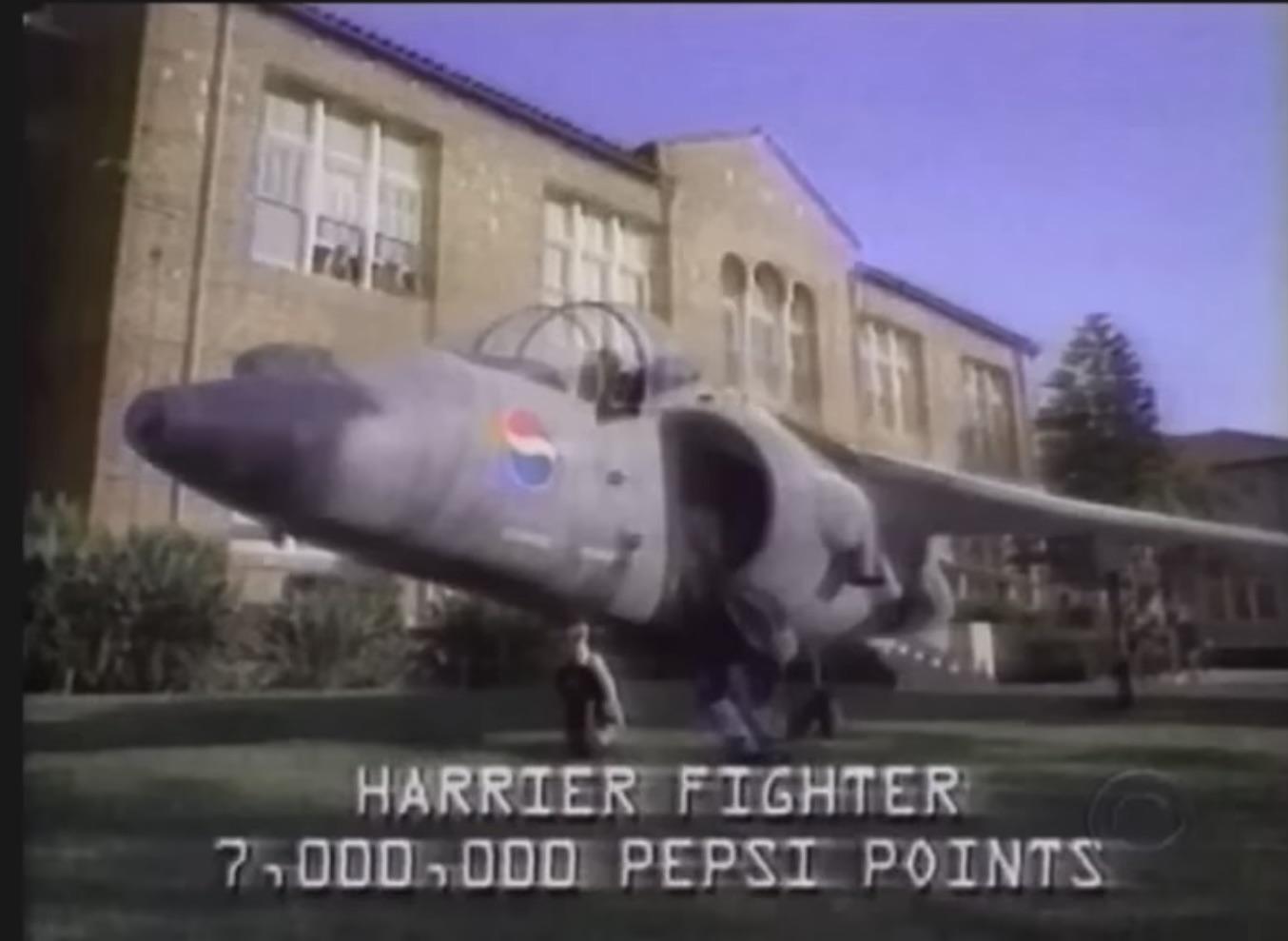
In 1995, Pepsi aired a commercial showing a teenager arriving at school in a Harrier fighter jet, supposedly available for 7 million Pepsi Points. Most Americans saw an absurd joke. John Leonard saw a calculation. He discovered that the points could theoretically be purchased for about $700,000, raised the money and sent Pepsi a check for the aircraft. Pepsi refused, and what began as a soda promotion soon became one of the strangest advertising disputes in American legal history.
The Commercial That Made A Fighter Jet Look Like A Pepsi Prize
The Pepsi Stuff campaign was built around a familiar idea: drink Pepsi, collect points and trade those points for merchandise. Customers could accumulate points from qualifying products and use them to obtain items such as T-shirts, sunglasses, jackets and other Pepsi-branded products. The campaign was deliberately designed to make collecting points feel entertaining, turning an ordinary soda purchase into a small reward system.
The television commercial pushed that idea to an entirely different level. A teenager appeared wearing Pepsi merchandise, with each new item presented as a more desirable reward. The final scene showed him arriving at school in a Harrier jet. The aircraft was presented as the ultimate Pepsi Stuff reward, and the screen displayed a seemingly precise price: 7,000,000 Pepsi Points. The commercial ended with the teenager stepping out of the jet as though arriving at school in a military aircraft were simply the next logical upgrade from wearing a Pepsi T-shirt.
The joke was intentionally ridiculous. A Harrier was not an ordinary consumer product, and the image of a teenager using one as his school transportation was clearly exaggerated. But there was an unexpected weakness in the joke: Pepsi had attached an exact number to the aircraft.

That number caught the attention of John D.R. Leonard.
He Didn’t Laugh At The Jet — He Started Doing The Math
Leonard was a 21-year-old business student living in Seattle when he saw the commercial. Rather than assuming the fighter jet was automatically excluded from the promotion, he began looking at how the Pepsi Points system actually worked.
The important detail was that Pepsi allowed customers to purchase additional points for 10 cents each. That meant 7 million points could theoretically be obtained for $700,000. The number was enormous, but Leonard apparently considered it achievable if he could find people willing to finance the purchase.
This changed the situation completely.
Leonard was no longer trying to collect seven million points by drinking Pepsi. He was treating the promotion as a financial transaction. If the rules allowed him to purchase points, and the commercial said the jet required seven million points, then the calculation appeared remarkably straightforward.
Seven million points.
Ten cents per point.
Seven hundred thousand dollars.
Leonard approached potential investors and eventually managed to assemble approximately $700,000 for his plan. He then prepared the documentation necessary to submit his claim.
On March 27, 1996, Leonard sent Pepsi 15 genuine Pepsi Points along with a check for $700,008.50. The order requested one Harrier fighter jet.
At that moment, the joke from a television commercial had become a real demand sitting on Pepsi’s desk.
Watch the bizarre story behind Pepsi’s famous fighter jet commercial — and discover what happened when one customer decided to take the offer seriously.
Pepsi Sent The Money Back — But Leonard Wasn’t Finished
Pepsi rejected the request.
The company’s position was that the Harrier was never actually part of the Pepsi Stuff rewards available to consumers. The official catalog and order form listed the merchandise that could be redeemed, and the fighter jet was not among those items. Pepsi therefore returned Leonard’s check and refused to fulfill the order.
From Pepsi’s perspective, the matter should have ended there.
From Leonard’s perspective, it had not.
He believed the advertisement itself had created an offer. The commercial had shown the Harrier, assigned it a specific price in Pepsi Points and invited viewers to participate in the Pepsi Stuff promotion. Leonard argued that he had done exactly what the advertisement appeared to require: he obtained the necessary points and submitted them with payment.
The disagreement now involved something much bigger than a soda promotion.
It raised a question that businesses and lawyers still care about today: When does an advertisement become a legally enforceable promise?
That question eventually brought Pepsi and Leonard into federal court.

The Court Had To Decide Whether The Commercial Was Actually An Offer
The resulting case, Leonard v. Pepsico, Inc., became one of the most famous examples used to explain the difference between advertising and a genuine contractual offer.
The court did not simply ask whether Leonard had taken the advertisement literally. It considered how a reasonable person would have understood the commercial in its full context.
Several details worked against Leonard’s argument.
The Harrier was not included in the Pepsi Stuff catalog. The actual rewards listed in the promotion were ordinary consumer merchandise, not military aircraft. The commercial also presented the jet in an obviously exaggerated situation: a teenager casually used an extremely sophisticated military aircraft to get to school.
The court concluded that the advertisement was intended as humor rather than a serious promise to provide a fighter jet. It therefore did not constitute an enforceable offer for the aircraft.
Leonard’s argument was ultimately rejected, and the decision in Pepsi’s favor was later upheld by the U.S. Court of Appeals for the Second Circuit.
The fighter jet was not going to Seattle.
But the court’s reasoning made the story even more interesting.
Watch the official trailer for Pepsi, Where’s My Jet? and discover how a ridiculous Pepsi commercial turned into a real-life fight over a fighter jet.
Why The Court Thought Nobody Could Seriously Expect A Harrier
The court considered the reality behind the joke.
A Harrier was not a luxury sports car or an expensive consumer product. It was a military aircraft designed for military purposes. The court noted that the aircraft discussed in the case had a value of roughly $23 million, making the supposed $700,000 Pepsi redemption price wildly unrealistic.
The mathematics of collecting the points through Pepsi products also illustrated how absurd the scenario would be.
Seven million Pepsi Points was an enormous number. The court calculated that collecting them through purchases would require an extraordinary amount of Pepsi consumption over an extremely long period. The fact that the advertisement showed a teenager using a military jet to go to school only added to the obvious exaggeration.
In other words, the court wasn’t saying that consumers are never allowed to take advertising claims seriously.
It was saying that context matters.
A reasonable consumer seeing a teenager land a military aircraft at school would understand that the scene was part of an exaggerated joke. The precise number of Pepsi Points did not transform that joke into a genuine offer for a $23 million aircraft.
Leonard had found a way to make the numbers work.
But the law was concerned with what the advertisement reasonably communicated, not simply whether a determined person could construct a mathematical argument from it.
Pepsi Learned That A Joke Can Become A Very Real Problem
The story might have ended with the court decision, but Pepsi made another change that became part of the legend.
The company later altered the commercial so that the Harrier was listed at 700 million Pepsi Points rather than 7 million.
The difference was enormous.
At 10 cents per point, 700 million points would represent $70 million if purchased directly. That made the calculation that had allowed Leonard to assemble a $700,000 offer completely impractical.
The joke remained.
The loophole disappeared.
The change also became a perfect illustration of what had gone wrong with the original advertisement. Pepsi had never intended to sell fighter jets through its loyalty program, but it had given the joke an unusually specific numerical value.
Once someone decided to treat that number literally, the absurdity became surprisingly difficult to dismiss without explaining exactly why the aircraft wasn’t available.
The revised commercial made the fantasy much harder to interpret as a realistic transaction.

The Pepsi Jet Was Never Really For Sale
The most fascinating part of the story is that Leonard’s attempt was not simply the result of someone failing to understand humor.
He approached the advertisement almost like a business problem.
He examined the rules.
He identified the price of additional points.
He calculated the total.
He found financing.
He submitted the required points.
And he sent Pepsi a check worth more than $700,000.
That level of commitment is what transformed an ordinary advertising joke into a remarkable legal story.
Had Leonard simply called Pepsi and asked whether the jet was real, the story probably would have ended there. Instead, he tested the boundaries of the promotion in a way that forced the company to defend its interpretation in court.
The result became a lasting lesson in how advertising works.
A company can use exaggeration, fantasy and humor to attract attention, but an advertisement does not automatically become a contract simply because a customer takes its words literally. Courts can look at the entire context and ask what a reasonable person would understand the advertisement to mean.
In Leonard’s case, the answer was clear.
The Harrier was a joke.
The seven million points were not enough to turn it into a real offer.
The Man Who Didn’t Get The Fighter Jet Still Made Advertising History
John Leonard never received the Harrier.
Pepsi kept its money.
The court ruled that the commercial did not create an enforceable promise to provide the aircraft.
But Leonard accomplished something that may ultimately have been more memorable than owning the jet.
He turned a few seconds of television advertising into one of the most famous stories in American marketing and contract law.
The episode is still fascinating because it exposes the strange boundary between advertising fantasy and literal promises. Pepsi wanted consumers to imagine how far its rewards could go. Leonard asked what would happen if someone actually followed the numbers to their logical conclusion.
The answer was a court case.
And perhaps that is the perfect ending to the story: Pepsi wanted people to dream about owning a fighter jet. John Leonard was the one person who looked at the screen and decided to check whether the dream came with a price tag.
The Pepsi fighter jet story began as a joke, but one customer’s determination turned it into a landmark advertising dispute. John Leonard never received the Harrier, yet his attempt forced Pepsi to defend the meaning of its own commercial in court. The case ultimately showed why advertisements, especially those filled with exaggeration, cannot always be taken literally. More than three decades later, the story remains memorable because Leonard did something almost nobody else thought to do: he looked at an impossible promise, did the math and decided to try.