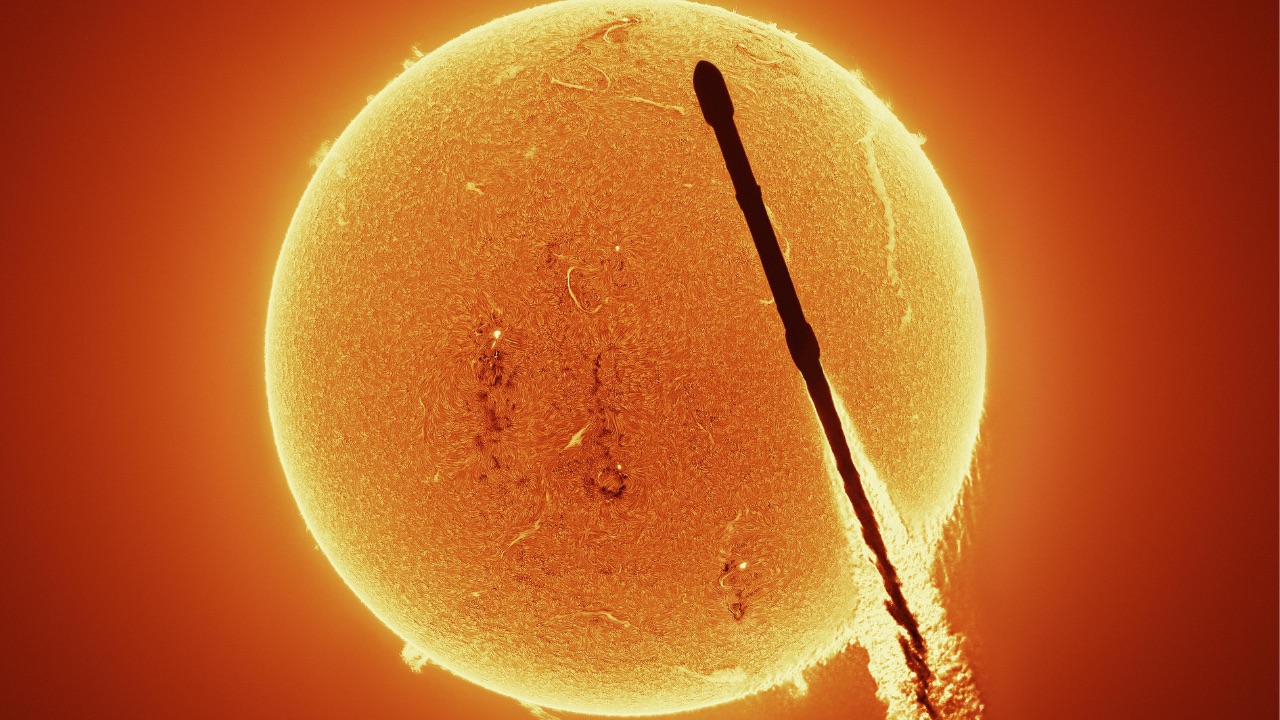
At first glance, the photograph looks almost impossible: a SpaceX Falcon 9 appears as a tiny dark silhouette cutting directly across the enormous disk of the Sun, with strange arcs and ripples surrounding it. But the rocket was never anywhere near the Sun. The extraordinary image was created by a precise alignment of the rocket, the distant Sun and a carefully positioned photographer. Even more remarkably, the rocket’s supersonic flight produced shockwaves that became visible in the photograph.
It Looks Like The Rocket Is Flying Through The Sun
The first thing that makes the photograph so remarkable is how completely it fools the eye.
The Falcon 9 appears to be passing directly across the Sun as though the rocket were somehow flying through the middle of the star. In reality, the rocket was climbing from Cape Canaveral toward low Earth orbit while the Sun remained roughly 150 million kilometers away.
The image is an example of a solar transit: an object relatively close to Earth passes across the apparent disk of the much more distant Sun from a particular viewing position.
The same basic phenomenon can occur when an airplane, bird or even the International Space Station crosses the Sun from the perspective of a photographer.
But capturing a rocket doing it is considerably more difficult.
The rocket is moving extremely quickly, the launch lasts only a short time and the photographer has to be in a very specific location.
The camera didn’t bring the rocket closer to the Sun.
It simply placed two enormously distant objects along almost exactly the same line of sight.
Take a closer look at the mysterious interstellar visitor 3I/ATLAS and the surprising questions scientists are asking about what is actually happening as it travels through our Solar System.
The Rocket Was Nowhere Near The Sun
This is where the photograph becomes even more fascinating.
The Sun is about 150 million kilometers from Earth, while Falcon 9 was only climbing into low Earth orbit.
That enormous difference in distance disappears in a two-dimensional photograph.
Imagine holding your thumb directly in front of a distant building. Your thumb can appear to cover the entire building even though it is only a few centimeters from your face.
The same principle is happening here, just on an extraordinary scale.
From the photographer’s position, the rocket lined up with the Sun.
Move the camera only a relatively small distance, or change the timing of the photograph, and the alignment disappears.
The apparent “crossing” was therefore a matter of geometry and perspective rather than anything happening between the rocket and the Sun.
The camera created the illusion.
The rocket simply happened to pass through the right part of the sky at the right moment.

The Hardest Part Was Getting The Timing Right
Taking a photograph like this isn’t simply a matter of pointing a camera at a rocket launch.
The photographer needs to know where the Sun will appear, where the rocket’s trajectory will take it and how those two paths will line up from a particular location.
That involves several variables:
- the launch trajectory;
- the photographer’s location;
- the Sun’s position;
- the exact timing of the launch;
- atmospheric conditions;
- camera equipment;
- and the incredibly short moment when the rocket crosses the solar disk.
Researchers have even used photographs of Falcon 9 solar transits to study the waves generated by the rocket’s exhaust. A 2025 scientific paper described photographs in which the rocket crossed the Sun and produced a sequence of images during the transit.
That means the photograph is more than a spectacular piece of space photography.
It can also contain information about the physics surrounding a rocket in flight.
And then something even stranger appeared in the image.
The Rocket Was Supersonic — And The Sun Revealed The Shockwaves
NASA’s Astronomy Picture of the Day featured a remarkable Falcon 9 photograph on June 15, 2026.
In the image, the rocket appears near the upper-left portion of the Sun, but several strange curved structures can also be seen around it.
Those aren’t artifacts added to the photograph.
They are shockwaves.
As the Falcon 9 accelerated through the atmosphere and became supersonic, its rapid movement produced bow-shaped regions of compressed air around the rocket. NASA explains that at least three of these shockwave structures were visible even outside the Sun’s disk because they refracted sunlight.
The exhaust plume created another visible effect behind the rocket.
Instead of seeing only a simple trail of exhaust, the photograph captured turbulence produced in the wake of the rapidly moving vehicle.
So the image contains several different phenomena at once:
A rocket.
The Sun.
A solar transit.
Supersonic shockwaves.
Atmospheric refraction.
And an exhaust plume.
All of them happened to appear in essentially the same frame.
It Looks Impossible — Until You Understand The Atmosphere
The strange shapes surrounding the rocket are particularly interesting because they reveal something we normally cannot see.
Air itself is invisible.
But differences in temperature, pressure and density can change the way light travels through the atmosphere.
NASA explains that relatively hot or rarefied air and cooler or compressed air can refract sunlight differently. That difference can make otherwise invisible atmospheric structures appear in the photograph.
In other words, the photograph isn’t simply showing the rocket.
It is also revealing the disturbance the rocket created in the air around it.
The Sun effectively became a gigantic backlight.
Without that bright background, those subtle changes in the atmosphere would be far harder to see.
The enormous solar disk therefore provided the perfect canvas for capturing the invisible physics surrounding a rapidly accelerating spacecraft.

A Picture Like This Is Almost Impossible To Get By Accident
There is an enormous amount of planning hidden behind a photograph that can look deceptively simple.
Astrophotographers who attempt solar-transit images may travel to specific locations based on predicted rocket trajectories and the Sun’s position. One photographer who captured a Falcon 9 crossing the Sun in 2025 described traveling to Florida specifically for a launch opportunity and using a hydrogen-alpha solar telescope to capture details of the Sun’s chromosphere.
Even after all that preparation, weather can ruin the attempt.
Clouds can block the Sun.
A launch can be delayed.
The rocket can follow a slightly different trajectory.
Or the camera can simply miss the critical moment.
That is why these photographs require a peculiar combination of mathematics, technology, planning and luck.
The photographer cannot control everything.
They can only arrange as many variables as possible and hope they all come together.
The Sun Made The Photograph Even More Incredible
There is another detail that makes the 2026 NASA image especially striking.
Sunspots are visible on the Sun itself.
That means the photograph is not simply a clean silhouette of a rocket against a featureless disk. The solar surface contains its own structure, while the rocket and its atmospheric effects create an entirely different layer of detail in front of it.
The scale difference is extraordinary.
A Falcon 9 is a human-built machine only a few tens of meters across, while the Sun is about 1.39 million kilometers in diameter.
Yet from a carefully selected position on Earth, the rocket can briefly appear to sit directly on top of that enormous star.
That contrast is what gives the photograph its almost surreal quality.
Human technology looks tiny against the Sun.
But for one brief moment, the two appear to occupy the same visual space.
What Looks Like Science Fiction Is Actually Geometry
The Falcon 9 never flew anywhere close to the Sun.
It was simply in the right place at the right time from the photographer’s perspective.
But the image reminds us how powerful perspective can be.
A rocket hundreds of thousands of kilometers from the Sun can appear to touch it. Invisible shockwaves can suddenly become visible. Atmospheric turbulence can reveal itself against a brilliant background. And an ordinary launch can become a once-in-a-lifetime photograph when the geometry happens to line up perfectly.
There was no special trick involved.
Just a rocket, a camera, the Sun and an incredibly precise moment.
And perhaps that is what makes the photograph so compelling: sometimes reality doesn’t need to be manipulated to look impossible. You only need to be standing in exactly the right place when it happens.
The Falcon 9 never came close to the Sun, yet for one extraordinary moment, perspective made it appear to cross the star itself. Behind the image was a remarkable combination of orbital timing, careful positioning, atmospheric physics and a little luck. The photograph is a reminder that some of the most unbelievable images in science are not computer-generated or staged. Sometimes, the universe simply lines up the right objects at exactly the right moment — and someone is there to capture it.