It looks like an ordinary 17th-century book — until you open it. Hidden inside are 11 tiny drawers labeled with the Latin names of poisonous plants, along with a haunting skeleton and a message about death. The mysterious object has become known as the “Assassin Cabinet,” but no one can say for certain who created it or what it was really used for. Was it a secret poison cabinet, a collector’s curiosity, or something far stranger?
It Looked Like An Ordinary Old Book
The strange object surfaced at a German auction in 2008, where its unusual construction attracted attention.
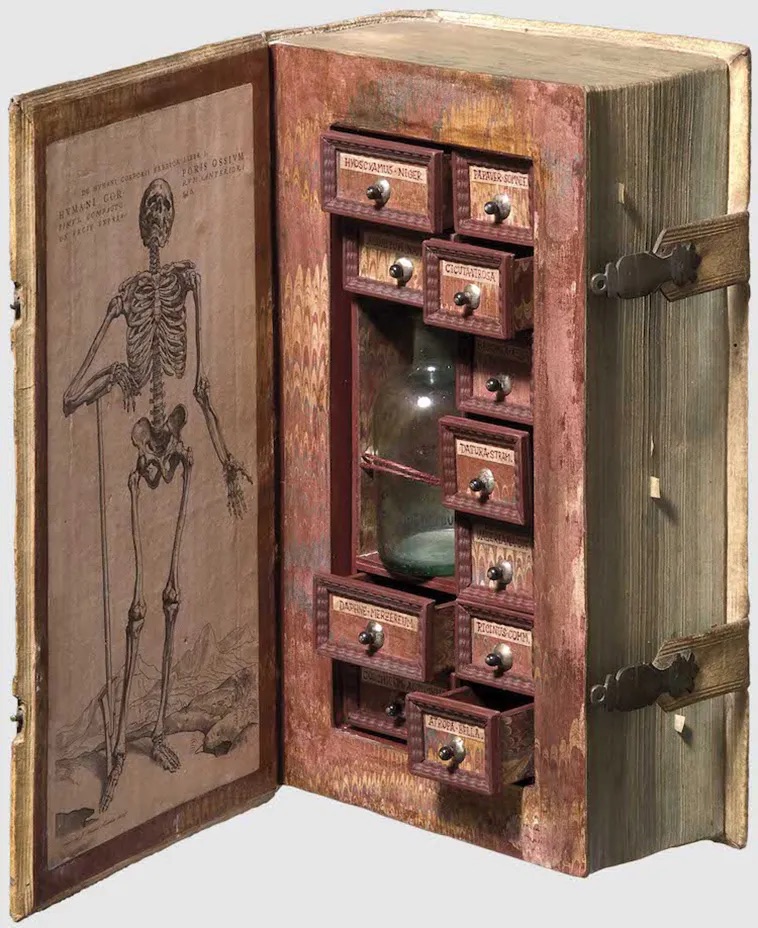
From the outside, it resembles a large, centuries-old book. But the interior has been carefully hollowed out and transformed into a compact storage cabinet.
Rather than pages, it contains 11 small drawers.
The design is remarkably deceptive. Someone looking at the closed object would have little reason to expect that it contains a hidden collection of compartments.
This type of secretive construction is part of what makes historical objects so fascinating. Long before modern safes, lockboxes and electronic security systems, craftsmen could disguise storage spaces inside objects that appeared to have an entirely different purpose.
In this case, the disguise was a book.
And what the drawers were apparently designed to hold makes the object even stranger.
Open It, And Eleven Hidden Drawers Appear
Each of the 11 drawers is labeled with the Latin name of a plant.
Among the names associated with the cabinet are plants such as henbane, monkshood, water hemlock and belladonna — species known for their poisonous properties.
That immediately creates an unsettling image.
A secret cabinet disguised as a book. Eleven drawers. Poisonous plants.
It is easy to see how the object acquired its sinister nickname.
But there is an important historical complication.
Not every poisonous plant was simply regarded as a weapon. Many plants that could be dangerous at certain doses also had medicinal uses or were studied for their properties.
In early modern Europe, the boundary between medicine and poison was not always as clear as it is today.
A person who understood plants could potentially possess knowledge that was useful for healing, experimentation, collecting — or something much darker.
That uncertainty is crucial when trying to understand the mysterious cabinet.

Was This Really An Assassin’s Cabinet?
The name “Assassin Cabinet” is certainly memorable.
But a memorable name is not the same thing as historical proof.
There is no definitive evidence establishing that the cabinet belonged to an assassin or was specifically created for someone who intended to poison people.
Its contents make that possibility sound plausible, but they do not prove it.
There are several other possibilities.
The cabinet could have been created for someone interested in medicinal plants. It might have belonged to an apothecary or collector. It could have been part of a collection of unusual objects designed to demonstrate knowledge and sophistication.
It is also possible that the cabinet was deliberately designed to create an air of mystery.
That is why the most accurate way to describe the object is not as a confirmed assassin’s tool, but as a mysterious historical cabinet whose original purpose is unknown.
The distinction may seem small, but it changes the entire story.
Instead of saying, “This belonged to a killer,” the evidence allows us to ask a much more interesting question:
What kind of person would have wanted a secret book filled with the names of poisonous plants?
What would it take to hide poison inside an old book? Watch this fascinating video as a mysterious “Assassin’s Cabinet” is recreated from scratch.
The Creepiest Detail Wasn’t In The Drawers
The drawers are certainly unsettling, but another detail makes the object even more intriguing.
Inside the book is an image of a skeleton accompanied by a Latin phrase:
“Statutum est hominibus semel mori.”
The phrase refers to the idea that human beings are destined to die once.
The imagery fits into a much broader European tradition known as memento mori — reminders of human mortality.
Skulls, skeletons, hourglasses and other symbols of death appeared frequently in European art and objects. Their purpose was not necessarily to celebrate death, but to remind people that life was temporary.
Seen in that context, the skeleton inside the cabinet does not necessarily prove that the object was created for murder.
It could instead reflect the cultural fascination with mortality that was common in early modern Europe.
Still, the combination is undeniably eerie.
A book that hides drawers containing the names of poisonous plants already sounds unusual. Add a skeleton and a reminder of death, and it becomes the kind of historical object that seems almost designed for a mystery story.

Medicine, Poison And The Strange World Of Early Modern Europe
To understand why someone might have collected poisonous plants, it helps to step back from the modern idea that a poison is simply a weapon.
Plant knowledge was extremely valuable in the past.
People studied plants for medicine, food, dyes, perfumes and other practical purposes. Some plants could have useful properties in one context and become dangerous in another.
Apothecaries and other specialists worked with substances that required knowledge and careful handling. Collectors also sought unusual plants and natural specimens as part of their broader interest in the natural world.
During the Renaissance and early modern periods, wealthy Europeans developed collections known as cabinets of curiosities, or Wunderkammer. These collections could contain unusual natural specimens, scientific instruments, artworks, archaeological objects and other items considered rare or fascinating.
A secret cabinet disguised as a book would fit surprisingly well into this culture of curiosity.
It could have been practical.
It could have been educational.
It could have been symbolic.
Or it could have been something created simply because its owner enjoyed possessing an unusual object.
Without more evidence, we cannot know.
The Mystery May Never Be Solved
The biggest question surrounding the cabinet is also the one that remains unanswered: who made it, and why?
Whoever constructed it went to considerable effort to transform a book into a hidden storage system.
Why 11 drawers?
Why these particular plants?
Why use their Latin names?
Why include the image of a skeleton?
And who was supposed to understand what the object contained?
Those questions are difficult to answer because the object has survived while much of its original context has disappeared.
The people who owned it are gone. The circumstances surrounding its creation are unclear. Whatever instructions or records may once have accompanied it may have been lost centuries ago.
That leaves modern observers with the physical evidence — a strange book, hidden compartments, plant names and an unmistakable reference to mortality.
It is tempting to fill the gaps with the most dramatic explanation.
But history rarely works that way.
Sometimes the most responsible answer is simply that we do not know.
And in this case, that uncertainty is exactly what makes the object so compelling.
The “Assassin Cabinet” may have been connected to poison, medicine, collecting or something else entirely. We may never discover the full story.
What we can see, however, is a remarkable example of how craftsmanship, botanical knowledge and fascination with mortality could come together in a single object.
It looks like a book.
It hides a cabinet.
The cabinet contains the names of poisonous plants.
And somewhere between those facts and the stories people later told about it lies a mystery that has survived for centuries.

The mysterious cabinet may never reveal exactly why it was created or who once owned it. Its hidden drawers, poisonous plant names and haunting imagery have inspired the “Assassin Cabinet” nickname, but the evidence leaves room for other explanations. Perhaps that uncertainty is what makes it so fascinating. After centuries, the object still sits somewhere between history and mystery — a strange reminder that sometimes the most intriguing stories are the ones we cannot completely solve.