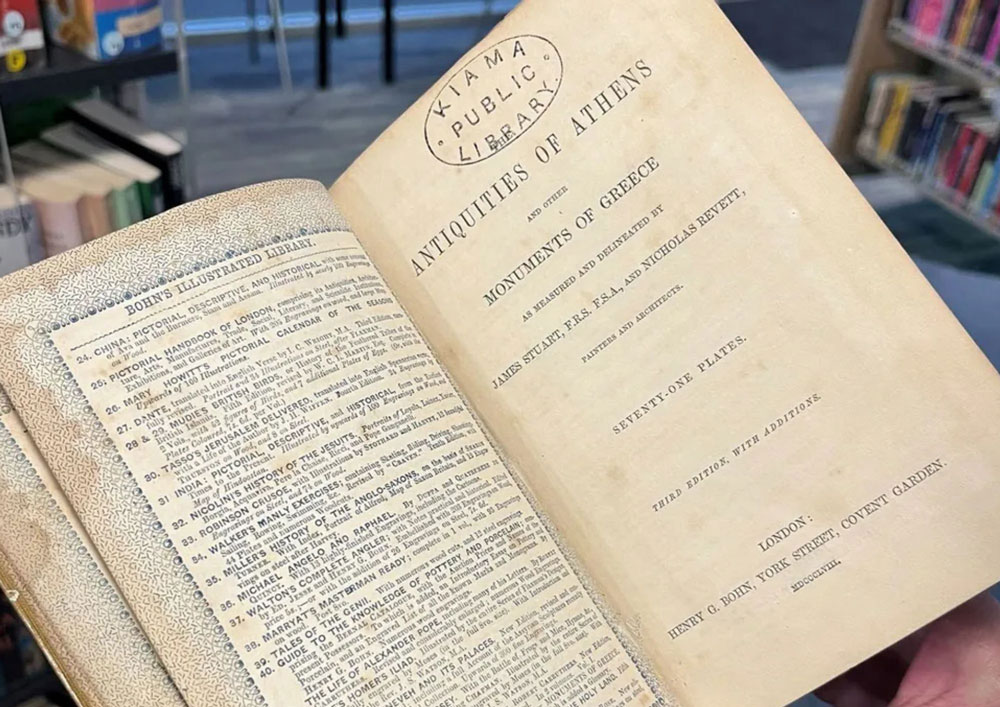
A library book has finally made its way back to Kiama Library in New South Wales, Australia, roughly 150 years after it was due. The book, The Antiquities of Athens, was discovered during a home renovation after a family found it hidden inside a tea chest sealed behind a bricked-up fireplace. The book still carried the library’s ownership stamp and borrowing rules from the 19th century, including a late fee that would theoretically amount to about A$28,000 today. Fortunately for the person returning it, the library no longer charges overdue fines.
The Book Disappeared From a Library More Than a Century Ago
The book was published in 1858 and became part of the original collection of Kiama Library, which was established in 1872. It was one of fewer than 1,000 books in the library’s early collection and was marked as item number 506. The volume contains historical information about ancient Athens, along with around 70 black-and-white illustrations and several fold-out diagrams.
At some point during the library’s early years, the book disappeared. Exactly when it was borrowed is impossible to determine because the library’s old lending records from the 1870s have been lost. That means nobody can say with certainty who checked it out or why it was never returned.
The book was borrowed when Kiama Library operated from the old School of Arts building, long before the library moved to its current location. For generations, the missing volume simply became part of the library’s forgotten history.
Then, more than a century later, it suddenly turned up somewhere nobody expected.

Someone Found It Hidden Inside a Fireplace
The discovery happened during renovations at a house in Kiama. Ross Simmons was working on the property when a family uncovered an old tea chest that had been sealed inside a fireplace.
Inside was the missing library book.
The chest had apparently remained hidden behind the fireplace for decades, protecting the book from ordinary view but exposing it to an environment that was not exactly ideal for preserving old paper. The volume had suffered some weather and water damage, but it remained in surprisingly good condition considering where it had spent so much of its life.
Simmons believed there might be a family connection to the book. His great-great-grandfather had lived in the house around the relevant period, so Simmons suspected that he may have been the person who borrowed it.
But that remains only a theory.
Without the original lending records, there is no way to establish who actually took the book from the library. The discovery therefore leaves behind a small historical mystery: why was a public library book placed inside a tea chest and hidden behind a fireplace in the first place?
Nobody knows for sure.
Perhaps it was deliberately stored away. Perhaps someone intended to return it and never did. Or perhaps it simply became forgotten as the house changed hands over the decades.
Whatever happened, the book remained there long enough for an entire family history to unfold around it.
Want to see the remarkable story behind this 150-year-old library book? Watch the video to discover how the missing book was found and the surprising journey that finally brought it back home.
The 150-Year-Old Fine Could Have Been Worth $20,000
The most entertaining part of the story is what the overdue fine might have looked like.
The borrowing rules printed inside the book state that the library charged three pence for every week a book remained overdue. At the time, the standard borrowing period was one month. If that rule were somehow applied across roughly 150 years and adjusted for inflation, library officials estimate the accumulated fine at about A$28,000, or roughly US$19,500.
That is an impressive bill for a single library book.
Fortunately, the person returning it did not have to worry about paying it.
Kiama Library no longer operates with the old overdue-fine system, and the original borrower cannot even be identified. The enormous figure is therefore best understood as a fascinating historical calculation rather than an actual debt being pursued by the library.
In a way, the missing borrower got extremely lucky.
After 150 years, the book finally came home, and the library was more interested in preserving the story than collecting a fine.
The Library Rules Were Very Different in the 1870s
The book itself provides an unexpected glimpse into how public libraries operated in 19th-century Australia.
Printed inside its pages are the old Kiama Library’s borrowing rules and regulations. They reveal a system that feels remarkably strict by modern standards.
Borrowers were generally limited to one volume at a time, although households could receive permission to borrow more if at least six members could demonstrate that they were able to read. People who arrived at the library while intoxicated were not permitted to borrow books, while disorderly behavior could result in a fine of at least five shillings.
The rules reflect a very different understanding of what a library was.
It was not simply a place where anyone could walk in, grab a book and leave.
Libraries were closely connected to education, social standards and the idea of improving the community through reading. The fact that literacy could affect how many books a household was allowed to borrow shows how strongly access to books was connected to educational expectations at the time.
Today, nobody needs to prove that six members of their household can read before checking out a book.
And thankfully, nobody has to worry about being turned away because they had too much to drink before visiting the library.
These rules make the returned volume much more valuable than an ordinary old book. It is also a physical record of how an Australian community viewed reading and public education more than a century ago.

The Book Won’t Be Borrowed Again
After finally returning to Kiama Library, The Antiquities of Athens will not be placed back into circulation.
Instead, it will become part of the library’s local history collection, where it can be preserved and displayed as an important piece of the institution’s past. Library staff noted that the book will be stored in archival-quality materials to help protect it for the future.
That decision makes perfect sense.
The book has already spent around 150 years away from the library. It has survived an unknown journey, disappeared into a house, been sealed inside a fireplace and eventually rediscovered during renovations.
At this point, it is no longer just a book about ancient Greek architecture and antiquities.
It has become an artifact of Kiama’s own history.
The library itself has moved locations several times since its early days at the School of Arts, but this particular volume has survived all of those changes. Its return connects the present-day library directly with the community that used it during the 1870s.
And librarians have no intention of taking another chance.
The book will not be loaned out again because, as the library manager explained, they do not want to wait another 150 years for it to come back.

After roughly 150 years, The Antiquities of Athens finally returned to the library that once owned it. Nobody knows exactly who borrowed the book or why it ended up sealed inside a tea chest behind a fireplace, but its strange disappearance has now become part of the book’s history. The potential A$28,000 overdue bill is amusing, but the real value of the discovery is much greater: the book has become a rare surviving link to Kiama’s early library and the community that used it in the 19th century.