When Jaguar unveiled the XJ220 concept at the 1988 Birmingham Motor Show, it looked like the ultimate expression of British performance. The sleek supercar was designed around a mid-mounted 6.0-liter V12, all-wheel drive and a target top speed of around 220 mph. The public response was overwhelming, and Jaguar quickly decided to turn the concept into a limited-production car. But there was a problem: the XJ220 that eventually reached customers was very different from the machine they had originally seen. The V12 was gone, the all-wheel-drive system had disappeared, and a 3.5-liter twin-turbo V6 had taken its place. What followed was one of the most controversial supercar stories of the 1990s.
The Original XJ220 Was a V12 Dream Machine
The XJ220 began as an unofficial project inside Jaguar. Engineer James Randle and a small group of colleagues wanted to create a road-going supercar that could showcase Jaguar’s engineering capabilities and racing heritage. The project was developed outside the company’s normal production programs, but the result was impressive enough to become a full-fledged concept.
The original XJ220 was built around a 6.0-liter V12 mounted behind the occupants and an all-wheel-drive system. Its name reflected the team’s ambitious target of reaching approximately 220 mph. The design was long, low and unmistakably exotic, yet it retained enough of Jaguar’s visual identity to make it feel like a very different kind of British supercar.
When the concept appeared at the 1988 British International Motor Show in Birmingham, the reaction was far beyond what Jaguar expected. The XJ220 immediately became one of the stars of the show, and the enormous interest convinced Jaguar that there was a market for a production version.
Customers were invited to place deposits to secure one of the limited cars. The response was extraordinary, with far more prospective buyers than Jaguar could accommodate.
At that moment, the XJ220 seemed destined to become one of the greatest supercars of its generation.

Jaguar Took Deposits—Then Changed Almost Everything
Turning the spectacular concept into a road-legal production car proved much more difficult than displaying it at a motor show. Jaguar eventually brought in Tom Walkinshaw Racing to help develop the vehicle, and the engineering team quickly discovered that the original configuration presented serious challenges.
The large V12 was heavy and difficult to package while meeting the necessary emissions requirements. The all-wheel-drive system also added considerable weight and complexity. As development progressed, Jaguar and TWR decided that the production car needed a different approach.
The V12 was replaced by a much smaller engine, and the all-wheel-drive system was abandoned. The production car would instead use rear-wheel drive and a 3.5-liter twin-turbocharged V6. The wheelbase was also shortened as the car evolved from the original concept into a production vehicle.
From an engineering perspective, the changes made sense. From a customer’s perspective, they were much harder to accept.
People had placed deposits after seeing a dramatic V12-powered, all-wheel-drive supercar. The car Jaguar eventually delivered was something else entirely. The controversy was intensified by the fact that production prices were far higher than many early customers had expected.
Some buyers refused to take delivery, while others took legal action against Jaguar. The XJ220 had effectively become a case study in what happens when the production version of a dream car changes too much from the original promise.
Take a closer look at the Jaguar XJ220 and the story behind one of the most controversial supercars of the 1990s. Watch the video to see this remarkable machine in action and discover why the XJ220 became such an unforgettable part of Jaguar history.
The Production XJ220 Lost Its V12—but Became a Monster Anyway
The irony is that the replacement engine was far more impressive than its smaller displacement might suggest. The production XJ220 used a 3.5-liter twin-turbocharged V6 derived from Jaguar’s racing programs. It featured four overhead camshafts, four valves per cylinder, twin Garrett T3 turbochargers and twin intercoolers.
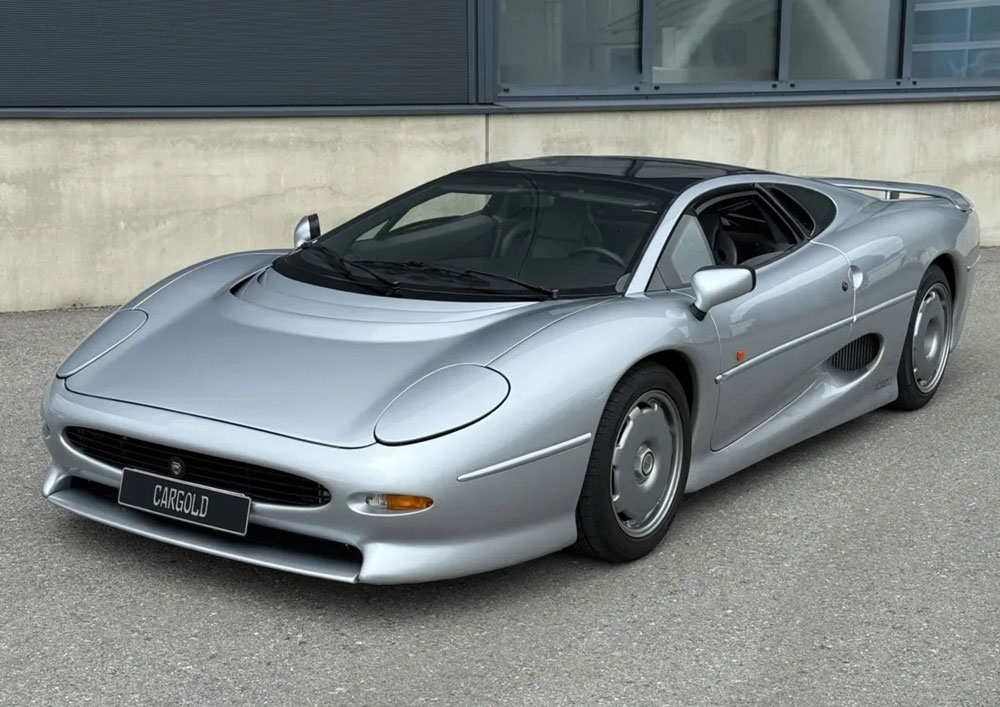
The engine produced around 542 horsepower and 475 lb-ft of torque, sending its power through a five-speed manual transmission to the rear wheels. The car also used an advanced aluminum honeycomb structure to help keep its weight under control.
The results were extraordinary. The XJ220 could accelerate from 0 to 60 mph in roughly 3.6 seconds and reach approximately 213 mph. At the time, that was enough to put it among the fastest production cars in the world.
So while customers had every reason to be disappointed about losing the V12, the production XJ220 was hardly a slow or compromised car. In fact, its smaller engine and rear-wheel-drive configuration helped create a remarkably quick machine.
That created the central contradiction of the XJ220 story. The car was technically extraordinary, but it was constantly judged against the even more spectacular concept that had come before it.

The XJ220 Became a Supercar Nobody Expected to Love
Production began in 1992, but the timing could hardly have been worse. The economic environment of the early 1990s was very different from the speculative supercar market that had helped fuel excitement around exotic cars at the end of the previous decade.
Jaguar eventually built just 275 examples between 1992 and 1994, making the XJ220 extremely rare. But rarity alone could not solve its image problem. The production car was expensive, controversial and fundamentally different from the vehicle that had attracted so many deposits in the first place.
The XJ220 also entered a fiercely competitive market. Ferrari had the F40, Porsche had the 959 and Lamborghini had the Diablo. Other manufacturers were producing exotic machines that captured the imagination of enthusiasts, while McLaren was preparing the F1, which would soon become one of the defining supercars of the decade.
Against that competition, the XJ220 struggled to establish the reputation its performance deserved. The controversy surrounding its changed specifications often became more memorable than the engineering achievement itself.
That is why the car was sometimes remembered as a disappointment rather than as the technological achievement it actually was.
Yet time has been much kinder to the XJ220.

The XJ220 Was Never as Forgotten as It Seemed
Once the initial controversy faded, enthusiasts began to appreciate what Jaguar and TWR had actually created. The XJ220 remained capable of more than 200 mph, had a racing-derived twin-turbo engine and was produced in extremely limited numbers.
Its design has also aged remarkably well. The long body, low roofline and enormous rear haunches give the XJ220 a distinctive character that separates it from many later supercars. It looks unmistakably like a product of the early 1990s, but it still has the visual presence expected from an exotic car.
The V6 that was once regarded as a disappointment has also become part of the XJ220’s identity. It was not simply a smaller replacement for the V12. It was a compact, highly developed racing-derived engine capable of producing more than 500 horsepower and pushing the car to extraordinary speeds.
The car’s rarity has only strengthened its appeal. With just 275 production examples, finding an original XJ220 today is a significant event for collectors. Hemmings has documented several high-value sales over the years, reflecting the growing appreciation for the model among enthusiasts.
The XJ220 therefore occupies an unusual position in automotive history. It is remembered both for what it was and for what it failed to become.
It was not the V12, all-wheel-drive dream car that Jaguar originally displayed.
But it was still one of the fastest and most technically interesting production cars of its era.
That contradiction is precisely what makes it so compelling.

The Jaguar XJ220 may not have become the V12, all-wheel-drive supercar that customers originally expected, but its complicated transformation ultimately became part of its legend. The production car was still remarkably fast, technically ambitious and exceptionally rare, proving that even a controversial compromise could produce something extraordinary. Decades later, the XJ220 is remembered not simply as the Jaguar that lost its V12, but as one of the most fascinating supercars of the 1990s.