During the Cold War, the CIA pursued some remarkably unconventional ways to gather intelligence, including an attempt to turn a cat into a covert listening device. Known as Acoustic Kitty, the project involved implanting a microphone and transmitter into a cat so it could secretly approach conversations. The technology reportedly worked, but the mission faced one problem no engineer could solve: the cat refused to follow the plan.
The CIA Really Did Try to Build a Spy Cat
The story of a CIA “spy cat” might sound like something invented for a comedy movie, but the basic story is real.
According to the CIA’s own account, the Agency began exploring the idea in 1964. The goal was to use a cat to monitor conversations in open environments, such as people sitting on park benches. The reasoning was simple: a cat could potentially move close to people without making them suspicious.
At the time, intelligence agencies were constantly searching for new ways to collect information without being detected. Conventional listening devices could be difficult to place close enough to a target, particularly when the target was in a public location.
A cat appeared to offer an unusual solution.
It could walk.
It could sit.
It could wander around seemingly without purpose.
And, unlike an obvious surveillance device, it would look completely ordinary.
The concept was unusual, but the CIA was serious enough about it to conduct actual experiments.
The project became known as Acoustic Kitty. And that was when the problem became much more complicated.

They Turned the Cat Into a Walking Listening Device
The technology behind Acoustic Kitty was surprisingly sophisticated for the 1960s.
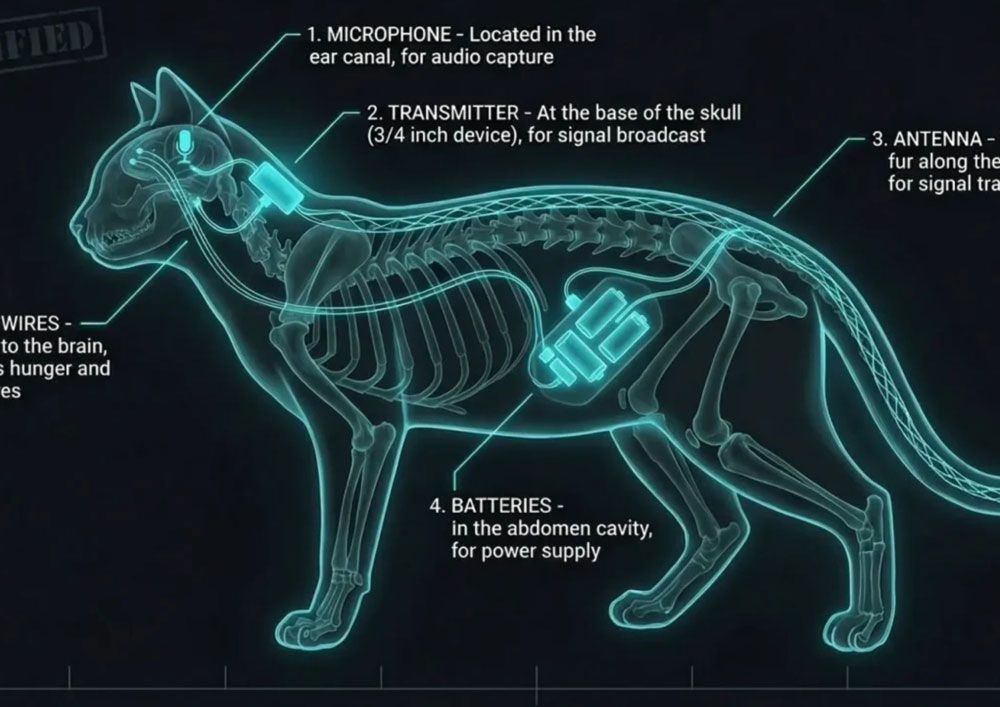
The CIA says a small microphone was implanted in one of the cat’s ears. A miniature transmitter was placed beneath the animal’s loose skin, while an antenna was incorporated into its long fur.
The objective was to create a self-contained listening system that could accompany the cat wherever it went.
The microphone would pick up nearby conversations.
The transmitter would send the audio elsewhere.
The cat would provide the mobility.
From an engineering perspective, this represented a difficult problem. Electronic components had to be made extremely small, while the entire system needed to remain concealed.
There was also the question of the animal itself.
A machine can be programmed to move toward a particular location.
A cat cannot.
That distinction would eventually become the project’s biggest weakness.
The CIA had managed to solve much of the technological problem.
But it had not solved the biological one.
Ever wondered how animals were used in real-life espionage? Watch the video to discover some of the CIA’s most unbelievable spy experiments. You won’t believe what they tried.
The Technology Worked. The Cat Had Other Plans
This is where the story becomes almost comical.
According to the CIA, the technology worked.
The problem was the cat.
During limited field testing, the animal did not reliably go where its handlers wanted it to go. It wandered according to its own behavior rather than following the mission plan.
That may sound obvious today, but it exposed a fundamental problem with the entire concept.
For a surveillance device to be useful, the operator needs some degree of control.
The CIA could control the electronics.
It could monitor the transmitter.
It could design the microphone.
But it could not tell the cat where to sit.
If the intended targets were sitting on one park bench and the cat decided to walk somewhere else, the equipment became essentially useless.
Even worse, the cat could not understand why it was supposed to remain in a particular location or why a particular group of people mattered.
The mission required precision.
The animal provided unpredictability.
As the CIA itself later summarized, the cat “had a mind of its own” and was impossible to control reliably.
It is a perfect example of the difference between something being technically possible and being operationally useful.

The Spy Cat Was Never Used Operationally
Despite the attention the story has received, Acoustic Kitty never became a functioning operational espionage tool.
The CIA says the program was eventually ended in 1967, without the cat ever being used operationally.
That distinction is important.
The project was not a case of the CIA successfully deploying an army of spy cats around Washington or foreign embassies.
Instead, it was an experimental program that attempted to determine whether an animal could serve as a covert platform for surveillance.
The answer was essentially no.
The hardware could function, but the animal could not reliably perform the mission.
This is a recurring problem when technology interacts with the unpredictable real world. Engineers can control machines according to carefully defined parameters. Living organisms introduce behavior that cannot always be predicted or commanded.
A cat might be physically capable of walking toward a particular location.
That does not mean it will choose to do so.
And in espionage, being in the wrong place at the wrong moment can make an entire operation worthless.
Acoustic Kitty therefore became an interesting example of a technological experiment that failed for a reason that had little to do with the technology itself.
The problem was the operator’s “platform.”
It had four legs, fur and an independent mind.

The Cat’s Alleged Death Became Part of the Myth
The story became even stranger after rumors about what happened to the cat began circulating.
One particularly famous version claims that the CIA sent the animal into the field, only for it to be struck and killed by a taxi or bus.
The story sounds like the perfect tragic ending to an already bizarre Cold War experiment.
But according to the CIA, it is not true.
The Agency says the source of the story was a former CIA official whose comments about the cat’s supposed death were intended as a joke. The joke was apparently taken seriously, and over time it became part of the mythology surrounding Acoustic Kitty.
The CIA also addresses another popular claim: that the animal was brutally transformed into a kind of “Frankenkitty.”
According to the Agency, the devices were implanted and removed through low-risk microsurgical procedures performed under humane conditions comparable to those used in veterinary medicine. The CIA says the cat was not harmed by the procedure.
That does not make the project any less unusual.
But it does show how easily a strange historical experiment can become even stranger through repeated retelling.
The real story is already bizarre enough.
It does not need an imaginary death scene to make it memorable.
Acoustic Kitty Shows How Far Cold War Espionage Could Go
The story of Acoustic Kitty is fascinating partly because it reflects the technological imagination of the Cold War.
The United States and the Soviet Union were competing not only in military strength but also in intelligence gathering, surveillance and technological innovation.
The CIA experimented with unconventional methods because intelligence collection often presented unusual challenges.
The idea behind Acoustic Kitty was based on a simple observation: people tend to ignore ordinary animals.
A cat walking through a public area might attract far less attention than a person carrying surveillance equipment.
The concept therefore made sense in theory.
But the project also demonstrates why intelligence technology cannot be judged purely by whether the hardware works.
A surveillance system needs to function in the real world.
It needs to be reliable.
It needs to be controllable.
And it needs to collect useful information at the right time and place.
Acoustic Kitty struggled with the last three.
The cat itself became the weakest component of an otherwise sophisticated system.
That is what makes the project so memorable.
The CIA had created a functioning listening device, but it had attached that device to something that refused to follow instructions.

The CIA’s Other Animal Experiments
Acoustic Kitty was not the only time intelligence researchers explored animals as potential tools.
The CIA’s own historical account describes other animal-related experiments, including Charlie and Charlene, unmanned underwater vehicles designed in the shape of catfish. Unlike Acoustic Kitty, these were robotic systems rather than living animals. Their purpose was to investigate underwater robotic technology and collect water samples without being detected.
The comparison is revealing.
A robotic fish could be designed with predictable movement, speed and depth control.
A real cat could not.
The difference illustrates why robotics eventually became much more practical than relying on trained animals for highly precise intelligence missions.
Technology could imitate some of the advantages of animals—small size, mobility and inconspicuous appearance—without having to deal with an animal’s independent behavior.
In that sense, Acoustic Kitty can be viewed as an unusual stepping stone in the broader search for covert technology.
The CIA’s Acoustic Kitty project sounds almost unbelievable, but the experiment was real. Engineers managed to create a tiny listening device that could be implanted in a cat, yet the project ultimately ran into a problem technology could not solve: the animal could not be reliably controlled. The program ended in 1967 without becoming an operational espionage tool. In the end, the CIA proved that it could build a spy cat—but not that it could make the cat cooperate.