Humans have drilled deeper into Earth than ever before—but the hole is only about 23 centimeters wide at its deepest point. On the Kola Peninsula, Soviet scientists spent more than two decades trying to penetrate the planet’s crust, eventually reaching 12,262 meters below the surface in 1989. They did not find the boundary between the crust and mantle they had hoped to reach. Instead, they encountered unexpectedly high temperatures, fractured rock filled with fluids and microscopic fossils preserved deep underground. The deeper they went, the more the real Earth contradicted their expectations. Eventually, heat and rock behavior stopped the project.
The Soviet Union Wanted To Drill Into The Earth
The Kola Superdeep Borehole was not an oil well. It was a scientific experiment designed to answer fundamental questions about the structure of Earth’s continental crust.
Drilling began in 1970 on the Kola Peninsula in northwestern Russia, close to the Norwegian border. Scientists wanted to obtain direct measurements and rock samples from depths that previously had been accessible only through indirect geophysical methods. Their broader ambition was to understand what the Earth’s crust actually looked like beneath the surface rather than relying entirely on seismic models. The original target was approximately 15 kilometers.
That may sound modest compared with the size of the planet, but drilling downward is nothing like digging a tunnel. Temperature, pressure, rock strength, borehole stability and the behavior of drilling equipment all change with depth. At Kola, every kilometer became a new engineering problem.
Curious about what’s hiding deep underground? Dive into the story of the Kola Superdeep Borehole, the deepest hole ever drilled on Earth! Learn how scientists pierced the crust, the surprising discoveries they made miles down, and why this engineering marvel remains a legend. Click to explore our planet’s hidden depths!
The Hole Reached 12,262 Meters Down
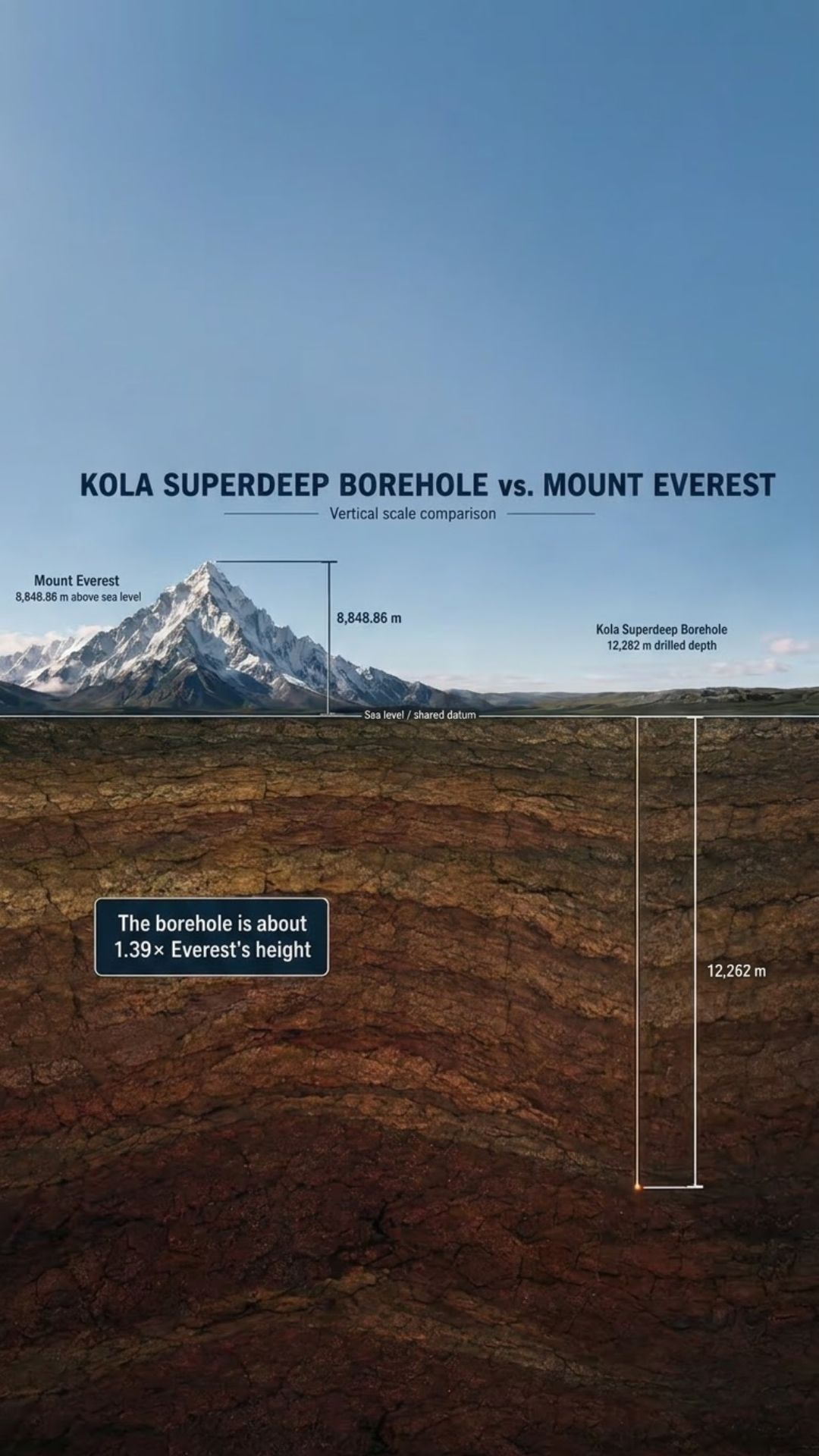
After years of work, the project broke previous drilling records. In 1989, the deepest vertical point of the Kola Superdeep Borehole reached 12,262 meters, or about 12.2 kilometers beneath the surface. It remained the deepest vertical borehole ever drilled. The number becomes even more striking when put into perspective.
The Mariana Trench reaches about 11,034 meters below sea level, meaning the Kola borehole extends farther vertically than the ocean’s deepest point. Mount Everest is about 8.8 kilometers high, so the Kola depth is also substantially greater than Everest’s height. Yet the physical opening is surprisingly small.
At the deepest section, the borehole was only around 23 centimeters in diameter. What looks like a monumental excavation from the outside was actually a narrow shaft created by a drill string extending more than 12 kilometers into the crust. And even that extraordinary depth represented only about one-third of the continental crust in the region. The planet was still hiding most of itself.
The Deeper They Went, The Hotter Earth Became
Heat became one of the project’s biggest enemies.
At shallower depths, engineers could work within temperature ranges they had anticipated. But as the drill went deeper, the temperature gradient became much steeper than expected. By around 12 kilometers, temperatures had reached roughly 180°C, far above the approximately 100°C that engineers had expected at that depth.
A 2026 scientific review gives an even higher figure for the deepest conditions, reporting bottom-hole temperatures of about 212°C and noting that the rock could undergo plastic deformation and repeatedly close around the borehole. This was not simply a matter of making a drill bit tougher.
Rock behaves differently under extreme heat, pressure and stress. At sufficient depth, material that appears rigid near the surface can begin to deform in ways that make maintaining an open borehole extremely difficult.
The Kola team had therefore reached an unexpected limit. They were not just drilling through harder rock. They were trying to drill through an environment in which the rock itself was beginning to work against the hole.

They Found Water And Ancient Life Far Below The Surface
The project became scientifically valuable even when it failed to reach its ultimate depth target.
One of the most surprising discoveries was liquid water at great depth. Scientists had expected the deep crystalline crust to be relatively sealed, but the borehole revealed fractures containing saline fluids, demonstrating that water could circulate through deep sections of continental crust.
The researchers also encountered something that challenged prevailing models of the crust.
Geologists had expected to encounter a clear transition between granite and basalt, sometimes associated with the so-called Conrad discontinuity. The drilling did not find the predicted boundary in the form researchers expected. Instead, the borehole revealed a much more complicated sequence of metamorphic and crystalline rocks. Then came one of the strangest discoveries.
At roughly 7 kilometers deep, researchers reported microscopic fossils of single-celled marine organisms preserved in rock dating back around 2 billion years. The fossils were tiny, but their presence showed that traces of ancient biological material could survive deep within Earth’s crust. The project had started as an attempt to understand the architecture of the planet. Instead, it found a deep underground environment containing water, chemical activity and evidence of ancient life.
The Earth Refused To Let Them Drill Any Deeper
The Soviet engineers continued after reaching the record depth, but the conditions became increasingly difficult.
The borehole had already required multiple drilling paths because sections of the drill string failed and deeper rock became increasingly challenging to penetrate. After the record depth was reached, additional attempts encountered the same fundamental problem: temperatures were simply too high and the rock was becoming too unstable for conventional drilling to continue.
The project was eventually discontinued in 1992. The collapse of the Soviet Union also brought severe financial difficulties, but the technical problem was fundamental: going substantially deeper required equipment and drilling methods capable of operating in conditions far beyond those encountered during the earlier phases of the project. The borehole was eventually sealed in 2005. The final depth therefore fell well short of the original 15-kilometer objective. Yet the project had already changed what scientists knew about the deep continental crust.
It demonstrated that temperature estimates could be badly wrong, that fluids could exist much deeper than expected and that seismic models did not always correspond neatly to the physical rocks found by drilling.

The Deepest Hole Still Barely Scratched The Planet
This may be the most astonishing part of the entire experiment.
The deepest vertical borehole ever created extends 12.262 kilometers downward. But Earth’s continental crust in the region is roughly 40 kilometers thick, meaning the drill penetrated only about a third of the crust. It never reached the mantle.
That means humans have built spacecraft capable of traveling billions of kilometers through space while reaching only a tiny fraction of the distance beneath our own feet. The contrast is extraordinary.
Space can be difficult because it is unimaginably far away. The deep Earth is difficult for the opposite reason: it is right beneath us, but its temperature, pressure and rock mechanics become increasingly hostile as we descend.
Modern ultradeep drilling research continues to use lessons from Kola. A 2026 scientific review describes deep boreholes as valuable observatories for heat flow, fluids, stress and rock behavior, while also emphasizing how difficult it remains to drill beyond 10 kilometers. Kola therefore was not simply a record-breaking hole. It was a reminder that the planet beneath us is much less familiar than the surface suggests.
The Soviets set out to drill 15 kilometers into Earth. They reached 12.262 kilometers. And before they could go any farther, the Earth itself became the obstacle.
The Kola Superdeep Borehole remains remarkable because it pushed drilling technology to a depth humans had never reached before, yet the discoveries were as important as the record itself. At 12,262 meters, scientists encountered unexpectedly high temperatures, deep fluids, complex rock structures and microscopic fossils preserved for billions of years. The project ultimately stopped because heat and rock deformation made deeper drilling impractical. Even after reaching the deepest point ever drilled vertically, humans had explored only a fraction of Earth’s crust—and the planet still had most of its secrets below.
The original HowStuffWorks article examines why the Kola Superdeep Borehole was created, how far engineers managed to drill and what scientists discovered along the way. Recent scientific research provides additional insight into the unexpectedly high temperatures, fluid-rich crust and engineering challenges that ultimately limited the project. Source: https://science.howstuffworks.com/engineering/civil/kola-superdeep-borehole.htm