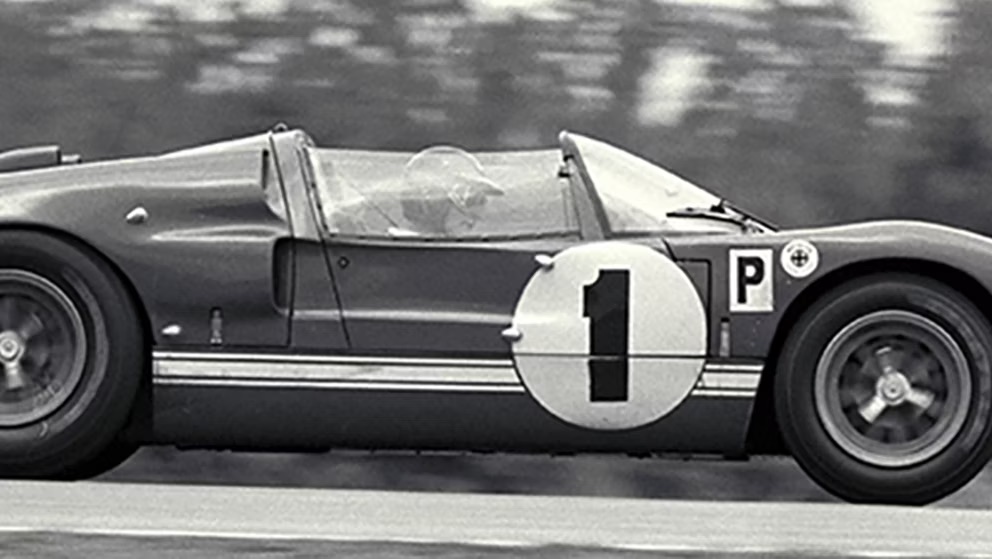
In 1964, Ford arrived at Le Mans with a new racing car built for one purpose: beating Ferrari. The GT40 was fast enough to set the pace and even set a lap record, but speed meant very little when the cars could not survive 24 hours. All three Ford entries were out of the race by the halfway mark, with gearbox failures ending the challenge. Two years later, Ford returned with a radically improved GT40 program. This time, eight cars were entered. When the 24 hours were over, Ford had finished first, second and third. The transformation was not a simple engine upgrade. Ford had rebuilt the car—and the way the entire racing program was run.
Ford Built The GT40 After Ferrari Rejected Its Deal
The story began before the GT40 even existed. In 1963, Ford and Ferrari had been negotiating a possible collaboration, but the talks were suspended in May. Ford had already developed an interest in becoming a serious force in international sports-car racing, and the failed negotiations gave that ambition a new target. If Ford could not work with Ferrari, it would have to challenge Ferrari.
Ford quickly created a high-performance program with an ambitious goal: build a GT racing car capable of competing at major endurance races such as Sebring and Le Mans. Roy Lunn developed the initial design, while British engineer Eric Broadley contributed experience from the Lola GT. John Wyer was brought in to manage the race operation, with Carroll Shelby helping represent the program in Europe.
The timetable was brutal. Ford had only about ten months to turn the concept into a functioning race car for Le Mans in 1964.
The resulting machine was low, fast and immediately dramatic. At roughly 40 inches high, the GT40 was built around a mid-engine layout and designed to attack the long straights of Le Mans at very high speed. But the first version was being developed under enormous time pressure, and the weaknesses would appear quickly.
Discover the legendary 1966 Le Mans battle! See how Ford took on Ferrari to build the iconic GT40 and claim history. It’s a story of speed, rivalry, and engineering genius that changed motorsport forever. Don’t miss this epic journey—click now to watch the full story of the GT40!
The First Le Mans Attempt Failed Almost Completely
The GT40’s speed was never really the problem.
During testing, the cars proved extremely quick, but high-speed aerodynamic stability needed work. Engineers made changes to spoilers and other bodywork before the race. When Le Mans arrived, Ford had three GT40s ready to challenge Ferrari. For a while, the plan looked promising.
The GT40 was fast enough to run at the front, and driver Phil Hill even set a lap record. But Le Mans was not decided by one fast lap. It was a 24-hour endurance test, and the car’s transmission proved unable to withstand the repeated stress of the circuit. All three Ford cars were out of the race after only 12 hours.
The result was devastating. Ford had built a car capable of frightening speed, but it had not yet built a car capable of surviving.
After further disappointments during the 1964 season, including a disastrous race at Nassau, Ford decided that the program needed a major change. Carroll Shelby was given operational control, while Roy Lunn retained engineering responsibility. The next version would be developed very differently.

Ken Miles Started Rebuilding The Car From The Ground Up
When the remaining GT40s reached Shelby’s California operation, developmental driver Ken Miles went to work.
Miles discovered that some of the original suspension settings had been lost. Restoring the correct settings immediately improved the car, but the team soon realized that the problems went much deeper. They began testing aerodynamics with computer assistance and with a far simpler technique: attaching pieces of yarn to the bodywork and watching how the airflow moved over the car. The results were revealing.
The airflow was worse than the engineers had expected. Shelby American engineer Phil Remington redesigned ducting and other systems, producing large gains while the team continued changing the body, suspension, wheels and weight distribution. Ford’s development effort eventually involved roughly a hundred separate modifications.
The car was becoming less like the machine Ford had hurried to Le Mans in 1964 and more like a purpose-built endurance racer. Then Ford tried something much more ambitious. It developed a seven-liter 427-cubic-inch V8 for the GT40.
The larger engine transformed the car’s performance, and during testing Ken Miles reached about 210 mph on the straight at Ford’s Romeo test track. The experimental GT40X was so fast that during Le Mans practice in 1965 it set a lap record of 3:33, nearly five seconds faster than the Ferraris. But speed alone still wasn’t enough.
The 1965 Season Taught Ford What The Car Still Could Not Do
Ford entered the 1965 Le Mans race with enormous confidence. The new 427 GT40X had demonstrated incredible speed, while the existing 289-powered cars had already shown that the basic GT40 platform could be competitive. Then the race turned into another disaster.
The new GT40Xs suffered gearbox problems, while the team also discovered reliability issues with the 289 engines. The engineering group had been stretched by other major Ford racing commitments, and some components reaching Le Mans had not received all the testing the team wanted. The result was another failure despite the car’s extraordinary pace. Ford had now learned an important lesson. It did not have a top-speed problem. It had a systems problem.
A Le Mans car had to survive extreme loads, heat, braking and continuous operation for an entire day and night. Every weak gearbox, brake component, cooling system or engine part could undo months of preparation. So Ford stopped treating the GT40 as just a racing car that needed more power.
The company started treating Le Mans as an engineering problem that had to be solved component by component.

The Le Mans Committee Changed Everything
For the 1966 season, Ford created something new: the Le Mans Committee.
Instead of allowing the project to become trapped in layers of corporate bureaucracy, Ford brought together the divisions involved in engineering, motorsports, parts and styling. The committee could make decisions faster, while the company also expanded the racing effort by adding NASCAR powerhouse Holman & Moody alongside Shelby American.
This changed the program as much as any modification to the car itself.
Ford now had engineering resources, experienced race teams and much more direct coordination between the people building the car and the people racing it. The Mark II GT40 received extensive revisions to its body, suspension, fuel system and brakes, while the 427 engine produced about 485 horsepower in its race configuration.
The company also began testing engines far more aggressively.
After Dan Gurney’s engine failed at Sebring, Ford engineers tore it apart to understand why. Ken Miles helped create a “dynamometer tape” simulating the operating conditions of Le Mans so engines could be run under race-like conditions for up to 48 hours—twice the length of the actual race. By the end of May, Ford had an engine capable of completing that test while producing about 485 horsepower, and 12 engines were built to the resulting specification.
The brakes received similar attention. The heavier and faster Mark II placed enormous loads on them, so Ford and Kelsey-Hayes engineers developed improved brake materials while Shelby American’s Phil Remington and Holman & Moody’s John Holman developed quick-change systems for calipers and rotors. This was no longer a desperate attempt to make a fast car. It was a coordinated campaign to eliminate every reason the car might fail.

In 1966, Ford Finally Beat Ferrari
By June 1966, Ford arrived at Le Mans with an entirely different operation.
Eight factory GT40s were entered—three each from Shelby American and Holman & Moody, plus two from Alan Mann Racing. Ferrari arrived with 11 cars, including several of its powerful factory prototypes. The race began at 4 p.m.
For hours, Ford and Ferrari traded positions at the front. But as the night progressed, Ferrari’s cars began suffering mechanical problems while Ford’s larger operation kept cars running. By 4 a.m., the last Ferrari had retired and Ford held several of the leading positions. Ford then made the decision to slow the pace.
With multiple GT40s still running strongly, the priority was no longer simply to go faster. It was to finish. That was the lesson Ford had learned the hard way in 1964.
Late in the race, the leading Ford cars ran nose-to-tail. Dan Gurney’s car had already fallen out with an engine failure, leaving Ken Miles and Bruce McLaren at the front. With the race effectively secured, Ford instructed the drivers to slow down and preserve the cars.
The three GT40s eventually crossed the finish together, producing one of the most famous podium photographs in endurance racing history. Ford finished first, second and third. The GT40 had finally beaten Ferrari at Le Mans. There was one final twist.
Ford had hoped to create a dead heat between the leading cars, but the Automobile Club de l’Ouest determined that Bruce McLaren and Chris Amon’s car would be classified first because it had started farther back and therefore traveled farther over the race distance. Ken Miles, despite playing a major role in developing the Mark II and leading much of the race, was classified second. Ford’s own account notes that the interpretation remains controversial. For Ford, the larger objective had finally been achieved.
Three years after the failed Ferrari negotiations, the company had built an endurance racing machine capable not only of outrunning Ferrari, but of surviving the most demanding race on the calendar.
The GT40’s 1966 victory was not the result of one brilliant engine or one heroic driver. It came from everything Ford had changed after failure: the aerodynamics, the brakes, the gearbox, the engine testing, the race teams and even the way the corporation itself made decisions. In 1964, Ford had brought a fast car to Le Mans. In 1966, it brought a system that knew how to finish.
Ford’s 1966 Le Mans victory was built on two years of failure, testing and relentless engineering. The GT40 had already proved it could be fast in 1964, but three cars failed to finish. By 1966, Ford had redesigned the machine, strengthened its engineering process, added Shelby American and Holman & Moody, and tested the 427 engine for twice the length of the race. The result was a historic 1–2–3 finish over Ferrari. The GT40 did not become a winner by simply becoming faster. It became a winner by finally learning how to survive.
The original Ford Heritage series documents the GT40’s difficult journey from its failed 1964 Le Mans debut to the breakthrough victory of 1966. The company’s archive provides detailed accounts of the engineering changes, Ken Miles’ development work, the Le Mans Committee and the race strategy that finally delivered Ford its first overall Le Mans victory. Source: https://corporate.ford.com/corporate/corporate/articles/history/ford-gt40-origins-le-mans-committee-victory/