Before radar transformed air defense, detecting an approaching aircraft could depend on nothing more than the sound of its engines. Military engineers responded by building enormous acoustic listening devices with giant horns pointed toward the sky, allowing operators to capture distant engine noise and estimate where a plane was coming from. These strange machines looked almost futuristic in their own way, yet they belonged to an era when finding an enemy aircraft meant listening carefully for a sound that might arrive before the plane itself.
Before Radar, the Military Had to Listen
The rapid development of military aviation during World War I created a problem that armies had never faced on the same scale before. Aircraft could approach from beyond the horizon, and at night or in poor weather, spotting them with the naked eye could be extremely difficult.
There was, however, one thing that often gave an aircraft away before it became visible: the sound of its engine.
Military planners began looking for ways to make that sound easier to detect and, more importantly, easier to locate. The basic idea was straightforward. If observers could hear an aircraft early enough, they could estimate its direction and warn searchlight crews or anti-aircraft defenses.
The difficulty was figuring out exactly where the sound was coming from.

The Giant Ears of the Pre-Radar Era
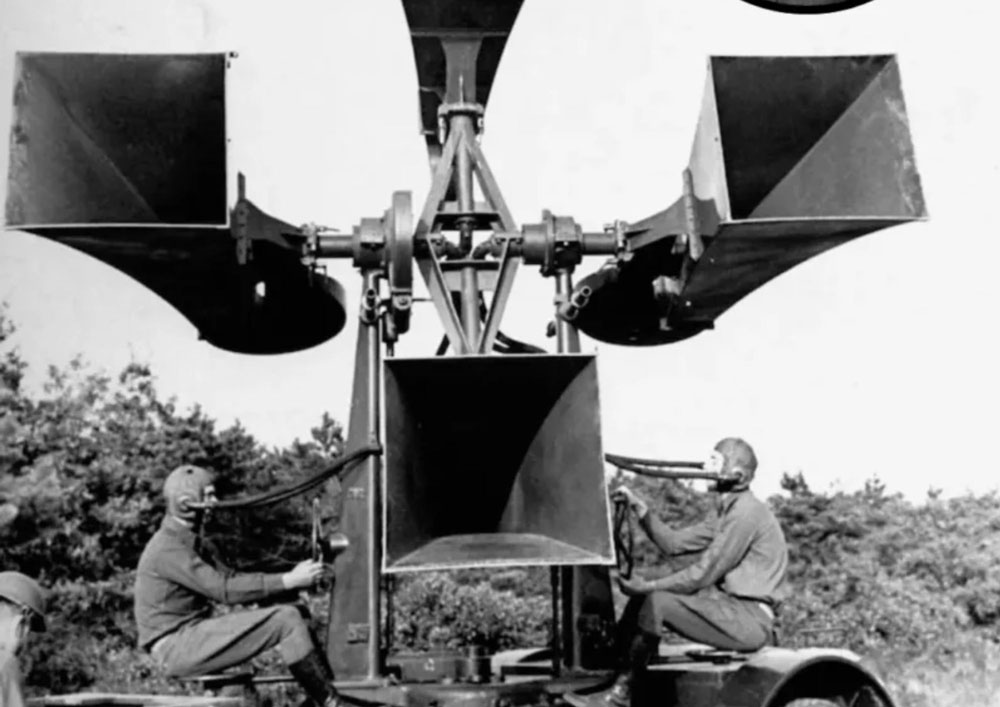
Engineers began experimenting with large acoustic collectors that acted like enormous ears. The best-known examples consisted of large horns pointed toward the sky, sometimes mounted on rotating platforms that allowed operators to search for approaching aircraft.
The horns gathered and concentrated sound, making distant engine noise easier for operators to hear. By carefully adjusting the position of the equipment, they could attempt to determine the direction from which the aircraft was approaching.
Some early systems were surprisingly simple. During World War I, British forces experimented with devices made from large gramophone-style horns, while later designs became much larger and more sophisticated.
The machines looked unusual, but their purpose was practical. They were not designed to see an aircraft. They were designed to hear one.
Why two horns?
A single horn could collect sound, but two horns provided a way to compare the sound arriving from different directions.
Operators could listen to the two sides and adjust the equipment until the aircraft’s engine appeared strongest or most balanced between them. This helped estimate the aircraft’s horizontal direction.
More advanced systems eventually used four horns, allowing operators to estimate both the direction of the aircraft and its elevation.
In other words, the military was trying to turn human hearing into an early warning instrument.
Watch the video for a fascinating look at how acoustic locators evolved between 1917 and 1940, from improvised gramophone horns to sophisticated multi-horn systems used to detect aircraft before radar made them obsolete.
How These Strange Machines Actually Worked
Operating an acoustic locator required more than simply standing behind a giant horn.
The equipment had to be positioned toward the suspected source of the sound, while operators listened carefully for the noise of aircraft engines. Some systems transmitted the collected sound through tubes to earphones, allowing the operator to listen while controlling the equipment.
Once a sound was detected, the operator tried to determine its direction and track changes as the aircraft moved.
The information could then be passed to other parts of the air-defense system. Searchlights could be directed toward the suspected location, while anti-aircraft crews could prepare for an approaching target.
The acoustic locator itself did not provide the kind of detailed information that modern radar can produce. Its job was much simpler: detect the sound, estimate the direction and provide an early warning.
And that depended heavily on the person operating it.
Weather, background noise and the operator’s ability to distinguish aircraft sounds could all affect the result. Listening for distant aircraft for long periods was demanding work, particularly when the equipment was being used during an actual air raid.

The Strange Machines Built Around the World
The idea spread well beyond Britain.
The United States developed large acoustic aircraft locators, including systems with four horns designed to help determine both horizontal direction and elevation. Some were mounted on platforms that could be rotated toward the source of an aircraft’s engine noise.
Britain experimented with another remarkable approach: enormous concrete acoustic mirrors. These structures were designed to reflect and concentrate sound toward listening stations, creating large permanent installations along parts of the coast.
Other countries developed their own versions.
Japan produced some of the most visually striking acoustic locators, including huge horn-shaped machines mounted on wheeled platforms. These devices later became popularly associated with the nickname “war tubas.”
Germany and other European countries also experimented with acoustic detection systems, producing a wide variety of designs during the period before radar became the dominant technology.
The machines looked different, but they were all attempting to solve the same problem: how do you find an aircraft that is still beyond your eyes?
When Sound Wasn’t Enough
Acoustic detection was clever, but it had obvious limitations.
Sound could be affected by weather, wind, terrain and surrounding noise. An operator might hear an aircraft without being able to determine its exact position. The effectiveness of the system could also vary depending on the type of aircraft and the experience of the people operating the equipment.
Speed created another problem.
Aircraft became faster and more capable throughout the 1930s. A system that could provide useful warning against a slower aircraft could become much less effective when the target was moving rapidly toward its destination.
There was also a fundamental limitation that engineers could not escape: the system had to wait for the sound to travel from the aircraft to the listener.
The military needed something that could detect an aircraft at greater distances and provide more reliable information without depending so heavily on human hearing.
That technology was already beginning to emerge.

Radar Changed Everything
Radar offered a completely different way to detect aircraft.
Instead of waiting for engine noise to reach an observer, radar used radio waves to detect objects at a distance. As radar technology developed during the 1930s and became increasingly important during World War II, its advantages became obvious.
Radar could provide earlier warning and more useful information about the location of an aircraft. It was not dependent on whether an operator could distinguish one engine from background noise, and it could function in circumstances where visual or acoustic detection was much more difficult.
The giant listening devices did not instantly disappear. Some acoustic systems remained useful as supplementary equipment during the transition, particularly before radar networks became sufficiently widespread.
But their days were numbered.
As radar improved, there was less reason to build enormous horns and assign people to listen for aircraft engines. A technology that could electronically detect an aircraft was simply more powerful than one that had to wait for the sound of that aircraft to reach the ground.
Before Radar, the Sky Had to Be Heard
Today, these machines can look almost comical. Giant horns pointed toward the sky, operators listening through tubes and enormous concrete structures along the coast seem primitive compared with modern radar installations.
But in their own time, they represented an ingenious response to a new military problem.
Aircraft had changed warfare, and armies needed early warning. Before radar provided a better solution, engineers used what they had: sound, acoustics and human observation.
The horns amplified the noise. The operators interpreted it. Searchlights and anti-aircraft defenses acted on the information.
It was imperfect, but it was a genuine technological step forward.
Before the military could electronically detect an aircraft from far away, it had to find another way to know that the aircraft was coming. For a remarkable period in history, that meant pointing enormous ears toward the sky and listening carefully for the sound of an engine approaching from beyond the horizon.