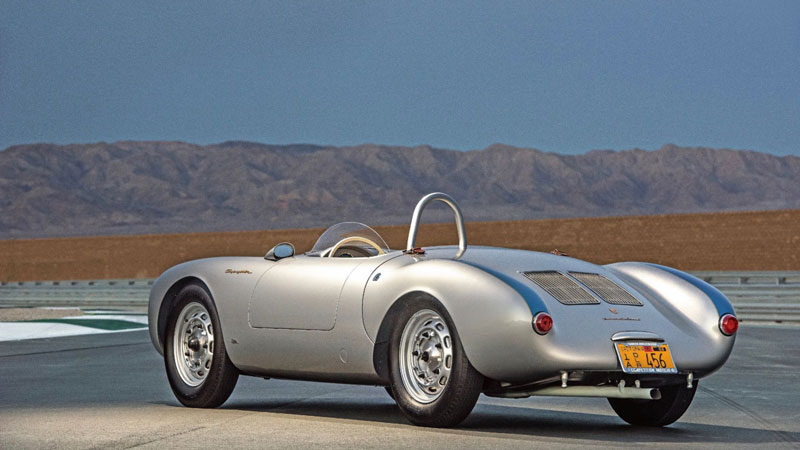
When Porsche introduced the 550 Spyder in the early 1950s, it was not simply building another sports car. The company was creating its first car specifically for racing, using a lightweight aluminum body, a mid-engine layout and a compact four-cylinder boxer engine. The result weighed just 550 kilograms while producing 110 horsepower from 1.5 liters. That combination gave the little Spyder performance that could challenge much larger racing machines. Decades later, its connection to James Dean would make it famous in Hollywood, but the engineering underneath the silver body is what made the 550 special.
Porsche Built The 550 Around One Simple Idea: Less Weight
The most remarkable number associated with the 550 Spyder is not its horsepower. It is its weight.
The car weighed approximately 550 kilograms, or about 1,212 pounds, when empty. That was extraordinarily light even by the standards of the 1950s, and Porsche achieved it by treating weight as something to eliminate rather than simply something to manage. The body was made from aluminum, while the compact construction kept unnecessary mass to a minimum.
This philosophy created a very different kind of performance. Instead of relying on a huge engine to produce overwhelming power, Porsche built a small car that did not need much power to move quickly.
The result was a machine where almost every component had a clear purpose. The low body, compact dimensions and lightweight construction were not styling exercises. They were consequences of designing a car around speed.
That approach would become one of the recurring ideas in Porsche engineering: performance could come from making a car lighter, more responsive and more efficient rather than simply making the engine larger.
Ever wondered what it’s like to own a piece of Hollywood history? Discover how this legendary car is being brought back to life. Watch the full story now!
The Engine Was Small — But Highly Sophisticated
Behind the driver sat a 1.5-liter, four-cylinder boxer engine. Porsche rated the engine at 110 horsepower, with four overhead camshafts helping it produce unusually strong performance for its size.
A boxer engine places opposing cylinders horizontally, allowing the engine to sit relatively low in the chassis. For a sports car designed around handling, that mattered. A lower engine position could contribute to a lower center of gravity, while the compact layout worked naturally with the 550’s mid-engine configuration.
The engine was also air-cooled, continuing a technical philosophy that would become closely associated with Porsche. Rather than using a large liquid-cooling system, the engine relied on airflow to remove heat, helping keep the overall mechanical package compact.
With 110 horsepower moving only about 550 kilograms, the power-to-weight ratio was the real story. Porsche’s official historical specifications list a top speed of around 220 km/h, while Porsche has also described the lightweight car as capable of nearly 230 km/h depending on the specification. For a tiny sports car from the 1950s, those numbers were remarkable.

The Mid-Engine Layout Put The Mass In The Middle
One of the 550 Spyder’s most important engineering decisions was where Porsche placed the engine.
Instead of putting the engine ahead of the driver, Porsche positioned it behind the cockpit but ahead of the rear axle. This mid-engine arrangement concentrated much of the car’s mass near its center.
For a racing car, that could make the chassis more responsive to steering inputs. Rather than having a large, heavy engine hanging far beyond one end of the car, the 550 kept its major mechanical components close to the center of the vehicle.
The result was a car designed to change direction quickly and carry speed through corners. This was particularly valuable on road circuits, where lap times depended on much more than straight-line acceleration.
The low body also had another advantage. At the 1954 Mille Miglia, works driver Hans Herrmann famously drove the low-slung 550 beneath a closing railway barrier. The episode became one of the car’s most memorable demonstrations of just how low its body was.
Its Aluminum Body Was Part Of The Performance
The silver appearance of the 550 was not merely a matter of style. The lightweight aluminum body was an important part of the car’s overall engineering philosophy.
Using aluminum helped Porsche reduce mass while creating the smooth, low-profile shape needed for racing. The result was a body that looked almost delicate compared with larger American sports cars of the period, but underneath it was designed around competition.
The 550 was also extremely compact. Its small size reduced the amount of material required and contributed to its low weight, while the streamlined shape helped it reach high speeds despite having only a 1.5-liter engine.
This combination illustrates something important about early Porsche engineering: the company did not attempt to overpower larger competitors. Instead, it looked for ways to make a smaller machine more efficient.
That approach quickly proved itself in competition. In the Carrera Panamericana, the 550 achieved a class victory and finished third overall against cars with significantly larger engines.

It Was A Racing Car That Could Also Reach The Track By Road
The 550 Spyder was unusual because it was designed specifically for racing but could also be driven on public roads.
That distinction mattered in the 1950s. A private driver could use the same basic machine for everyday travel and competition rather than needing a dedicated trailer and a completely separate racing car.
Porsche’s later descriptions of the 550 emphasize exactly this dual-purpose character: it was a race car that drivers could drive to the circuit and then race.
That helped make the car attractive to enthusiasts who wanted genuine motorsport technology without completely separating it from road use.
It also explains why the 550 became important in California’s growing sports-car culture. Lightweight European cars were beginning to attract American enthusiasts who were interested in road racing, and the 550 offered something very different from the large American cars that dominated much of the market.
James Dean Added Hollywood Fame To A Serious Racing Machine
James Dean’s connection to the 550 Spyder came during this period. In September 1955, Dean saw a silver 550 Spyder at Competition Motors in Hollywood after his friend Lew Bracker told him about the car. Three days later, Dean arrived at Bracker’s home in that same Spyder after trading his Porsche 356 Speedster for it.
Dean was already interested in motorsport, and he and Bracker regularly talked about cars and racing. Bracker eventually entered roughly 40 races in Porsche models, winning six, while Dean himself participated in only a few events because of restrictions connected to his film career.
Their friendship even extended into business ideas. The two had discussed opening a restaurant and Porsche dealership in California under the name James Dean Motors.
But Dean’s celebrity connection is ultimately only one chapter in the history of the 550. Long before it became associated with Hollywood, the car had already established its identity through engineering and competition.

The Porsche 550 Spyder remains fascinating because its performance came from a remarkably focused engineering formula: a lightweight aluminum body, a mid-engine layout, a 1.5-liter four-cylinder boxer producing 110 horsepower and a total weight of roughly 550 kilograms. Porsche built it specifically for racing, and its results against much larger cars demonstrated what careful weight reduction and chassis design could achieve. James Dean later gave the 550 a place in popular culture, but the car’s real legacy began with something much simpler: a small, lightweight machine engineered almost entirely around speed.
The technical history and James Dean connection are documented by Porsche’s official historical material and Porsche Newsroom. Source: https://newsroom.porsche.com/en/christophorus/porsche-550-spyder-lew-bracker-james-dean-passion-racing-friendship-california-14624