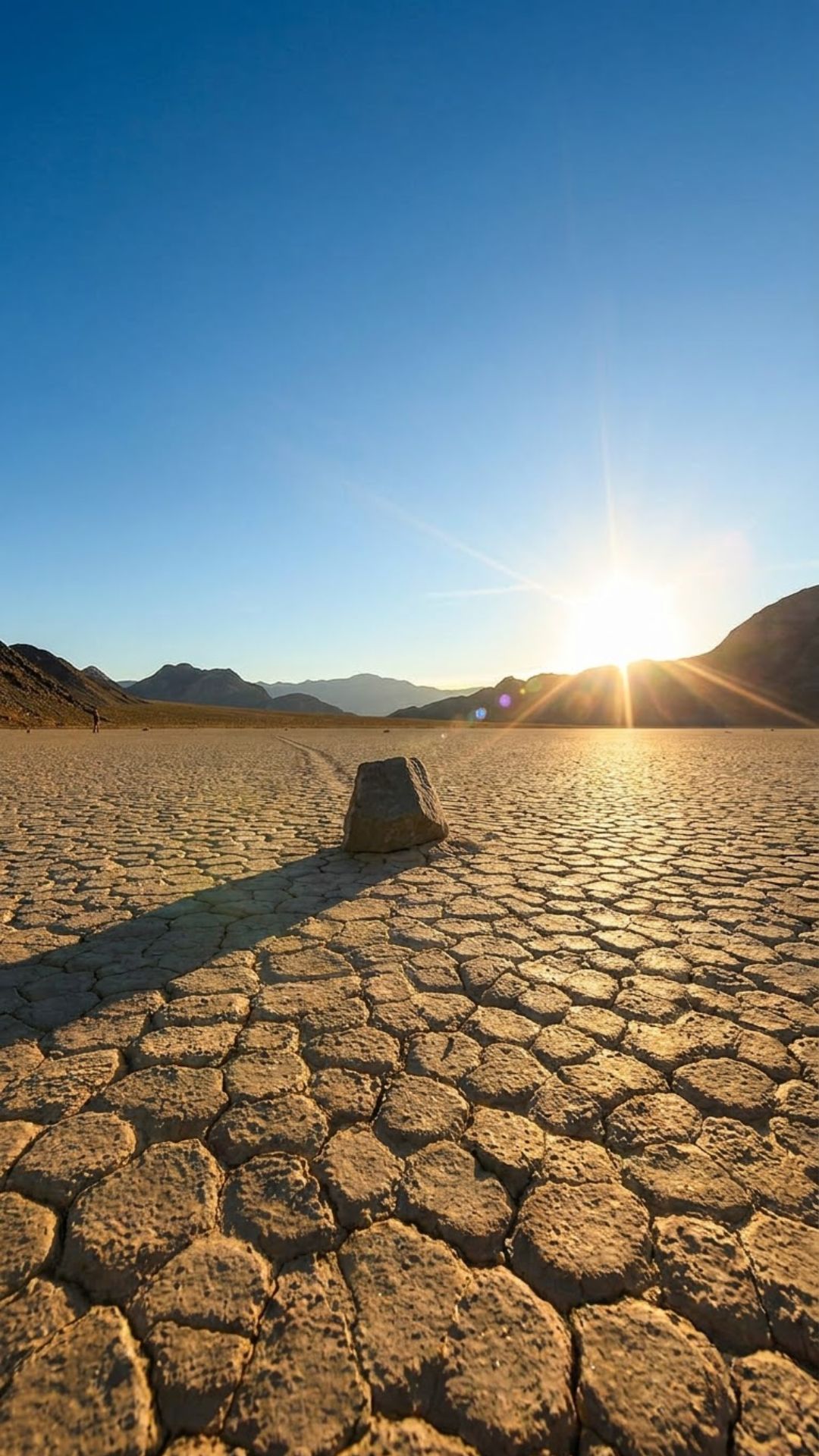
Across a vast, dry lakebed in California’s Death Valley, hundreds of rocks have left long trails in the mud as if someone dragged them across the desert. Some weigh as much as 700 pounds, yet there are no tire tracks, no machinery and no obvious force capable of moving them. For decades, visitors and researchers could only study the paths after the rocks had moved. Then, in December 2013, scientists happened to be standing at Racetrack Playa when the landscape changed: water, thin sheets of ice and a light wind combined to push dozens of rocks across the frozen surface.
The Rocks Leave Trails Across A Completely Dry Landscape
Racetrack Playa is a remarkably flat dry lakebed in a remote part of Death Valley National Park. Most of the year, its surface appears almost perfectly still, covered by pale, cracked mud and scattered rocks that have fallen from the surrounding mountains. But some of those rocks sit at the end of long grooves carved into the playa, creating the strange impression that they have somehow traveled across the landscape.
The trails can extend for hundreds of meters, and some individual rocks have traveled as far as about 1,500 feet. What makes the tracks particularly unusual is their variety. Some run almost perfectly straight, while others curve, change direction or appear to move alongside trails made by other rocks. In several cases, multiple rocks left remarkably similar paths at roughly the same time.
The rocks themselves provide no obvious explanation. Some are relatively small, but others can weigh around 700 pounds. Nothing visible on the empty playa appears powerful enough to push such a large object across the ground. For decades, the trails were therefore the evidence and the mystery at the same time.
The mystery of Death Valley’s moving stones has finally been solved! Click to find out how these rocks travel across the desert floor.
For Decades, Nobody Actually Saw The Rocks Move
Researchers had been studying the phenomenon since at least the 1940s, but there was a frustrating problem: the rocks could remain in place for years before moving again. That made direct observation extraordinarily difficult. Scientists could compare the position of a rock with its old trail, but they rarely had the opportunity to see the actual movement that created it.
Over the years, several explanations were proposed. Strong winds were an obvious possibility because the playa is exposed and exceptionally flat. Other theories involved water, ice, slippery surfaces and different combinations of these forces. Some earlier ideas even suggested that powerful winds or thick sheets of ice might be required to move the largest rocks.
The problem was that none of these explanations could be properly tested without catching the rocks in motion. So researchers decided to wait.
In 2011, a team led by Richard Norris installed a weather station and placed GPS instruments on selected rocks, while cameras recorded conditions around the playa. Because the stones could remain motionless for years, the researchers expected that they might have to wait five or ten years before witnessing anything useful. Instead, nature gave them an answer much sooner than expected.

Then Scientists Arrived At The Right Place At The Right Time
In December 2013, the researchers returned to Racetrack Playa and discovered something unusual: the normally dry surface was covered by a shallow pond only a few inches deep. Temperatures during the night dropped below freezing, allowing ice to form across the water. Then the weather changed.
As the sun rose, the thin ice began to break apart. Instead of remaining as one solid sheet, it fractured into large floating panels. A light wind began pushing those panels across the shallow water. Some of the rocks sitting on the playa surface were directly in their path. And then the rocks moved.
On December 20 and 21, researchers observed multiple movement events. More than 60 rocks moved during one event, with some traveling more than 60 meters. GPS-equipped rocks recorded movement of up to 224 meters across several events between December 2013 and January 2014. After decades of studying the evidence left behind, scientists were finally watching the phenomenon itself.
The rocks were not racing across the desert. They were moving so slowly that the motion could easily go unnoticed without a stationary reference point.
Thin Ice Turned Out To Be The Missing Piece
The mechanism was surprisingly delicate.
The playa first needed enough water to create a shallow pond. During cold nights, the water froze into a thin layer of ice. Researchers measured ice sheets only about 3 to 6 millimeters thick—far thinner than the thick slabs of ice that earlier theories had imagined.
When the morning sun warmed the surface, the ice began breaking into floating panels that could be several meters or even tens of meters across. Light winds then pushed these panels through the shallow water. When an ice panel encountered a rock, it could push the rock along the soft surface beneath the water.
The process was slow. Researchers measured rock movement at roughly 2 to 5 meters per minute in the observed events. That is only a few feet per second, making the motion extremely difficult to notice from a distance.
The surprising part was therefore not simply that ice was involved. It was that very thin ice and relatively gentle wind were enough when the conditions were exactly right. The rocks did not need a hurricane.
They needed a rare combination of shallow water, freezing temperatures, sunlight, floating ice and wind.
The Tracks Were Recording A Natural Experiment
Once researchers understood the mechanism, the strange trails became easier to interpret.
A rock’s path depends partly on the direction of the wind and the movement of the water beneath the floating ice. If the ice panel changes direction, the rock can change direction as well. Different rocks can therefore create parallel tracks, curved paths or sudden turns during the same movement event.
This also explains why the rocks can appear to have moved independently of one another. The ice panels do not necessarily move as one enormous sheet. They break apart, drift and interact with the rocks in different ways. The result is a kind of natural record written directly into the mud.
Once the water disappears and the playa dries again, the rock trails remain. Visitors arrive months or years later and see only the final lines, not the temporary combination of ice, water and wind that created them.
In that sense, the Racetrack is like a landscape that preserves the tracks of an event while hiding the event itself.

The Mystery Was Solved By A Remarkably Small Force
The sailing stones are fascinating because the final explanation is much less dramatic than the mystery initially suggests. There was no invisible force and no extraordinary geological process required. The movement came from ordinary elements—water, freezing temperatures, sunlight and wind—working together under unusually specific conditions.
What made the phenomenon difficult to understand was not the strength of the force. It was the rarity of the right combination.
For most of the year, Racetrack Playa is simply a dry lakebed. The rocks sit still. Then, during a narrow window of winter conditions, rain or other precipitation can create shallow water, freezing temperatures produce thin ice, sunlight breaks that ice apart and wind pushes the floating pieces across the surface.
The entire event can happen slowly enough that someone standing nearby might not immediately realize the rocks are moving.
That is why the sailing stones remained mysterious for so long. Scientists had been looking at the evidence for decades, but the crucial experiment was happening only occasionally and for a very short time.
Today, the tracks at Racetrack Playa are no longer evidence of an unexplained force. They are the visible remains of a rare natural process—one that required researchers to spend years waiting for the desert to create exactly the right conditions.
And when those conditions finally arrived, the rocks did something that had puzzled people for generations: they moved.
The National Park Service notes that the playa is extremely fragile, particularly when wet, and visitors are asked not to disturb the rocks or walk across muddy areas.
The National Park Foundation introduced the sailing stones as one of Death Valley’s most unusual natural phenomena, while the National Park Service and the original scientific study provide the detailed explanation of how researchers finally observed the rocks moving. Together, these sources show how a decades-old mystery was transformed into a documented natural process. Source: https://www.nationalparks.org/connect/blog/sailing-stones-death-valley