A classic Chevy can look flawless in the garage and still feel loose, vague or difficult to keep straight once it hits the road. Before replacing the steering box or converting to a modern setup, it is worth finding out where the wear is actually coming from—and deciding whether preserving the original system or improving the car’s drivability makes more sense.
Should You Repair or Replace Your Classic Chevy Steering?
A classic Chevy can look perfect sitting in the driveway and still feel surprisingly different once you get behind the wheel. Maybe the steering feels loose, the car wanders slightly at highway speeds, or you find yourself making constant corrections just to keep it moving straight. After decades on the road, some wear is expected. But when the problem involves steering, “that’s just how an old car drives” is not always a good answer.
For an owner of a classic Chevy, the decision can be more complicated than simply buying a replacement part. You may be trying to preserve an original restoration, improve the way the car drives, or find a sensible balance between authenticity and modern drivability. Before deciding whether to repair or replace the steering, it helps to understand what is actually worn—and what you want the car to be when the work is finished.
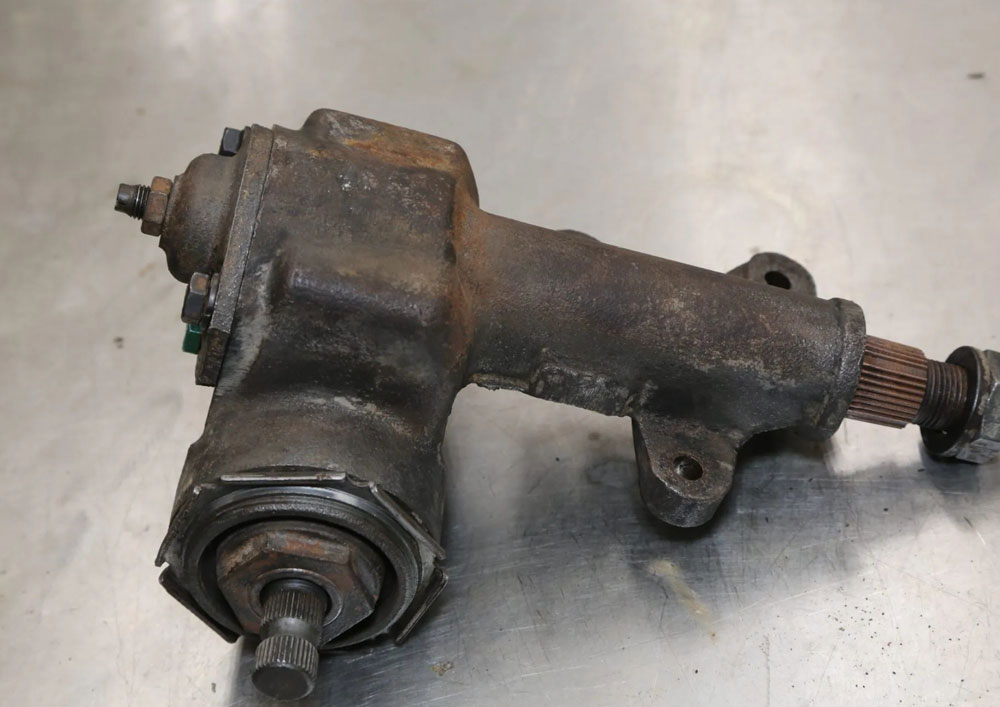
Watch the video for a closer look at how a classic Chevy steering box works and what goes on inside the components that keep the car moving in the right direction.
The Problem May Not Be the Steering Box
When an old Chevy develops loose steering, the steering box is an obvious suspect. But it is only one part of the system.
Depending on the model and year, the steering system can include the steering box, steering shaft, rag joint, Pitman arm, idler arm, center link and tie-rod ends. Decades of use can leave wear in several of these components at the same time.
That means replacing the steering box without first finding the source of the play may not solve the problem.
A useful inspection begins with the steering wheel itself. As the wheel is moved back and forth, the various steering components can be observed to determine where the movement is occurring. The goal is to distinguish normal movement from excessive play and identify whether the problem is concentrated in the gearbox or spread throughout the linkage.
The difference matters.
A worn steering box may be rebuildable. A deteriorated rag joint may need replacement. A collection of worn linkage components may call for a more comprehensive repair.
The first decision, therefore, should not be “Which steering box should I buy?” It should be “Where is the play actually coming from?”

When Rebuilding the Original Steering Box Makes Sense
Not every old steering box needs to be replaced simply because it has become worn.
For some classic Chevys, rebuilding the original unit can be an attractive option. A rebuild can address worn internal components while allowing the owner to retain the original housing and configuration.
That matters more than it might seem.
A classic car is not always judged solely by how quickly or precisely it drives. For many owners, the mechanical components are part of the history of the vehicle.
Consider a Chevy being restored as closely as possible to its original specification.
The owner may have spent years finding correct trim, original components and period-correct details. In that situation, replacing an original steering box with an aftermarket unit could work against the entire philosophy of the restoration.
Rebuilding the original box offers another path. The component stays with the car, but its worn internal parts can be addressed.
For a collector-oriented restoration, that can be more valuable than simply installing whatever newer steering component happens to offer the quickest response.
There is also something satisfying about keeping an original mechanical part alive.
A steering box that has been in a car for decades does not necessarily need to be discarded because it has finally worn out. Sometimes it simply needs to be restored.

When Replacement Starts to Make More Sense
There are, however, situations where rebuilding the original steering box is not the most practical answer.
If the steering box is worn and several other components are also showing significant wear, repairing only the gearbox may leave the car with a system that is still loose.
The steering system works as a whole. If multiple connections have developed excessive movement, replacing one component may improve the steering without completely resolving the underlying problem.
There is also the question of how the car is used.
A classic Chevy that spends most of its time parked at shows has different requirements from one that regularly travels on highways, takes weekend road trips or is driven several times a week.
For the latter, improved steering response can be a meaningful upgrade rather than an unnecessary modification.

The Classic Chevy Question: Originality or Drivability?
This is ultimately where the decision becomes personal.
Imagine two owners with nearly identical classic Chevys.
The first wants a faithful restoration. He cares about originality and wants the car to remain as close as possible to the way it left the factory. For him, rebuilding the original steering box may be the obvious choice.
The second owner has a different goal. He wants to drive his Chevy. He wants to take it on long trips, use modern highways and enjoy the car without constantly thinking about how much slack is in the steering.
For him, a carefully selected replacement or steering upgrade may make more sense.
Neither approach is inherently wrong.
They simply answer different questions.
When Preservation Comes First
If the car is rare, highly original or being restored for historical accuracy, preserving the factory steering system can be an important part of the project.
The goal is not to make the car feel like a new vehicle. It is to restore the old vehicle to a condition that respects what it originally was.
When Driving Comes First
If the car is primarily a driver’s classic, the priorities can be different.
A more responsive steering system may make the car easier to enjoy in modern traffic. An owner who regularly drives at highway speeds may value predictable steering more than maintaining every original mechanical characteristic.
This is one reason many classic owners choose selective upgrades rather than complete restorations. The car can retain its original appearance and character while receiving improvements underneath.
The result does not have to look modern to drive better.
Don’t Overlook the Smaller Components
One of the easiest mistakes is to focus so heavily on the steering box that the rest of the system gets ignored.
The Rag Joint
The rag joint is a flexible connection between the steering shaft and steering gearbox. After decades of use, its material can deteriorate, and wear in this small component can contribute to noticeable steering play.
That makes it an excellent example of why diagnosis matters.
A driver may feel excessive movement through the steering wheel and assume the gearbox is finished, when another component is actually contributing significantly to the problem.
Replacing a perfectly serviceable steering box will not fix a worn component somewhere else in the system.
The Steering Linkage
The same principle applies to the steering linkage.
Tie-rod ends, the idler arm, center link and other connections can all experience wear. On a decades-old car, the cumulative effect can be much greater than the wear found in any single component.
This is particularly important when deciding whether an upgrade is worthwhile. If the entire system is tired, simply changing the steering box may not produce the result the owner expects.
A proper steering repair is about the system, not just the most obvious part.
Before You Buy Anything, Inspect the Entire System
The smartest approach is to diagnose the problem before spending money on parts.
Have the steering system inspected as a complete assembly and determine where excessive movement exists. The condition of the steering box should be considered alongside the linkage, shaft and coupler.
This is also where the car’s intended use becomes important.
If it is a valuable restoration that rarely leaves the garage, preserving the original equipment may make perfect sense.
If it is a weekend cruiser that spends plenty of time on the road, the owner may reasonably place greater value on steering response and confidence.
And if the car has widespread wear, a larger overhaul may be more sensible than repairing one component at a time.
Steering is also a safety-critical system, so this is one area where an owner should be particularly cautious about treating excessive wear as simply part of the charm of an old car.

The Best Steering System Is the One That Fits the Car
There is no single answer to the classic Chevy steering question.
Sometimes the best decision is to rebuild the original steering box and preserve the component that belongs with the car. Sometimes the wiser choice is to replace worn parts or upgrade the system so the car is better suited to the way it is actually driven.
The important thing is to understand the condition of the entire steering system before making that decision.
A classic Chevy does not have to be completely original to retain its character. And it does not have to be modernized to be enjoyable. The right balance depends on the car, the owner and the purpose of the restoration.
For a collector, keeping the original steering may be part of preserving the car’s story.
For a driver, improving the steering may be part of giving that story another few decades on the road.
In either case, the goal is the same: to make sure that when you turn the key, the car is ready to be driven—not just admired.
The right answer for a classic Chevy is not always to replace what is old with something new. Sometimes the original steering box is worth rebuilding, especially when preserving the car’s character and authenticity matters. In other cases, years of wear across the steering system make replacement or a carefully chosen upgrade the more sensible path. The important thing is to understand where the wear actually comes from and decide whether the car is meant to be preserved, driven, or given a little of both.