In 1903, driving across America was not a road trip. It was an experiment in survival. There were no interstate highways, no reliable road maps and long stretches of the West had little more than dirt trails, mud, rocks and open country. Yet a Vermont doctor named H. Nelson Jackson decided to attempt something that had never been successfully done before: drive from San Francisco to New York. He bought a new 1903 Winton touring car, hired a mechanic named Sewall Crocker and eventually acquired an unlikely travel companion—a bulldog named Bud. Sixty-three days later, the three reached New York and helped prove that the automobile could take Americans farther than anyone had imagined.
The Journey Began With A Bet About The Future Of Cars
The idea began in San Francisco during a conversation about whether an automobile could actually cross the United States. Cars were still expensive and relatively new, and many Americans viewed them as recreational machines rather than dependable transportation. Jackson, a physician and businessman from Burlington, Vermont, decided that the only way to settle the question was to try it himself.
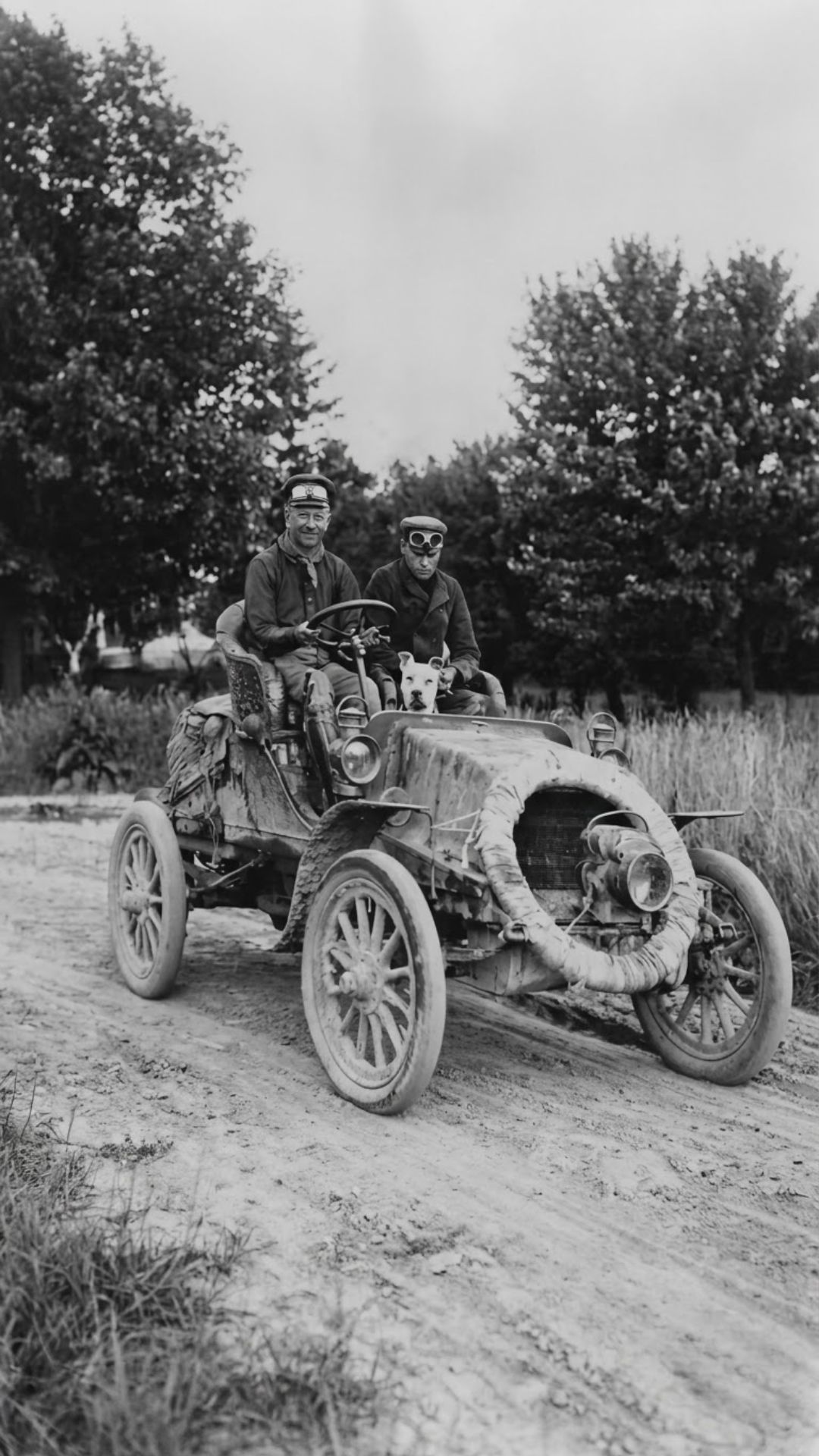
He purchased a 1903 Winton touring car and named it Vermont after his home state. The Winton was hardly a modern touring vehicle. It had none of the conveniences that make long-distance travel easy today, and the journey would depend heavily on whatever roads—or trails—happened to exist. Jackson recruited Sewall Crocker, an experienced mechanic, because crossing a continent in an early automobile meant that mechanical knowledge could be just as important as driving ability.
They left San Francisco in May 1903 and headed east. Their route was not simply a matter of following a highway. They crossed mountain passes, followed railroad lines and traveled along rough trails and river routes, often having to figure out the way as they went. The trip quickly demonstrated the difference between owning an automobile and actually depending on one for hundreds of miles. And they soon discovered that the biggest challenge was not the distance. It was the country itself.
Discover the incredible true story of Horatio Nelson Jackson, who made history in 1903 by driving across the United States for a daring $50 bet! Witness how this pioneer tackled broken roads and mechanical failures in his trusty car, the Vermont. Watch this amazing journey to see how he proved the world wrong.
Their Winton Was Not Built For The Roads They Found
The 1903 Winton was considered a capable automobile for its time, but the roads Jackson and Crocker encountered were often barely roads at all. Mud could swallow the wheels, washouts could block their path and rough terrain could force them to find ways around obstacles that a modern driver would never notice.
When the Winton became stuck, the men sometimes used a block and tackle to pull the automobile out. When parts broke or wore out, there was no roadside repair shop waiting around the corner. They had to contact the Winton factory, arrange for replacement parts and then wait for those parts to travel by railroad before they could continue.
This made the journey as much a logistical experiment as an automotive one. Every mile depended on keeping the machine running, finding fuel and solving problems with whatever tools and supplies the men carried.
The Smithsonian’s collection of the actual Winton used on the journey includes reproductions of the equipment Jackson and Crocker carried, illustrating how different early automobile travel was from the road trips Americans would take only a few decades later. There was no modern navigation system, no roadside assistance and no network of repair stations. A long journey meant bringing much of your own solution with you.
The Winton itself became part of the story. Its survival through mud, rough terrain and repeated repairs helped demonstrate that an automobile could be more than a machine for short trips around town. But then the expedition acquired its most memorable passenger.

Then A Bulldog Named Bud Joined The Expedition
Somewhere in Idaho, Jackson acquired a bulldog and named him Bud. The dog quickly became part of the expedition and eventually one of the most recognizable figures associated with the historic journey.
Bud had one immediate problem with early automobile travel: dust.
The roads were largely unpaved, and the moving Winton kicked up clouds of dirt. The dust irritated Bud’s eyes, so Jackson bought him a small pair of goggles. Photographs of the bulldog wearing his goggles became some of the most memorable images from the trip, and Bud appeared in publicity surrounding the journey.
The dog was more than a publicity image, however. He traveled with Jackson and Crocker for the remainder of the journey, becoming their companion as the three crossed the country.
That detail may sound amusing today, but it also captures something important about early automobile culture. The trip was becoming an adventure that newspapers and the public could follow. People were fascinated by the idea of ordinary individuals using this new technology to cross a continent, and Bud gave the story a personality that a machine alone could never provide.
The expedition was no longer just a test of an automobile. It was becoming a national spectacle.

The Hardest Part Was Finding A Way Forward
As Jackson and Crocker moved east, the landscape gradually changed. They crossed some of the most difficult territory in the West, where mountains, mud and primitive routes repeatedly slowed them down. At times, the men had to leave what passed for a road and improvise their own route.
The lack of infrastructure was perhaps the most important lesson of the entire journey. America was already connected by railroads, but the automobile operated in a completely different world. A train traveled along a fixed track. A car needed roads, bridges, fuel stations, repair facilities and signs. In 1903, much of that infrastructure simply did not exist.
The Winton therefore had to follow whatever transportation network was available. Jackson and Crocker sometimes traveled alongside railroad routes because the railway provided a useful guide through unfamiliar territory. When the automobile could not cross an obstacle directly, they had to find another route or physically move the car.
The journey also became a race against other motorists. Once news spread that Jackson was attempting to cross the country, rival teams set out hoping to claim the distinction for themselves. Two other motoring parties began their own attempts while Jackson and Crocker were still on the road, turning the pioneering expedition into an unofficial competition. Neither rival team managed to overtake them.
By the time Jackson, Crocker and Bud reached the East, they had demonstrated something that had seemed uncertain only weeks earlier. An automobile could cross America.
Sixty-Three Days Changed The Meaning Of A Car
After roughly 63 days of travel, the Winton reached New York City. The achievement immediately attracted attention because it represented something much larger than a successful vacation.
Before the journey, the automobile’s usefulness for long-distance travel was still uncertain. Afterward, Americans had proof that a car could cross the continent—even if doing so required enormous patience, mechanical skill and money. Smithsonian records note that Jackson spent about $8,000 on the expedition, including the automobile, gasoline, tires, parts, supplies, food and hotels.
The trip did not instantly create America’s highway system. But it helped change the way people thought about the automobile. If a car could travel from California to New York under those conditions, then better roads and better vehicles could eventually make such journeys practical for ordinary motorists. That is exactly what began happening.
The expedition inspired other motorists to attempt cross-country journeys. In 1909, Alice Huyler Ramsey became the first woman to drive across the United States, completing the journey in a Maxwell touring car in 59 days. Over the following decades, improvements in roads, automobiles and roadside services gradually transformed cross-country travel from an extraordinary expedition into a recognizable part of American life.
The road trip culture that Americans would later take for granted had to be invented before it could become ordinary. Jackson and Crocker were among the people who proved it was possible.

The First Great Road Trip Was Really A Test Of What Cars Could Become
Today, driving across America can mean stepping into a modern car, entering a destination into a navigation system and following thousands of miles of paved highways. In 1903, Jackson, Crocker and Bud had none of those advantages. They had a Winton touring car, a mechanic’s knowledge, basic supplies and a willingness to keep moving when the road disappeared.
Their journey mattered because it demonstrated more than endurance. It showed that the automobile could connect places that were already connected by rail but not yet linked by a practical road network. The trip helped inspire further cross-country attempts and contributed to a growing belief that Americans could explore their own country by automobile.
The Winton that carried them across the country eventually became a museum artifact. The Smithsonian now preserves the actual 1903 touring car, along with Bud’s goggles and other objects associated with the journey. They are reminders of a moment when the automobile was still young enough that crossing the country in one seemed almost like an experiment in the future. And perhaps that is why the story still feels so familiar.
Every modern American road trip—from a family vacation to a cross-country drive—depends on an infrastructure that those early motorists helped prove was worth building.
In 1903, two men and a bulldog climbed into a Winton and drove toward New York because they wanted to know whether a car could cross America. They came back with an answer.

In 1903, H. Nelson Jackson, mechanic Sewall Crocker and their bulldog Bud completed the first successful automobile journey across the United States. Their 1903 Winton touring car survived mud, rough trails, mechanical failures and a lack of reliable roads before reaching New York after about 63 days. The journey proved that automobiles could connect the country beyond the railroad network and helped inspire a new era of long-distance motoring. Bud’s goggles became an enduring symbol of the adventure, but the greater legacy was the idea that America could be explored from behind the wheel.
This story draws primarily on the Smithsonian National Museum of American History’s documentation of the 1903 cross-country journey and its collection of the Winton touring car used by H. Nelson Jackson and Sewall Crocker. The museum’s records also preserve Bud’s famous driving goggles and explain how the expedition helped change Americans’ understanding of what automobiles could do. Source: https://www.atlasobscura.com/articles/the-first-crosscountry-road-trip-took-2-men-and-a-pitbull-63-days