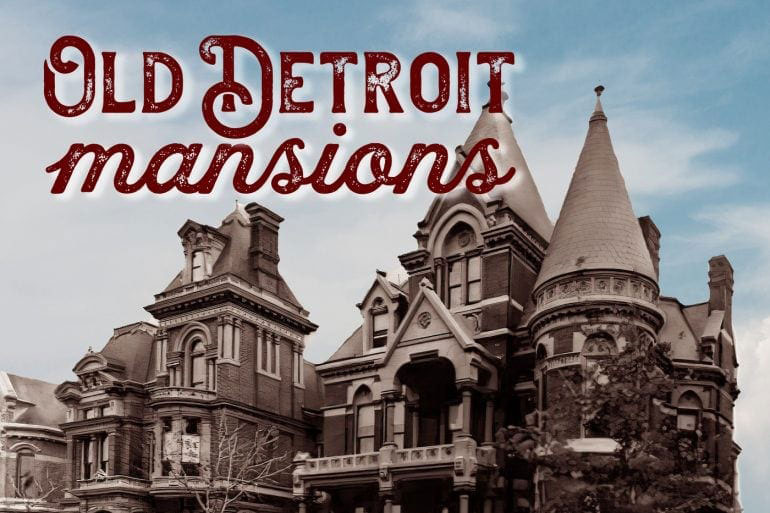
Long before Detroit became the Motor City, the city was already home to wealthy businessmen, industrialists and influential families who built remarkable residences along its most prestigious streets. These homes reflected the fortunes created by lumber, shipping, manufacturing, commerce and media during Detroit’s rapid growth in the late 19th and early 20th centuries. From elaborate Victorian mansions to grand urban residences, these 11 historic homes offer a closer look at the architecture and people who shaped a very different Detroit.
The David Whitney Jr. Mansion
The David Whitney Jr. Mansion is one of the clearest symbols of Detroit’s wealth before the automobile industry came to define the city. Whitney made his fortune in the lumber business before expanding into real estate, banking and other commercial ventures. By the end of the 19th century, he had become one of Detroit’s wealthiest businessmen, and his home was designed to make that position unmistakably clear.
Built between 1890 and 1894, the mansion became one of the most elaborate private residences in Detroit. The enormous structure contained around 52 rooms, 10 bathrooms, 218 windows and 20 fireplaces. It was built with rose-colored stone and decorated with stained-glass work, expensive woodwork and elaborate interiors. At roughly 21,000 square feet, the mansion was closer in scale to a small institutional building than an ordinary family home.
One of its most remarkable features was a private elevator, an extraordinary luxury for a residence at the time. The property also included a large carriage house, reflecting the transportation needs of wealthy families before automobiles became common. Today, the building survives as The Whitney, allowing visitors to experience one of the few remaining examples of Detroit’s Gilded Age residential architecture.

The Henry Russel Residence
The Henry Russel Residence represented another side of Detroit’s wealthy residential landscape at the beginning of the 20th century. Homes such as this were built when the city’s elite were increasingly concentrating along prestigious avenues and creating neighborhoods where architecture became part of social identity.
The residence reflected the elaborate design language popular among affluent Americans during the Victorian era. Large homes were rarely designed simply around efficient living space. Towers, decorative roofs, porches, ornamental facades and complex floor plans allowed owners to create buildings that could immediately communicate wealth and status.
For a modern reader, these homes reveal something important about Detroit before the automobile boom. The city already possessed a class of people wealthy enough to commission ambitious private architecture. Ford and the auto industry would eventually make Detroit famous, but they entered a city that already had established commercial wealth.

Step back into old Detroit and discover the remarkable homes built by the city’s first wealthy families. Watch the video to explore the architecture, history and forgotten world that existed long before Detroit became the Motor City.
The McGraw House on Woodward Avenue
Woodward Avenue became one of the most important addresses in old Detroit, and the McGraw House was part of the residential landscape that made the avenue a symbol of prestige. During this period, wealthy residents were not simply purchasing houses—they were positioning themselves along the city’s most visible and influential corridors.
The house reflected the large-scale residential architecture that characterized Detroit’s upper-class neighborhoods. Its presence on Woodward Avenue connected it to a larger collection of mansions, churches and prominent buildings that transformed the route into an architectural showcase.
Today, it is difficult to imagine Woodward Avenue entirely as a corridor of private mansions. The avenue would eventually change as Detroit expanded, commercial development increased and the city became more heavily associated with industry and automobiles. Historic photographs of homes like the McGraw House therefore preserve an image of a Detroit that has largely disappeared.

The George Gough Booth Home
The George Gough Booth Home offers another example of how business success and architecture became closely connected among Detroit’s elite. Booth was part of an influential family associated with publishing and business, and his residence reflected the wealth and social position accumulated by prominent Detroit families during the city’s period of expansion.
Homes of this scale were often designed not only for private life but also for entertaining, hosting guests and maintaining a public social position. Large reception rooms, formal dining areas, extensive grounds and elaborate entrances allowed a residence to function almost as a private institution.
The architecture therefore tells only part of the story. A house such as the Booth residence also represented access—to political networks, business relationships and the social circles that shaped Detroit’s development. The mansion was a home, but it was also part of the infrastructure of elite life.

The Charles L. Freer House
Charles Lang Freer was one of Detroit’s most successful industrialists and later became internationally known as an art collector. His house provides an opportunity to see how industrial wealth could eventually be transformed into cultural influence.
Freer built his fortune through manufacturing, particularly the production of railroad cars. As his wealth increased, he developed a serious interest in art and eventually assembled one of the most significant collections of Asian and American art of his era. His collection later became the foundation of the Freer Gallery of Art.
The importance of his residence therefore extends beyond architecture. It represents a pattern common among wealthy industrialists of the period: first, the creation of capital through business; then, the accumulation of property and luxury; and finally, the use of wealth to build a cultural legacy.

The John Scripps Residence
The Scripps family was one of the most influential families in Detroit, particularly through its connection with newspapers and publishing. The John Scripps Residence represented the type of large urban home associated with families whose influence extended beyond private business into public life and media.
Detroit’s wealthy families did not always build their fortunes in factories. Publishing, trade, finance and other industries also created powerful networks of wealth. The Scripps residences therefore help expand the story beyond the traditional image of Detroit as purely an industrial city.
Architecturally, these large homes also demonstrated how family influence could become physically embedded in the city. A prominent surname could be associated with businesses, institutions, streets and residences, creating a legacy that extended across generations.

The William C. McMillan House
The William C. McMillan House reflected the architectural confidence of a city whose economy and population were expanding rapidly. Large private residences became one of the most visible ways for successful businessmen and professionals to demonstrate that they had become part of Detroit’s upper class.
Like many homes of the period, the building combined practical residential space with elaborate decorative elements. Victorian architecture encouraged complexity rather than minimalism, producing homes with multiple visual layers and highly detailed exteriors.
This makes the old Detroit mansions particularly interesting today. Modern luxury architecture often emphasizes clean lines and simplicity. The houses of Detroit’s Gilded Age elite did almost the opposite. Their complexity was part of the message.

The John N. Bagley House
The John N. Bagley House is among the strongest reminders that Detroit’s wealthy families were deeply connected to the city’s commercial development. Bagley was a prominent businessman whose success helped place his family among Detroit’s social elite.
A mansion built for such a family had to perform several functions simultaneously. It had to provide comfortable private living space, accommodate family members and staff, and create a public impression strong enough to match the owner’s position.
This explains why these houses were often much larger than modern family homes. Their size was not necessarily the result of personal extravagance alone. Large households, servants, formal entertaining and social expectations all influenced the architecture.

The James Scripps Residence
The James Scripps Residence continued the story of the Scripps family’s influence on Detroit. Like other large homes associated with wealthy families, it reflected the way economic success could become intergenerational.
This is an important feature of the old Detroit landscape. Many mansions were not built as temporary luxury purchases. They were intended to become family properties and long-term symbols of stability. Their massive construction and prominent locations suggested permanence.
History, however, had other plans. Detroit would change dramatically over the following century, and many homes that once appeared permanent would eventually be demolished or converted to other uses.

The Colonel Hecker House
The Colonel Hecker House was associated with one of Detroit’s most prominent industrial figures and represented the city’s growing connection to large-scale manufacturing. Hecker was involved in several industrial and business activities, making his residence part of the larger story of Detroit’s transformation into a major economic center.
The architecture of such homes reflected the confidence of industrial America. Wealth was increasingly being generated at scales that previous generations could hardly imagine, and successful entrepreneurs had both the capital and the motivation to build accordingly.
For modern readers, this makes the Hecker House interesting not simply because it was beautiful. It was a physical product of industrial capitalism. Without the businesses, factories, labor networks and expanding markets that generated enormous wealth, buildings of this scale would never have existed.

The James E. Scripps House
The James E. Scripps House completes the picture of Detroit as a city where wealth, family influence and architecture were closely connected. The Scripps name represented a powerful business and media legacy, and the family’s residences became part of Detroit’s elite residential landscape.
Like the other homes in this collection, the building was designed during an era when private architecture could function as a statement of public status. The house did not need a corporate logo or advertising campaign. Its size, location and appearance communicated the message.
Looking at these homes together reveals how Detroit’s wealthy residents used architecture to create permanence. Yet many of the buildings have disappeared, while others survived only by changing their original function.

The John H. Bagley House
The John H. Bagley House deserves attention as more than another large residence from old Detroit. It belonged to a period when the city’s most successful businessmen and influential families were using architecture to establish a visible presence in prestigious neighborhoods. A house of this scale was both a private residence and a public statement, reflecting the financial strength and social position of the family behind it.
Its Victorian-era design followed the architectural language popular among Detroit’s wealthy residents, where complexity was often a feature rather than a flaw. Elaborate façades, prominent rooflines, decorative details and large interior spaces gave these homes a sense of permanence and importance. For families such as the Bagleys, a mansion could also serve as a gathering place for business associates, political figures and members of Detroit’s upper social circles.
The Bagley House is particularly useful within the broader collection because it helps show how several powerful families helped shape the physical landscape of old Detroit. Their influence was not confined to factories, offices or commercial buildings. It extended directly into the city’s residential districts, where private wealth was transformed into architecture designed to be seen.

The William Livingstone Jr. Residence
The residence of William Livingstone Jr. connects old Detroit to one of the most important forces behind the city’s early prosperity: the Great Lakes. Before automobiles transformed Detroit into a global industrial symbol, the city’s location on the Detroit River and its access to the Great Lakes made shipping, trade and maritime business central to its economy.
For successful figures connected with this world, wealth was generated by movement. Timber, raw materials, manufactured goods and commercial cargo moved through the Great Lakes system, linking Detroit to a vast economic network across North America. The fortunes created through these activities helped support the construction of large residences and the growth of wealthy neighborhoods throughout the city.
The Livingstone residence therefore represents an important reminder that Detroit’s history cannot be reduced to cars and factories. Long before the assembly line became the city’s most famous economic symbol, Detroit had already developed commercial networks powerful enough to produce influential businessmen and substantial private fortunes.

The Charles C. Bowen Residence
The Charles C. Bowen Residence adds another layer to the story of wealth in early Detroit. When viewed alongside the homes of lumber barons, industrialists, publishers and shipping figures, it demonstrates that the city’s elite did not emerge from a single industry.
Detroit’s rapid growth created opportunities across commerce, professional services, manufacturing, property and transportation. As different sectors expanded, successful individuals accumulated enough capital to join the city’s upper class. Their homes became one of the most visible records of this process.
Architecturally, residences such as the Bowen home also reveal how competition among wealthy families could shape the city. A prominent location and impressive house could communicate achievement without the owner needing to explain anything. In an era before corporate skyscrapers became the dominant symbols of business power, the private mansion was often one of the clearest physical expressions of individual success.

The Robert M. Grindley House
The Robert M. Grindley House helps illustrate the scale of residential ambition that existed in Detroit’s wealthiest neighborhoods. Today, Detroit is often remembered through factories, automobile plants and large industrial structures, but the city also possessed an impressive landscape of private architecture built for people who benefited from its economic expansion.
Large residences required more than wealthy owners. They also depended on architects, builders, skilled craftsmen, suppliers and workers capable of constructing elaborate buildings from stone, brick, timber, glass and metal. Every mansion was therefore the product of a much larger economic system.
The Grindley House is useful because it shifts attention away from the individual owner and toward the city around the building. Detroit’s mansions were not isolated objects. They existed within entire neighborhoods designed around wealth, transportation and social prestige. Taken together, these homes show that old Detroit once possessed a residential landscape far more luxurious and architecturally diverse than the popular image of the city might suggest.

The E. W. Meddaugh Residence
The E. W. Meddaugh Residence captures many of the architectural characteristics that made upper-class homes of the Victorian era so visually distinctive. Unlike much modern residential architecture, which often emphasizes clean surfaces and simplified forms, Victorian design frequently embraced complexity.
Rooflines could rise and fall across different sections of the house. Gables, chimneys, porches and decorative elements created multiple layers across the exterior. Windows were not always arranged according to strict symmetry, and the overall building could appear to grow outward in different directions.
This approach made each major residence feel highly individual. A mansion was not supposed to disappear into the background. Its architecture created a recognizable identity, allowing the home to function almost like a personal brand for the family that owned it.
The Meddaugh residence therefore helps readers understand why historic photographs of old Detroit remain so visually compelling. These houses were designed during an era when wealthy homeowners often wanted more than efficiency and comfort. They wanted character, scale and unmistakable presence.
The Henry D. Shelden Residence
The Henry D. Shelden Residence provides a fitting final example of the world that existed in Detroit before the city became universally associated with automobiles. Like the other homes in the collection, it belonged to a period when commercial success and social ambition were being translated into increasingly ambitious private architecture.
Looking at the Shelden residence alongside the other 16 properties reveals an important pattern. Detroit’s wealthy residents came from different industries and professional backgrounds, but many shared the same instinct: success should leave a physical mark on the city.
That mark could take the form of a large mansion, an important business, an institution or a prominent address. In many cases, the architecture survived longer than the economic circumstances that originally created it. Even when a family’s influence declined or a neighborhood changed, photographs of these houses preserved evidence of a period when Detroit’s elite were reshaping the city around them.
As the final property in the collection, the Henry D. Shelden Residence provides a natural transition into the larger story. These 17 homes were not simply examples of old architecture. Together, they form a map of Detroit’s early wealth—revealing the industries, families and ambitions that helped build the city long before the automobile made it famous.
What These 11 Homes Reveal About Detroit’s First Industrial Fortunes
These houses demonstrate that Detroit did not suddenly become wealthy when the automobile industry arrived. The city already possessed established fortunes generated through lumber, shipping, publishing, manufacturing, trade and real estate. The automobile industry would eventually transform Detroit into a global industrial symbol, but it entered an economy that already had experienced decades of commercial growth.
That makes the houses especially interesting for readers interested in business and economic history. Each mansion represents more than architectural taste. Behind every large residence was a source of capital: a company, industry, family fortune or commercial network capable of generating enough wealth to finance construction on an extraordinary scale.
The question behind these homes is therefore not only “Who lived here?” but also “How did they make the money to build it?”
From Symbols of Power to Relics of a Lost Detroit
Many of these homes were built to look permanent. Heavy stone, elaborate masonry and massive structures suggested that their owners and families would remain part of Detroit indefinitely.
But cities change faster than architecture.
Detroit would become the Motor City, grow into one of America’s most important industrial centers and later experience enormous economic and demographic transformations. Neighborhoods changed, land values changed and large private homes became difficult to maintain.
Some mansions were demolished.
Others were converted.
A few survived.
That may be the most fascinating part of their story. These houses were originally built as symbols of personal success, but today they have become records of an entire economic era.
The great homes of early Detroit offer a glimpse into a city that existed before automobiles became its defining identity. Built for businessmen, industrialists and influential families, these residences reflected fortunes created through lumber, publishing, manufacturing, commerce and other industries. Their architecture revealed the ambitions of a growing American city, while their later disappearance or transformation shows how quickly wealth and urban landscapes can change. Together, these 11 homes preserve the story of a powerful Detroit that existed long before the Motor City was born.