On July 20, 1969, more than half a billion people watched as Neil Armstrong stepped onto the Moon. The United States had achieved what had seemed impossible only a generation earlier, and the images became some of the most famous ever recorded. Yet almost immediately, another story began to grow around Apollo 11: what if the astronauts had never gone there at all? The strange-looking flag, the missing stars, the shadows and the photographs all seemed to offer clues. More than five decades later, the conspiracy theory is still alive. But when those clues are examined alongside the physical evidence, a very different story emerges.
The Night America Watched A Man Walk On The Moon
Apollo 11 was not a small experiment conducted in secret. It was the culmination of a national program that had consumed enormous amounts of money, engineering effort and political attention. On July 16, 1969, Neil Armstrong, Buzz Aldrin and Michael Collins launched toward the Moon aboard a Saturn V rocket. Four days later, Armstrong and Aldrin landed in the lunar module Eagle while Collins remained in orbit above them. The mission was being watched around the world, and for many people the sight of human beings actually walking on another world seemed almost too extraordinary to be real.
Armstrong climbed down the ladder first, followed by Aldrin. The two astronauts spent about two and a half hours on the lunar surface, collecting rocks and soil, photographing their surroundings and deploying scientific instruments before returning to the lunar module. They then lifted off from the Moon, rendezvoused with Collins and began the journey home. Apollo 11 had accomplished President John F. Kennedy’s decade-old challenge, and the United States had won one of the most important symbolic contests of the Cold War.
The photographs from that mission would eventually become more than historical records. They would become the center of an entirely different story. The images looked unlike anything most people had ever seen: a black sky, a barren landscape, strange shadows and a flag apparently standing in an environment where there was no wind. Decades later, those unusual details would be repeatedly presented as clues that the entire mission had been staged.
But a photograph can look strange without being false.
Then People Started Asking: What If It Was Fake?
The Moon-landing conspiracy theory became particularly influential through books, television programs and later the Internet. Its basic argument was simple: the United States desperately needed to beat the Soviet Union to the Moon, so perhaps NASA had created a spectacular illusion instead of actually sending astronauts there. The theory offered an attractive alternative to a complicated technological explanation because it reduced an enormous achievement to one dramatic claim: the astronauts never left Earth.
The theory also had an advantage that many historical conspiracy theories possess. It did not require people to understand rocket propulsion, orbital mechanics or lunar geology. Instead, it invited them to look at a photograph and notice something that seemed wrong. Why was the flag moving? Why were there no stars? Why did the shadows look strange? Why did the astronauts’ footprints remain so sharply defined? Each question could be asked in a few seconds, while explaining the science behind the answer could take much longer.
That imbalance matters. Suspicion is often easier to communicate than explanation. A mysterious photograph can be shared millions of times with a single sentence attached to it, while the explanation requires context about lighting, vacuum, perspective and the properties of the lunar surface.
So rather than dismissing the conspiracy theory outright, it is more useful to examine its strongest arguments one by one.

Why Was The Flag Moving If There Is No Wind?
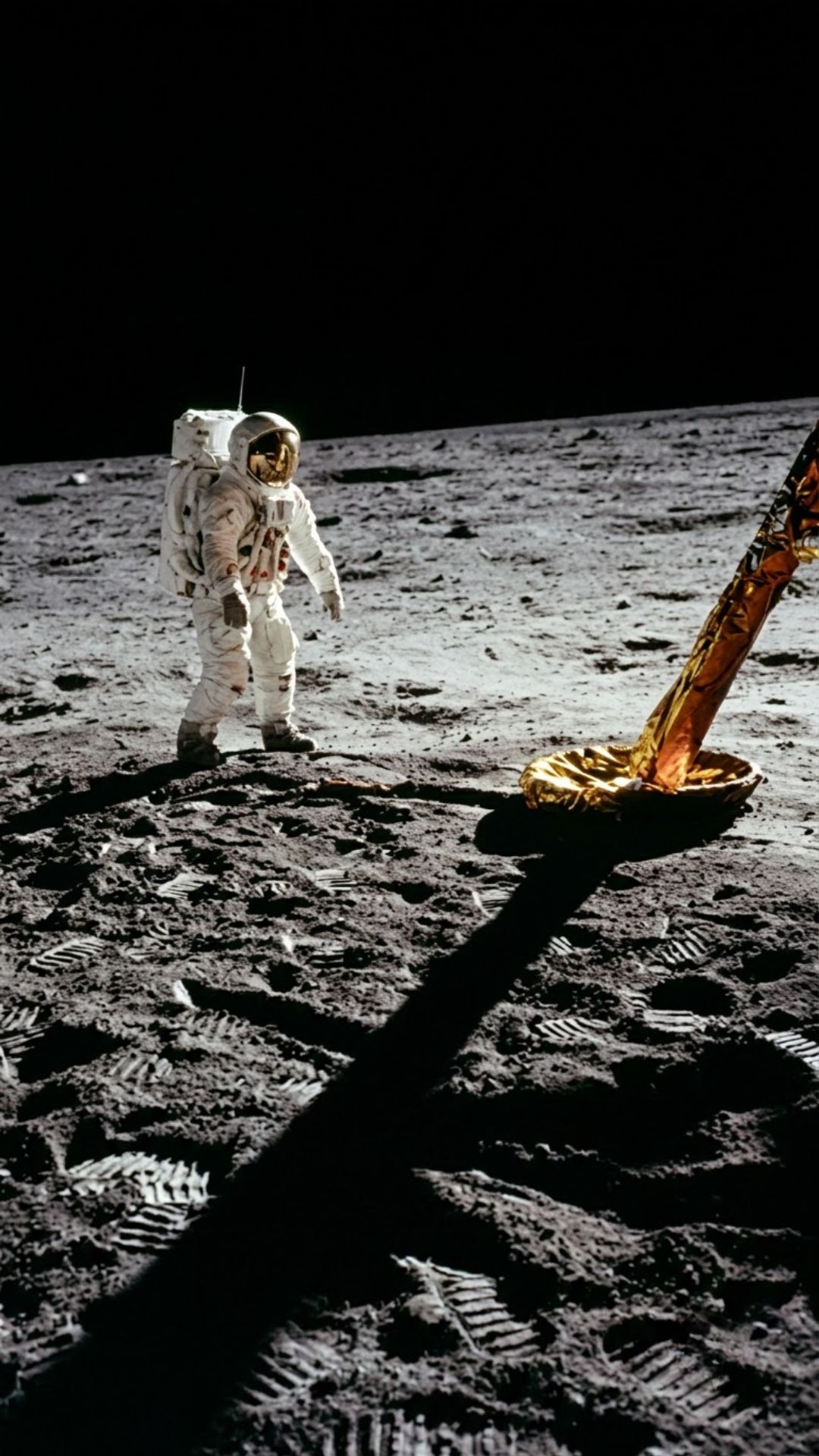
One of the most famous Apollo photographs shows Buzz Aldrin standing beside the American flag. To someone looking at it from Earth, the fabric appears to ripple as though a breeze is passing through it. That immediately creates a problem: the Moon has essentially no atmosphere, so there is no wind to make a flag wave.
The explanation begins with the way NASA designed the flag. Engineers knew that an ordinary flag would simply hang downward on the Moon, so the Apollo flag assembly included a horizontal support rod extending from the top of the vertical pole. This allowed the fabric to remain extended even though there was no wind to hold it open.
When Armstrong and Aldrin installed the flag, they had to rotate and manipulate the pole to push it into the lunar soil. That movement transferred energy into the fabric, causing it to oscillate. On Earth, air resistance would quickly damp such movement, but on the Moon there was almost no atmosphere to slow the fabric down.
The wrinkles created another visual effect. The horizontal rod did not fully straighten the material, leaving the flag with folds that made it look permanently caught in a breeze. What appears in the photograph, therefore, is not a flag being blown by wind. It is a piece of fabric that has been mechanically disturbed and is moving in an environment where there is almost no air resistance. The photograph really does show a moving flag. It just does not show wind.
Ever wondered why the Moon landing conspiracy theory still persists today? In this video, we dive deep into the origins, common myths, and the real evidence behind Apollo 11. Join us as we uncover the truth and explore why some secrets are so hard to let go. Watch now!
Why Can’t You See The Stars?
The black sky creates another famous Apollo mystery. If the astronauts were standing on the Moon, why are there no stars visible behind them?
The answer is connected to photography rather than astronomy. The lunar surface was being illuminated by direct sunlight, and the astronauts’ white spacesuits were extremely bright. To capture them correctly, the cameras were configured for the bright foreground. Stars, which are vastly dimmer, were not bright enough to register under those exposure settings.
This is why the absence of stars does not mean the sky was somehow artificial. The stars were still present above the astronauts, just as they are above Earth during the daytime. A camera exposed for a brightly illuminated object will not necessarily record much fainter objects in the same frame.
The effect can be demonstrated on Earth as well. A photograph taken outside on a bright sunny day can show a person clearly against a sky without recording faint stars, even though those stars remain physically present. The lunar environment makes the contrast even more dramatic because the Moon has no atmosphere to scatter sunlight and turn the sky blue.
The black sky therefore looks unfamiliar, but it is completely consistent with the environment in which the photographs were taken.

Why Do The Shadows Look Wrong?
The shadows in Apollo photographs have generated another line of suspicion. Some appear to point in different directions, leading conspiracy theorists to argue that several artificial lights must have been used inside a studio.
But photographs flatten a three-dimensional landscape into two dimensions, and the lunar surface is not perfectly flat. Small slopes, ridges and depressions can change the apparent direction and length of shadows when viewed from a particular camera position. Perspective can also make lines that are physically parallel appear to diverge or converge in an image.
There is another source of illumination that can be overlooked. Sunlight reflects from the bright lunar surface and can illuminate areas that are not receiving direct sunlight. That reflected light does not mean there was another artificial lamp beside the astronauts; it is a natural consequence of sunlight striking the Moon.
The result can look surprisingly complicated in a photograph. Shadows that seem inconsistent at first glance can become understandable once the terrain, perspective and reflected light are considered together.
Again, the important distinction is between something that looks unusual and something that contradicts physics.
The Apollo photographs often look unusual because the Moon itself is an unusual photographic environment.
What About The Radiation Belts?
One of the more technical arguments against the Moon landings concerns the Van Allen radiation belts surrounding Earth. The argument claims that astronauts could not have passed through these regions without receiving a lethal dose of radiation.
Radiation was certainly a genuine danger for Apollo astronauts. NASA did not ignore it, and the missions were designed with radiation exposure in mind. But passing through a radiation zone is not the same thing as remaining inside its most intense regions indefinitely. The Apollo spacecraft traveled through the belts relatively quickly, and exposure depended on the route, duration and shielding.
The astronauts also faced other serious risks that are sometimes forgotten when the missions are described as though they were carefully choreographed television events. The Apollo program involved powerful rockets, complex spacecraft, difficult navigation and the constant possibility of mechanical failure. Apollo 11 itself experienced computer alarms during the final descent, forcing Armstrong to take manual control while the lunar module was approaching the surface with limited fuel remaining.
That was not the behavior of a scripted performance. It was a real mission in which a series of small failures could have produced a real disaster.
The radiation argument therefore takes a genuine engineering challenge and turns it into a claim that the mission was impossible. The available evidence does not support that conclusion.
The Moon Rocks Are A Much Bigger Problem
The strongest evidence against the hoax theory is not a photograph.
It is what the astronauts brought home.
Across the six successful Apollo lunar landing missions, astronauts collected about 382 kilograms of lunar rocks and soil, comprising thousands of individual samples. Scientists have studied those samples for decades, using them to investigate the Moon’s origin, age and geological history.
These samples are not simply ordinary Earth rocks that were presented as lunar material. They contain distinctive characteristics associated with formation and exposure on the Moon, including evidence of an airless environment and a geological history different from that of Earth.
More importantly, the Apollo samples do not exist in scientific isolation. Robotic Soviet missions also returned lunar material to Earth, and lunar meteorites have been independently identified after falling to Earth. These separate sources provide scientists with material against which Apollo samples can be compared.
That creates an enormous problem for the idea of a Hollywood production.
A studio can reproduce a landscape. It can manufacture a costume. It can create a photograph.
But producing hundreds of kilograms of material with the physical and chemical characteristics of lunar samples—and having those samples agree with independently obtained lunar material—is a completely different challenge.
The Moon rocks therefore matter far more than whether a single photograph looks suspicious.
They are physical evidence that can be studied without trusting a television broadcast, a NASA press conference or one particular photograph.
Then There Was The Soviet Union
There is another piece of the story that makes the conspiracy theory especially difficult to sustain: the Cold War.
The Moon race was not a friendly scientific competition between countries that trusted one another. The United States and Soviet Union were geopolitical enemies, competing for technological prestige and strategic advantage. Moscow had every reason to expose an American deception if one existed.
The Soviet space program was also capable of monitoring what was happening. Soviet spacecraft were conducting their own lunar missions, and the Luna 15 probe was operating near the Moon at the same time Apollo 11 was carrying out its mission. The two countries’ space programs were closely aware of one another’s activities.
The Soviet Union had also been pursuing its own crewed lunar program. Its massive N-1 rocket was intended to carry cosmonauts toward the Moon, but repeated launch failures eventually destroyed that effort. One N-1 launch exploded in July 1969, only weeks before Apollo 11 successfully landed.
If the United States had secretly staged the Moon landing, exposing that deception would have been an extraordinary propaganda victory for the Soviet Union. Yet Soviet officials did not announce that Apollo 11 was a fraud. Instead, the Soviet space program continued to treat the American achievement as a genuine technological accomplishment. The Soviet response is not the only evidence that Apollo happened.
But it is an important piece of the larger picture because the United States’ greatest geopolitical rival had both the motive and the technological interest to challenge the story.
The Evidence Was Not Sitting In One NASA Filing Cabinet
The conspiracy becomes even harder to maintain when Apollo is considered as an entire program rather than as one television broadcast.
Apollo 11 was followed by five additional successful crewed lunar landings: Apollo 12, Apollo 14, Apollo 15, Apollo 16 and Apollo 17. Twelve astronauts eventually walked on the Moon between 1969 and 1972, collecting samples, conducting experiments and photographing the lunar surface.
The astronauts also left scientific instruments on the lunar surface. Among the most famous are laser-ranging retroreflectors placed by Apollo 11, 14 and 15. These devices can reflect laser pulses sent from Earth back toward their source and have been used to make extremely precise measurements of the Earth-Moon distance and the Moon’s motion.
Later spacecraft have also photographed the Apollo landing sites from lunar orbit. Modern images can show the descent stages and other traces associated with the missions, providing evidence that exists independently of the original television broadcasts.
This matters because a conspiracy based entirely on staged photography would have to explain far more than photography.
It would have to account for spacecraft trajectories, communications, tracking, scientific experiments, physical samples, hardware left on the Moon and observations made decades later.
The evidence does not sit in one NASA filing cabinet. It exists across different scientific disciplines and across more than half a century.
Could Thousands Of People Really Keep The Secret?
Another difficulty is the sheer scale of the supposed deception.
The Apollo program involved enormous numbers of scientists, engineers, technicians, contractors, manufacturers, astronauts and flight controllers. Thousands of people worked directly on the missions, while many more were involved in producing the rockets, spacecraft, computers, communications systems and scientific equipment.
The launch itself was witnessed by thousands of journalists and spectators, while mission communications were followed by tracking stations and observers around the world. The astronauts were then recovered in the Pacific Ocean in full view of a large naval operation.
That does not make a conspiracy logically impossible. Governments have kept secrets before.
But the Moon-landing theory requires something much larger than a secret government project.
It requires the creation of false physical evidence and the maintenance of that false story across multiple missions and decades. It requires lunar samples to withstand scientific examination, spacecraft tracking to remain consistent, equipment to appear on the lunar surface and rival nations to accept the deception.
The more independent evidence that has to be fabricated, the larger the conspiracy becomes.
Eventually, the explanation becomes far more complicated than the event it is supposed to replace.
Why Did NASA Stop Going To The Moon?
There is another question that often sounds more suspicious than it really is: if humans landed on the Moon six times, why did they stop?
Apollo was created for a specific political and national objective. President Kennedy’s challenge had been to land a man on the Moon and return him safely to Earth before the end of the 1960s. Once that goal had been achieved, the political urgency behind the program declined.
Apollo 17 became the sixth and final crewed lunar landing in December 1972. NASA had originally envisioned additional missions, but changing priorities and budget constraints brought the Apollo program to an end.
The important point is that ending a program does not erase the achievement that came before it.
The United States stopped sending Apollo astronauts to the Moon for political and financial reasons, not because the technology suddenly revealed that the earlier missions had been impossible. Robotic spacecraft continued exploring the Moon, and decades later NASA began developing a new generation of crewed lunar missions through the Artemis program.
History is full of expensive projects that governments abandon once their original objective has been achieved. The Moon was no different.
Why The Conspiracy Theory Refuses To Die
If the evidence is so extensive, why does the conspiracy theory continue to attract believers?
Part of the answer is that conspiracy theories often thrive on distrust. The Apollo era was followed by Vietnam, Watergate and other events that damaged public confidence in government institutions. Once people begin assuming that authorities routinely conceal important truths, official explanations can become less persuasive even when the evidence supporting them is strong.
The Internet added another powerful ingredient: context can disappear almost instantly.
A photograph of the Apollo flag can be separated from the explanation of how it was installed. A photograph without stars can be presented without explaining exposure. A shadow can be isolated from the terrain that produced it. A short video can raise a question without providing the scientific context needed to answer it.
The conspiracy therefore survives partly because its questions are visually powerful. The answers are usually much less dramatic.
That is why simply telling people to “trust NASA” is not particularly useful. The stronger approach is to examine the evidence itself and ask whether the different pieces independently point toward the same conclusion. They do.
The Most Extraordinary Part Was That It Really Happened
The Moon landing is sometimes described as unbelievable because it was extraordinary.
But extraordinary does not mean impossible.
By 1969, the United States had spent years developing the rockets, spacecraft, navigation systems, computers, communications networks and scientific equipment needed for a lunar mission. The Apollo program had also already suffered a tragedy: three astronauts were killed in the Apollo 1 fire during a ground test in 1967, forcing NASA to redesign important parts of the spacecraft.
The program was therefore not a flawless technological miracle. It was a dangerous engineering project that repeatedly confronted failures, delays and enormous technical problems.
Apollo 11 itself came close to running out of options during the final descent. The lunar module’s computer issued alarms, while the automated landing trajectory was taking the spacecraft toward an area Armstrong considered unsafe. He took manual control and searched for a suitable landing site while the spacecraft’s fuel continued to decrease. Then Eagle touched down.
Armstrong and Aldrin walked onto the Moon. They collected rocks and soil, deployed scientific equipment and photographed the surface. They returned to lunar orbit, rendezvoused with Collins and came home. And then five more Apollo missions landed humans on the Moon. The story sounds extraordinary because it was. It does not need to be a hoax to be remarkable.
The Moon Landing Was Not Proven By One Photograph
There is no single Apollo photograph that proves the Moon landing happened. That is not how serious evidence works. The case is cumulative.
The photographs are consistent with the lunar environment. The flag behaves as expected from its mechanical design. The absence of stars is explained by the camera exposure. The strange-looking shadows are consistent with sunlight, perspective, uneven terrain and reflected illumination. The radiation threat was real but manageable through mission design and limited exposure. Then the evidence becomes physical.
There are hundreds of kilograms of lunar samples. There are scientific instruments left on the Moon. There are laser-ranging experiments. There are mission records and communications. There are observations from later lunar spacecraft. And there was a rival superpower with every incentive to expose an American fraud.
Any individual piece can be questioned. The entire network is much harder to explain away. That is the crucial difference between suspicion and evidence. A conspiracy theory can always ask another question. Evidence becomes powerful when independent answers repeatedly point in the same direction.
The Greatest Hoax Would Have Required Explaining Everything
The Moon-landing conspiracy begins with an apparently simple question: what if the photographs were fake?
But once that question is taken seriously, it creates a much larger set of problems.
Where did the lunar samples come from? Why do they match independently identified lunar material? What happened to the scientific instruments? How were the communications and tracking handled? How did the spacecraft reach the Moon and return? Why did the Soviet Union accept the achievement rather than expose it? How did five additional successful lunar landing missions fit into the same deception? And why can modern spacecraft still identify physical traces of Apollo landing sites on the Moon? At some point, the conspiracy becomes more complicated than the event itself. The simpler explanation is the one supported by the evidence: Apollo 11 happened.
Neil Armstrong really stepped onto the Moon. Buzz Aldrin really followed him. Michael Collins really orbited above them. The astronauts really returned lunar material to Earth, and the equipment they left behind really remained on the lunar surface. The photographs do not undermine that story. They show us what the Moon actually looked like.
The Moon Landing Was Real. The Mystery Is Why We Still Doubt It.
The most interesting question may therefore no longer be whether Apollo 11 happened.
It is why an event witnessed by hundreds of millions of people, documented by thousands of participants and supported by decades of physical and scientific evidence can still feel unbelievable.
Part of the answer may be that the Moon landing represented a moment when technology moved far beyond ordinary human experience. Most people will never travel 240,000 miles through space, orbit another world or stand on a landscape where the sky is permanently black. The images therefore look alien because the environment really was alien.
That unfamiliarity created the perfect material for suspicion.
The flag looked wrong because there was no wind. The sky looked wrong because there was no atmosphere. The shadows looked wrong because the terrain and lighting were unlike Earth. The photographs looked empty because there were no trees, buildings or clouds.
In other words, some of the strangest things about the photographs are strange precisely because they show another world.
That may be the most ironic part of the entire conspiracy. The photographs look unreal because the place they captured was real.
The Apollo Moon landing remains one of history’s most extraordinary achievements, which is partly why the conspiracy theory has survived for so long. The flag, missing stars, strange shadows and radiation arguments can look convincing when isolated from their context. But the wider evidence tells a very different story: hundreds of kilograms of lunar samples, scientific instruments left on the Moon, laser-ranging experiments, mission records, later orbital observations and the scrutiny of America’s Cold War rival all point in the same direction. The Moon landing was not a perfect illusion. It was a real journey—and one of humanity’s most remarkable achievements.
This story draws on NASA’s historical and scientific records concerning Apollo 11, the Apollo lunar missions, lunar samples and experiments left on the Moon. Additional historical material on the Apollo conspiracy theory and the Cold War space race helps place the familiar claims about the photographs in their wider context. Together, these sources provide a stronger basis for examining the evidence than relying on any single photograph or argument. Source: https://www.britannica.com/topic/Was-the-Moon-Landing-Fake