The divers had gone down to the bottom of the Atlantic expecting to find bodies. The tugboat had capsized, 11 crew members were already believed dead, and the wreck lay about 100 feet beneath the surface. Then a diver’s camera revealed what looked like another body inside the darkness. He reached toward the hand. Suddenly, the hand grabbed him. The man inside the wreck was not dead. Harrison Okene had been trapped underwater for almost three days, and somehow, he was still alive.
The Diver Was Looking For Bodies
On May 26, 2013, Harrison Odjegba Okene was working as the cook aboard the Nigerian tugboat Jascon-4. The vessel was operating in waters off the coast of Nigeria, helping to stabilize an oil tanker, when the situation suddenly turned catastrophic. Okene was in the bathroom at about 4:30 in the morning when the tug lurched violently and began to overturn. Within minutes, the vessel was underwater.
Okene was 29 years old and wearing only his boxer shorts. As the boat rolled, he was thrown around inside the small bathroom and struggled to understand what was happening. Water rushed through the vessel, and the darkness was almost complete. He tried to escape through an emergency hatch but could not reach it in time, while other crew members were swept away as the tug disappeared beneath the surface.
The Jascon-4 eventually came to rest upside down on the seabed at a depth of roughly 30 meters, or about 100 feet. Of the 12 people aboard, Okene would become the only survivor. The other 11 crew members died. By the time divers reached the wreck, nobody expected to find a living person inside. They were there to recover the dead.
Witness an incredible story of survival! Watch the dramatic moment divers discover Harrison Okene alive after he was trapped for 60 hours in an air bubble within a sunken ship, 98 feet underwater. This rare, heart-pounding rescue footage is truly unforgettable. Click now to see how this miracle unfolded!
He Found A Pocket Of Air In The Darkness
After escaping the bathroom, Okene felt his way through the submerged vessel, searching for somewhere that might offer protection. He found some tools and two flashlights, which he tucked into his clothing, and eventually reached a cabin where the water had not completely filled the space. Above him was a small pocket of trapped air.
It was not a large room where he could move around comfortably. It was a tiny refuge inside a completely submerged wreck, surrounded by freezing water and darkness. As the water level rose, Okene climbed onto a platform and placed two mattresses on top of it, trying to keep his body above the water. His entire world had been reduced to a small pocket of air inside a ship resting on the ocean floor.
He had almost nothing to eat or drink. One bottle of cola became his only source of liquid and energy during the ordeal. The temperature was dropping, the available oxygen was slowly being consumed, and Okene had no idea whether anyone knew he was still alive.
The psychological isolation was just as frightening as the physical conditions. He later described the surroundings as completely black and filled with noise from the water and wreckage. He was cold, hungry and terrified, but he had nowhere to go. Leaving the air pocket meant entering the dark water inside the wreck, with no guarantee that he could find another pocket of air. So he stayed where he was and waited.

Three Days In The Dark
As the hours passed, Okene began to believe that he might never leave the wreck alive. He knew the other crew members were somewhere inside the overturned vessel, but he could not reach them. He also knew that anyone searching from the surface might assume that everyone aboard had died.
His wife had sent him Bible passages before he went to sleep that night. Trapped in the darkness, Okene began repeating the verses he remembered, reading mentally from Psalm 54 through Psalm 92. His faith became one of the few things he could control while everything else around him remained beyond his reach.
At one point, he heard something that sounded like an engine. Then he heard an anchor dropping. For the first time, he realized that rescuers might actually be nearby.
Okene tried to make himself heard. He moved through the cabin and found a section of the wall where he could reach the steel structure of the boat. He took a hammer and began striking it, hoping the sound would travel through the wreck and reach the divers outside. But nobody came.
Eventually, he heard the rescuers moving away. They were close enough for him to know they had been there, yet far enough away that they never realized someone was desperately trying to attract their attention from inside the wreck. It was one of the most devastating moments of the ordeal: help had arrived, but the rescuers had no idea that a living man was waiting for them in the darkness.
By the time the divers returned, Okene had already been underwater for almost three days.
Then The Diver Found The Hand
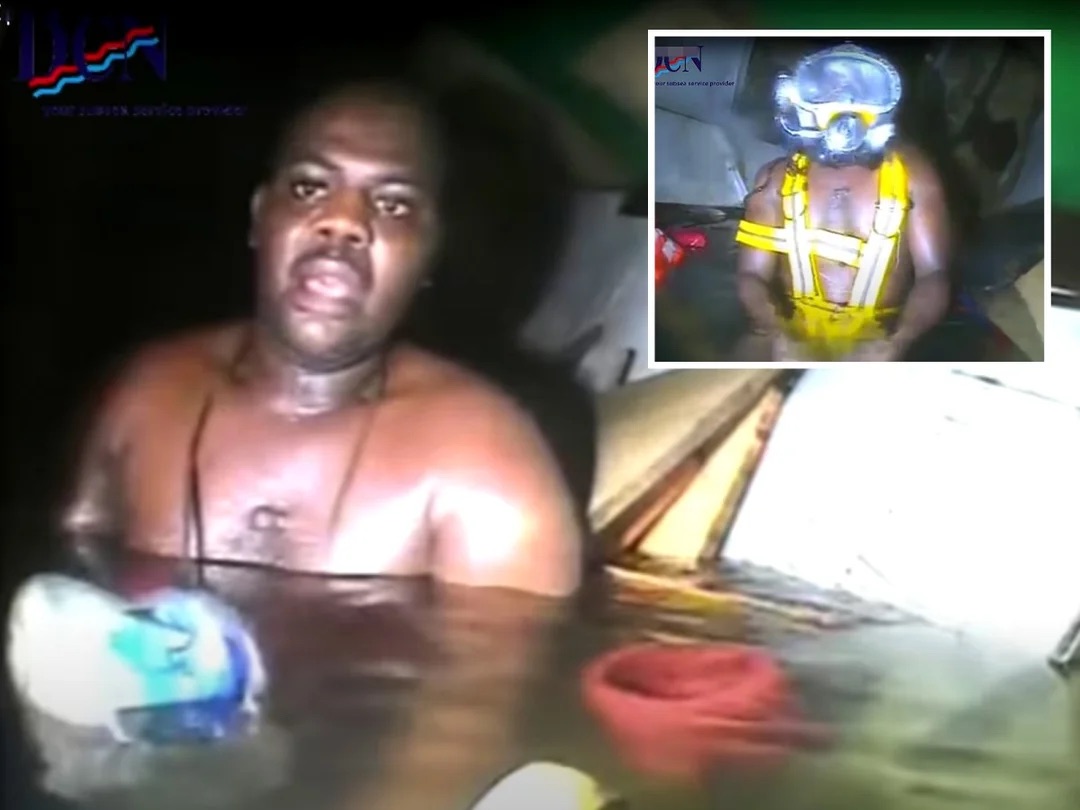
The rescue team had not come looking for Okene. They were searching for bodies. The divers had already recovered four bodies from the wreck when one of them entered another section of the sunken tug. His camera transmitted the scene back to the support vessel, allowing the team above to watch what he was seeing.
Then a hand appeared on the screen. Everyone assumed they were looking at another corpse. The diver moved toward it and reached out to grab the hand. Instead, the hand grabbed him.
For a moment, neither side understood what was happening. The diver was underwater expecting to find a dead crew member. Okene had been trapped in darkness for nearly three days and suddenly saw a light and a human figure approaching him. The shock was mutual, but the realization soon reached the people watching from the surface: there was someone alive inside the wreck.
The divers had found a survivor. After nearly three days beneath the Atlantic, Okene had finally made contact with another human being. But finding him was only the beginning. Getting him out alive would be another problem entirely.
The Most Dangerous Part Was Still Ahead
At first glance, the rescue might seem simple: find the survivor, bring him to the surface and take him home. At a depth of about 30 meters, however, the human body cannot simply be pulled rapidly from high pressure underwater to normal atmospheric pressure. Okene had spent roughly 72 hours breathing compressed air inside an enclosed space at depth, and bringing him directly to the surface could have caused severe decompression illness.
The divers therefore had to bring him out carefully. They supplied him with oxygen and helped prepare him for the journey from the wreck. He was moved into a diving bell and then taken through a controlled decompression process rather than being rushed directly to the surface. Afterward, he spent additional time in a decompression chamber while his body gradually returned to normal pressure.
This was not simply a matter of surviving the shipwreck. Okene had survived the sinking, survived the darkness, survived the cold and survived nearly three days inside an air pocket that was steadily running out of oxygen. Now he also had to survive the journey home.Eventually, he did.
The Man Who Was Supposed To Be Dead
By the time Okene was brought safely back to the surface, his relatives had already been told that the sailors aboard the Jascon-4 were dead. From their perspective, there had been no reason to believe that anyone could still be alive inside the wreck after so many hours underwater. Yet there he was.
Okene later described the rescue as an act of divine deliverance. During the ordeal, he had prayed repeatedly and clung to the Bible passages his wife had sent him. The physical circumstances were extraordinary enough that even the rescue professionals involved described his survival as remarkable.
What makes the story particularly powerful is that there was nothing comfortable about those three days. There was no large chamber, no supply of food, no functioning power system and no certainty that anyone would come. There was only a small pocket of air inside a wreck, one bottle of cola, a few tools, two mattresses and a man trying to remain alive long enough for somebody to find him.
And almost nobody was looking for him. The divers had gone down expecting to recover the dead. Instead, they discovered a man who had somehow remained alive.

A Survival Story That Should Have Ended Differently
The sinking of the Jascon-4 was a tragedy in which 11 people lost their lives. Okene’s survival does not change that fact, and it does not make the disaster less devastating for the families who lost someone. What it does provide is an extraordinary example of how a person can survive under circumstances that appear almost impossible.
He had been trapped about 30 meters below the surface for approximately three days. The surrounding water was cold, the available air was gradually diminishing, and rescue was uncertain. At one point, rescuers were close enough for him to hear them but failed to realize he was alive.
Then came the moment nobody expected. A diver entered the wreck searching for a body. A hand appeared. He reached for it, and the hand reached back.
That single movement transformed the entire rescue operation. What had begun as a recovery mission suddenly became a race to bring one living man out of a sunken ship before his remaining air, strength and body could no longer sustain him.
Okene survived. The Jascon-4 did not. And the image of that hand reaching out from the darkness remains one of the most extraordinary moments ever captured during an underwater rescue.
The Survivor Who Would Not Let The Ocean Define Him
Years later, Okene continued to speak about the experience and its effect on his life. The ordeal left him with nightmares and a difficult relationship with what had happened, but it did not permanently drive him away from the water. In a later account, he described gradually confronting his fear rather than allowing the experience to control him.
That makes his story more interesting than a simple tale of miraculous survival. Surviving the wreck was only one part of what happened to him. The longer challenge was returning to ordinary life after spending nearly three days convinced that death was approaching from every direction.
The ocean had almost taken his life. Instead, it left him with a story very few people could ever tell. He had entered the wreck as a ship’s cook and emerged as the sole survivor of a disaster that killed everyone else aboard.
Somewhere in between those two moments, alone in the darkness at the bottom of the Atlantic, he had managed to stay alive long enough for a diver to find the one thing everyone else believed was no longer there: a living man.
In May 2013, Harrison Okene was trapped inside the overturned Jascon-4 at the bottom of the Atlantic after the tugboat sank off the coast of Nigeria. Eleven other crew members died, while Okene survived for roughly 72 hours inside a small pocket of trapped air. When divers arrived, they were searching for bodies and initially assumed the hand on their camera belonged to another victim. Then the hand grabbed the diver. Okene was alive. His rescue still stands as one of the most extraordinary underwater survival stories ever recorded—a story of fear, faith, endurance and a single pocket of air that kept one man alive until help finally found him.
This story is based on reporting from The Guardian about Harrison Okene’s survival and the remarkable video footage showing the moment divers discovered him alive inside the sunken tugboat. The original report provides the details of the sinking, his nearly three days underwater and the extraordinary moment when a routine body-recovery mission suddenly became a rescue. Source: https://www.theguardian.com/world/2013/dec/03/video-rescue-ships-cook-three-days-under-water