On the afternoon before Thanksgiving in 1971, a quiet man in a business suit walked into Portland International Airport and bought a one-way ticket to Seattle for $18.52. He looked like an ordinary businessman, but he was about to commit one of the strangest crimes in American history. Less than an hour after takeoff, he told a flight attendant that he had a bomb and demanded $200,000, four parachutes and a refueling truck waiting in Seattle. The passengers were eventually released, but the mysterious man stayed aboard. Then, somewhere over Washington that night, he opened the rear staircase of the Boeing 727 and jumped into the darkness. He was never seen again.
The Man Who Bought A One-Way Ticket
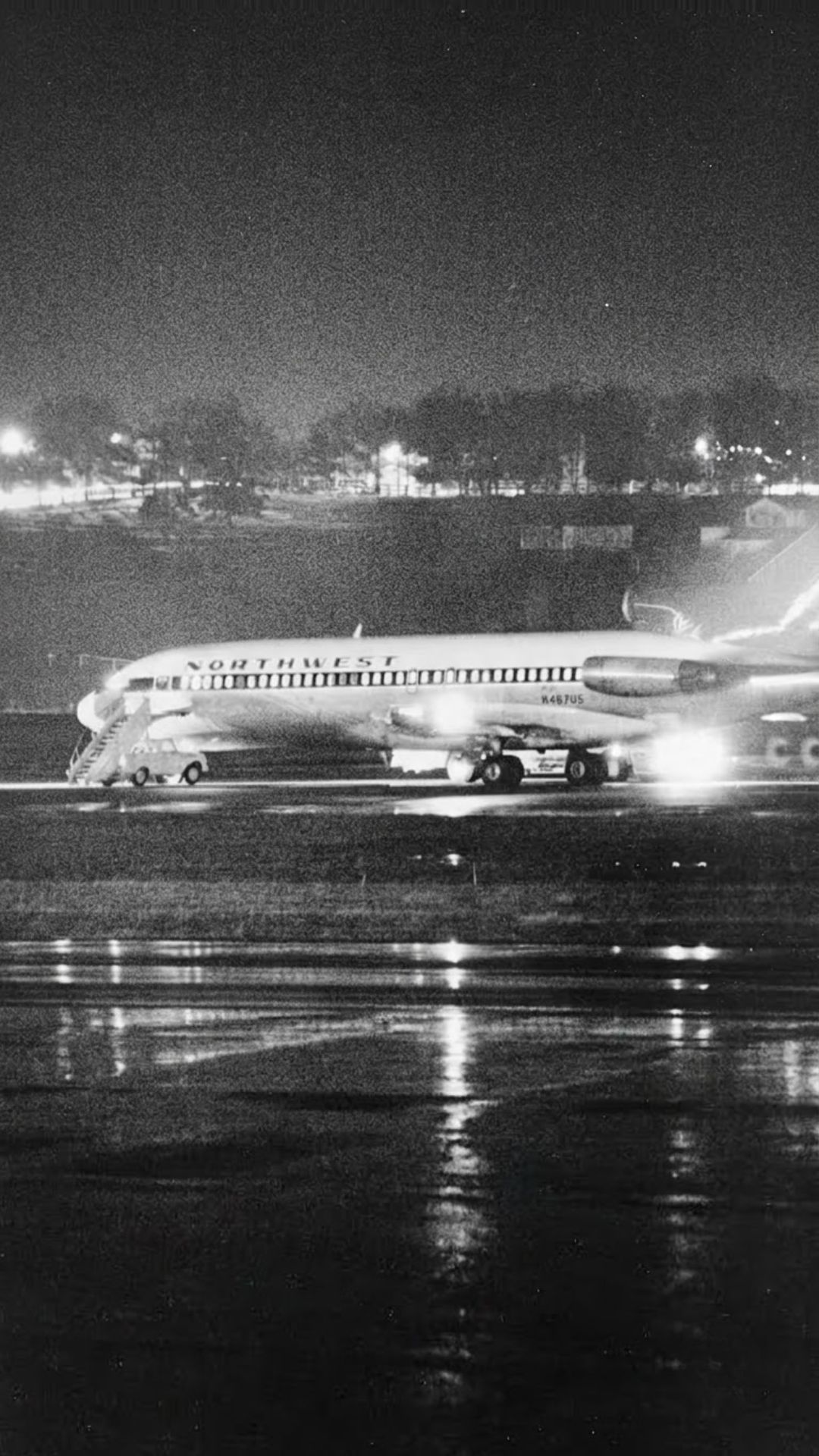
The man called himself Dan Cooper. On November 24, 1971, he walked up to the Northwest Orient Airlines counter at Portland International Airport, paid $18.52 in cash and purchased a one-way ticket to Seattle. At the time, airline security was nothing like it is today, and passengers did not routinely go through the extensive identification and screening procedures that became standard decades later. Cooper therefore boarded Flight 305 without attracting much attention, taking a seat toward the back of the Boeing 727 as if he were simply another traveler heading north for Thanksgiving.
He was described as a man in his mid-40s wearing a dark business suit, white shirt and black tie. He ordered a bourbon and soda and settled into his seat. Nothing about him immediately suggested that he was planning anything extraordinary. Then, shortly after the plane took off, he handed a flight attendant a note. When she initially put it away without reading it, Cooper leaned toward her and quietly indicated that she should look at it. He then showed her what appeared to be a bomb inside his briefcase.
The demands were precise. He wanted $200,000 in twenty-dollar bills, four parachutes and a refueling truck waiting when the aircraft reached Seattle. The flight attendant carried the message to the cockpit, and the crew quickly understood that the man sitting quietly among the passengers had taken control of the situation. The money was not an arbitrary amount, and the parachutes were not an afterthought. In retrospect, those demands were the first indication that Cooper had thought carefully about what would happen after the plane landed.
The strangest part was that Cooper apparently had no intention of escaping through the airport. He was planning to leave the aircraft itself.
Dive into the enduring mystery of D.B. Cooper, the only unsolved skyjacking case in FBI history. Discover new scientific evidence, dramatic reenactments, and expert theories about whether he survived his daring jump. Was he a mastermind or a tragic victim of the elements? Watch the full episode to uncover the truth!
He Was Planning Something More Dangerous Than A Normal Getaway
When Flight 305 landed in Seattle, the ransom money and parachutes were delivered. Cooper then released all 36 passengers, leaving only himself and several members of the crew aboard. He instructed the pilots to take off again and fly toward Mexico City, but his demands contained another important detail: the aircraft was to remain at a relatively low altitude and slow speed, conditions that would make a parachute jump possible.
Cooper’s choice of aircraft was crucial. The Boeing 727 had a rear staircase that could be lowered during flight, allowing someone to exit from the back of the aircraft rather than having to jump through a side door. It was an unusual feature, and it gave Cooper a potential escape route that most passengers would never have considered. The FBI later learned that he appeared to have a surprisingly good understanding of the aircraft and its operating conditions.
The newly released FBI files make that part of the story even more interesting. Cooper apparently knew enough about the aircraft to question the crew about its fuel requirements and insisted on details that suggested he understood how the plane needed to be operated. He was not behaving like someone who had simply watched a few movies about hijacking. His questions indicated that he had some knowledge of aviation, although investigators never established exactly where that knowledge came from.
Then there was the parachute.
At some point during the flight, Cooper took one of the parachutes apart to inspect it. A crew member noticed what he had done and asked whether he had dismantled it. Cooper acknowledged that he had. It is a tiny detail, but it may reveal more about him than almost anything else in the case: before trusting his life to a piece of equipment, he wanted to know what he was dealing with.
The man was preparing to jump from a passenger airplane at night. And he wanted to make sure the parachute worked.

Then He Opened The Rear Staircase
After the plane left Seattle, the atmosphere inside the cabin became increasingly tense. The passengers were gone, the ransom was aboard, and Cooper remained with the crew while the Boeing 727 flew south. The pilots knew what he intended to do, but they could not simply overpower him without risking the lives of everyone aboard. Instead, they followed his instructions while law enforcement tried to understand what was happening from the ground.
Sometime after 8 p.m., the rear staircase was lowered. Cooper had already secured the ransom money and selected a parachute. The aircraft was somewhere between Seattle and Reno, flying through darkness over the forests and mountains of Washington. Nobody outside the aircraft knew precisely what was about to happen, and even the crew could not see exactly what Cooper was doing behind them. Then he jumped. That was the last confirmed sighting of Dan Cooper.
The pilots eventually landed safely, but the hijacker was gone. So was the $200,000. Investigators now faced a problem that would make the case extraordinarily difficult: they did not know exactly where Cooper had landed. The plane had been moving, the weather was poor, the terrain below was heavily forested and the jump had occurred at night. Even a small error in calculating the aircraft’s position or the parachute’s descent could move the search area by miles.
The FBI launched an enormous investigation known as NORJAK, short for Northwest Hijacking. Agents interviewed witnesses, examined the aircraft, searched the suspected landing area and began building a profile of the mysterious hijacker. But there was an immediate and unsettling possibility that investigators could not ignore. Cooper might have survived.
The FBI Chased Hundreds Of Suspects
If Cooper had survived the jump, he would have had to accomplish something almost as difficult as hijacking the airplane itself: he would have needed to disappear completely. He had an eight-year head start before investigators even knew whether they were looking for a living man or a body somewhere in the wilderness. There was no confirmed landing site, no reliable identity and no clear explanation of what he might have done with the ransom.
The FBI followed hundreds of leads. Men with military backgrounds were investigated. So were pilots, parachutists, mechanics and people who appeared to have unusual knowledge of aviation. By the early years of the investigation, agents had examined hundreds of suspects and eliminated many of them through alibis, eyewitness testimony or other evidence.
One of the most intriguing suspects was Richard Floyd McCoy Jr., who hijacked another airplane only months after Cooper’s crime and escaped by parachute. McCoy possessed many of the skills investigators believed Cooper would have needed, and the similarities between the two crimes were striking. Yet the FBI eventually ruled him out, in part because his appearance did not match the descriptions provided by the flight attendants and because other evidence worked against the theory.
The investigation became so extensive that agents explored increasingly sophisticated methods of finding Cooper. An SR-71 Blackbird, one of the most advanced reconnaissance aircraft of its era, was even used in an attempt to photograph areas along the suspected flight path. Weather and visibility limited what the aircraft could accomplish, and the search produced no decisive breakthrough. Still, Cooper had made one mistake. He left his tie behind.

The $1.49 Tie Became One Of The Biggest Clues
The tie seemed almost meaningless at first. It was a cheap black J.C. Penney clip-on tie, the sort of ordinary piece of clothing that would normally disappear into the background of any investigation. But Cooper had removed it during the hijacking and left it on the airplane. For investigators who had almost no physical evidence connecting them to the man, that small object suddenly became extremely important.
The FBI eventually obtained a DNA sample from the tie, although the evidence has never produced a definitive identification. Later examination also revealed more than 100,000 microscopic particles embedded in the fabric. Among them were unusual materials such as unalloyed titanium, bismuth and strontium sulfide. Those particles generated theories that Cooper might have worked in or around specialized industrial, aerospace or electronics environments.
But once again, the evidence created as many questions as it answered. The particles might tell investigators something about where the tie had been, but they could not tell them with certainty who had worn it. The DNA might belong to Cooper, but it did not produce a confirmed name. The most important physical clue in the case therefore remained frustratingly incomplete.
Then, almost nine years after the hijacking, something much more tangible appeared. Someone found the money.
A Child Found Part Of The Ransom
On February 10, 1980, an eight-year-old boy named Brian Ingram was playing along the Columbia River near Vancouver, Washington, when he noticed something unusual buried in the sand. It was not treasure in the usual sense. It was a collection of deteriorating twenty-dollar bills, bundled together and partially damaged by the elements.
The serial numbers revealed that the money was part of the ransom given to Cooper nine years earlier. The total was $5,800, making it only a fraction of the original $200,000, but it was the first undeniable physical evidence connected to the money after the hijacking.
The discovery immediately reopened the central question.
How did the money get there?
The Columbia River was nowhere near the most likely landing site for Cooper, and the condition of the bills suggested that they had been exposed to the elements for some time. Perhaps Cooper had buried the money and never returned for it. Perhaps he had died before he could use it. Perhaps the river had carried the packets from somewhere else. Or perhaps another person had placed them there years after the hijacking.
Nobody could establish which explanation was correct.
The money therefore became another Cooper clue that seemed tantalizingly close to an answer without actually providing one. If he had survived and escaped, why abandon $5,800 of the ransom? If he had died, where was the rest of the money? And if the river had carried it to the location where it was found, from where had it originally entered the water?
More than half a century later, those questions remain unresolved.
The FBI Eventually Stopped Chasing Him
For decades, the Cooper investigation continued to consume time and resources. Agents followed new leads, reconsidered old suspects and examined evidence using technologies that had not existed when the hijacking occurred. The case became one of the FBI’s most famous mysteries, partly because the identity of the suspect remained unknown and partly because there was never a body to establish what had happened after the jump.
In July 2016, the FBI announced that it was redirecting resources away from the active investigation. The Bureau had spent 45 years pursuing credible leads, examining physical evidence and investigating hundreds of possible suspects. It was no longer willing to devote the same level of resources to a case in which the central question remained unanswered. The Bureau did, however, say that physical evidence related to the hijacking could still be submitted if genuinely new material emerged. The case should have faded into history. Instead, it became one of those mysteries that refused to disappear.
Newly released FBI records in 2026 have provided another glimpse into the investigation. The files reveal more about Cooper’s apparent aviation knowledge, his behavior during the hijacking and the enormous effort investigators made to determine his identity. They also show that some of the details that seemed insignificant at the time may have been more revealing than investigators initially realized.
But the new documents do not provide the one piece of information everyone wants.
They do not tell us who Dan Cooper really was.
The Greatest Mystery May Be Whether He Survived
There are two fundamentally different versions of the D.B. Cooper story.
In one, Cooper was an extraordinarily competent criminal who planned his escape, survived the parachute jump and disappeared into ordinary life. He may have changed his name, spent the ransom slowly and taken the secret to his grave. If that happened, there could have been a man somewhere in America for decades who knew that the FBI had been searching for him while nobody around him knew why. In the other version, Cooper died that night.
The jump was extremely dangerous. He was wearing business clothes rather than equipment designed for a night parachute landing, the parachute he used was not steerable and he was descending into a heavily wooded landscape in poor weather. He was also carrying the ransom money and had no confirmed knowledge of exactly where he would land. The FBI has long considered the possibility that he simply did not survive.
If that is what happened, the mystery becomes even stranger.
A man could have disappeared not because he executed the perfect escape, but because the wilderness swallowed the evidence.
The missing body would then explain almost everything. The lack of a confirmed landing site would explain the failed searches. The absence of the ransom would make sense if it had been lost or buried. And the lack of another confirmed sighting would simply mean that there was no one left to see him.
But there is still that money. And the tie. And the fact that someone who seemed to know exactly what he was doing took a parachute and jumped from an airplane at night. Perhaps he knew what he was doing. Perhaps he did not.
That is the question that has kept the Cooper mystery alive for more than five decades.
Fifty-Five Years Later, He Is Still A Mystery
The name D.B. Cooper itself is part of the mystery. The hijacker never called himself that. He identified himself as Dan Cooper, and the initials “D.B.” appear to have originated from a media error that became permanently attached to the case. Even the name by which the world remembers him is therefore not really his.
Everything else is similarly uncertain.
We know what Cooper demanded. We know how much money he received. We know which aircraft he hijacked and how he escaped. We know about the tie he left behind and the portion of the ransom that was eventually found. We know that the FBI spent decades investigating him and that new files continue to reveal details about the investigation.
But we do not know his real name. We do not know exactly where he landed. We do not know whether he survived. And we do not know what happened to the remaining $194,200.
That is why the story has survived when so many other crimes from the 1970s have faded from memory. Most mysteries become less interesting as evidence accumulates because each new discovery brings investigators closer to a final answer. D.B. Cooper is different. Every new piece of evidence seems to make the story richer without bringing the ending any closer. The FBI now knows more about the hijacking than it did in 1971. It still does not know the one thing that matters most. Who was he?
On November 24, 1971, a man using the name Dan Cooper boarded a plane in Portland, demanded $200,000 and four parachutes, and turned a routine flight into one of America’s most enduring mysteries. He released the passengers in Seattle, stayed aboard the aircraft and then jumped from the rear staircase into a dark Washington night. The FBI spent decades chasing suspects, examining evidence and searching for the missing ransom. A cheap tie yielded DNA and thousands of microscopic particles, while $5,800 of the ransom eventually surfaced along the Columbia River. Yet after 55 years and hundreds of pages of newly released files, the mystery remains. The FBI knows more about D.B. Cooper than ever before—except who he really was.
This article draws on FBI records and the newly released 2026 case material reported by Popular Mechanics. Source: https://www.popularmechanics.com/culture/a71471692/db-cooper-fbi-files-mystery-new-case-details/