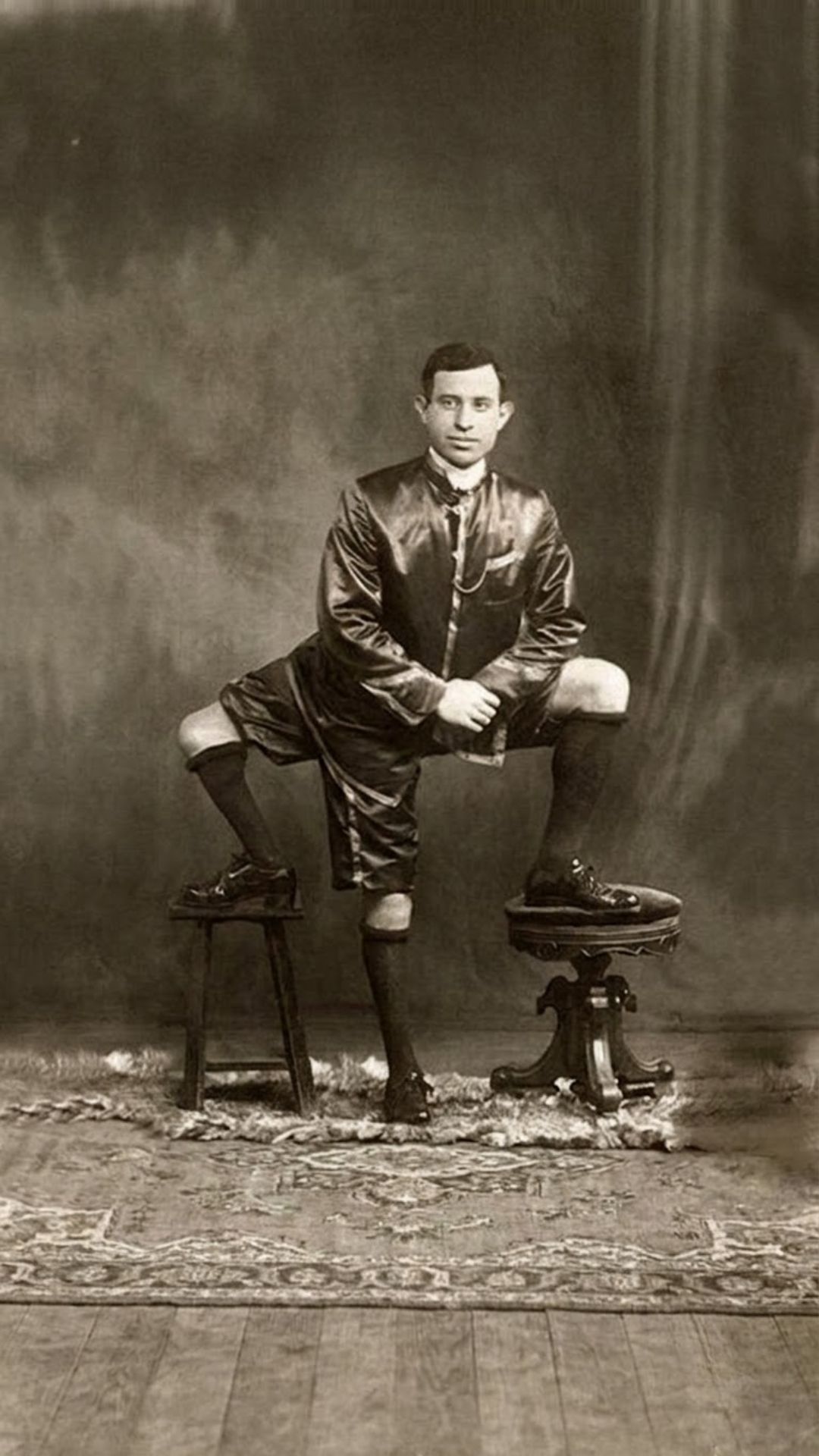
Frank Lentini was born in Sicily in 1889 with three legs, four feet and other physical differences caused by a parasitic twin. Doctors considered amputating the extra limb when he was an infant, but the operation was judged too dangerous because of the risk of paralysis or death. As a child, he was treated as a curiosity by some people around him, yet Lentini eventually moved to America and turned the condition that had set him apart into a remarkable career. For more than 40 years, he traveled with major circuses, became known as “The Great Lentini,” married, raised four children and built a life that extended far beyond the stage.
His Childhood Was Defined By Something He Could Not Hide
Lentini was born in Rosolini, Sicily, on May 18, 1889, as the fifth of 12 children. His unusual anatomy was the result of a second embryo that began developing alongside him but did not fully separate, leaving him with an additional leg and foot as well as other duplicated structures. The extra leg emerged from his right hip area and was shorter than his two primary legs, while one of its feet was clubbed.
When Lentini was only four months old, his family took him to a specialist in Naples to consider whether the additional limb could be removed. Doctors decided against the operation because of the danger it posed, including possible paralysis or death. The limb therefore remained with him as he grew, and he had to learn how to move through the world with a body unlike anyone around him.
His childhood was not always easy. Some people in his hometown cruelly called him a “little monster,” while others viewed him with fascination. His family eventually sent him to live with an aunt, in part because of the shame his condition brought to the household. But Lentini himself later remembered a different lesson from childhood.
Discover the incredible true story of Frank Lentini, the man born with three legs who defied expectations to become a global superstar! From his unique life journey to the legends of the sideshow era, watch now to see how he turned his difference into his greatest superpower. You won’t believe it!
He Learned To See His Difference Differently
As a boy, Lentini was taken to an institution for children with disabilities, where he saw young people who appeared deeply unhappy with their circumstances. The experience stayed with him.
Later in life, he explained that the visit influenced the way he viewed his own situation. Rather than dwelling on what he could not change, he developed an attitude of acceptance that would become one of the defining characteristics of his public personality. He later said he had never complained and that he believed life was beautiful and worth enjoying.
That attitude did not make his physical challenges disappear. His two main legs were different lengths, while the third was considerably shorter, making ordinary movement something he had to learn to manage. But as Lentini grew older, he became remarkably capable of controlling his body and even began discovering ways to turn his unusual anatomy into part of his performance. The first opportunity came when he was still a child.

America Turned Him Into A Sideshow Star
Lentini’s unusual condition became known beyond Sicily while he was young. In 1897, he appeared at an exhibition in London, and two years later, when he was about nine, a traveling showman named Giuseppe Magnano encountered him and brought him and his father to the United States.
By 1899, Lentini was being promoted as a major attraction with the Ringling Brothers circus. He would later work with other famous American shows, including Barnum & Bailey and Buffalo Bill’s Wild West show. Over time, his stage names became increasingly elaborate: “The Three-Legged Sicilian,” “The Only Three-Legged Football Player in the World,” and “The Great Lentini.”
His performances were not limited to simply standing before an audience. Lentini kicked soccer balls with his third leg, jumped rope, skated and rode bicycles. He also claimed that he could walk, run, jump, ride horses, swim and drive his own car, using the extra limb as a kind of rudder while swimming. The audience came to see an unusual body. What they often remembered was the man controlling it.

His Humor Became Part Of His Act
Lentini understood something important about performing: curiosity could either humiliate a person or become a source of power.
Audiences asked him remarkably personal questions, and he became known for answering them with confidence and humor. He would sometimes use his third leg as a stool while talking with visitors, turning what could have been an uncomfortable encounter into a performance he controlled himself.
When someone asked how he dealt with buying shoes in sets of three, Lentini reportedly joked that he bought two pairs and gave the extra shoe to a one-legged friend. His answers allowed him to decide how the audience perceived him rather than simply reacting to their curiosity.
That personality helped distinguish him in an industry built around novelty. Lentini was not simply presented as a medical curiosity. He developed a reputation for poise, intelligence and wit, eventually becoming so respected among fellow sideshow performers that he was often called “The King.”
His success also gave him something that his childhood could hardly have predicted: independence.

He Built A Family Outside The Spotlight
Lentini’s life eventually became more ordinary in ways his stage career might suggest. In 1907, he married Theresa Murray, and the couple had four children: Josephine, Natale, Francesco Jr. and Giacomo.
The marriage later ended in separation, but Lentini eventually began a long relationship with Helen Shupe, who remained with him for the rest of his life. His family life provided another dimension to a man whose public identity had been built around physical difference.
His career also continued for decades. He toured widely across the United States and Europe, worked with major circus organizations and built a small fortune. By the time he was an older man, he had transformed a condition that once caused his family shame into the foundation of a long professional life. He was not merely surviving the world around him. He had found a place in it.
The “Three-Legged Man” Kept Working For Four Decades
Lentini remained associated with sideshows well into middle and later life. Historical accounts place him in performances at places such as Coney Island and other major attractions, where he continued to meet audiences long after the shock value of his appearance had become familiar.
He died of lung failure in Jackson, Tennessee, on September 21, 1966, at the age of 77. By then, he had spent roughly four decades as a professional performer. His career had lasted far longer than the curiosity that initially surrounded his body.
That longevity matters. A sideshow attraction can become famous for a photograph or a sensational headline and then disappear from public memory. Lentini instead built a professional identity that endured across changing audiences and decades of American popular culture.

His Legacy Became Bigger Than The Sideshow
Lentini’s hometown eventually remembered him in a very different way from the way he had sometimes been treated as a child. In 2016, Rosolini held a two-day memorial festival honoring him and welcoming descendants of the man who had once left Sicily as a child.
His image also returned to popular culture when the 2017 film The Greatest Showman included a character based on him, portrayed by actor Jonathan Redavid. The movie was fictionalized entertainment rather than a documentary biography, but the appearance reflected how enduring the story of Lentini had become.
The most interesting part of his legacy, however, is not the film or the old circus posters. It is the life behind them.
Frank Lentini was born into a world that immediately noticed how different his body was. He could not change that fact, but he could decide what to do with it. Over the course of 77 years, he turned public curiosity into a profession, developed a reputation for humor and dignity, raised a family and continued working long after the novelty of his appearance should have faded. He was born with something extraordinary. But the extraordinary part of his story was what he did with it.

Frank Lentini was born in Sicily in 1889 with three legs and other physical differences caused by a parasitic twin. Surgery was considered too dangerous, and his unusual body made childhood difficult, but Lentini eventually learned to adapt and entered the American sideshow world as a boy. He became a celebrated performer with Ringling Brothers and other major shows, using athletic ability, humor and confidence to control his own story. He married, raised four children and built a career lasting roughly four decades. Lentini died in 1966 at 77, leaving behind a life remembered for far more than the body that first made him famous.
P.S. This article draws primarily on All That’s Interesting’s 2026 biography of Frank Lentini, supplemented by historical material from the Wethersfield Historical Society and other biographical references. The sources document his childhood, medical history, circus career, family life, public persona and later legacy. Sources: https://allthatsinteresting.com/frank-lentini