In 1990, Ken Imhoff decided that owning a Lamborghini Countach was not something he had to buy. He could build one himself. For the next 17 years, the Wisconsin engineer worked in the basement of his home, designing a tubular chassis, shaping aluminum body panels by hand and assembling a working Countach replica piece by piece. The project eventually produced an extraordinary machine, but finishing the car created one final problem that Imhoff had somehow overlooked: the Lamborghini was sitting underground, and there was no easy way to get it outside. To free his 17-year project, he had to tear open part of his own house.
It Started With A Lamborghini On A Movie Screen
Imhoff’s obsession began after watching The Cannonball Run, the 1981 comedy famous for its outrageous collection of cars. The Lamborghini Countach caught his attention immediately, and the idea of owning one stayed with him for years. Rather than simply save for the real thing, Imhoff decided that the more interesting challenge was to build his own.
That decision fit the way he had been raised. Imhoff later recalled that his father strongly believed people should make things themselves when they had the skills to do so. So instead of shopping for a kit or looking for an easier project, Imhoff approached the Countach as an engineering problem that could be solved with enough patience, fabrication and time.
In 1990, the project moved from an idea into his basement workshop. What followed was not a normal weekend garage build.

He Didn’t Start With A Kit
Imhoff built the car from the ground up rather than beginning with a finished vehicle and modifying it. He fabricated a tubular steel space-frame chassis, created wooden bucks to establish the shape of the body and then hand-formed aluminum panels over those forms. The work involved measuring, welding, machining, sanding and repeatedly correcting small details until the shape matched the Countach he had studied so carefully.
The mechanical side was just as unconventional. Instead of the Countach’s original Lamborghini powertrain, Imhoff installed a Ford 351 Cleveland V8 paired with a five-speed ZF manual transmission. The car also used components from other vehicles, including Corvette C4 suspension and brakes, while genuine Lamborghini parts such as the windshield, taillights, parking lights and some exterior pieces were incorporated into the build.
That mix is important to the story. This was not a factory Lamborghini secretly rebuilt in someone’s basement. It was a carefully engineered replica, with many major elements fabricated by one determined builder and selected original Lamborghini components used where they made sense. The result was meant to capture the appearance and spirit of a Countach while remaining a unique machine in its own right.
Could you spend 17 years building a car from scratch in your basement? Discover how Ken Imhoff made his dream a reality in this incredible build journey!
The Basement Became His Second Workshop
For years, the basement was where Imhoff disappeared after work. His daughter reportedly grew up telling relatives that “Daddy’s down in the basement,” because that was where he spent so much of his free time designing, machining, welding and refining the car.
The project did not move smoothly every year. Imhoff sometimes became frustrated, lost momentum or set the work aside for stretches of time. Then the unfinished Lamborghini would still be there, waiting for him, and eventually he would return to the workshop and find another part of the problem to solve.
That is one reason the 17-year figure matters. The car was not built during 17 uninterrupted years of obsessive labor. It was a long-running personal project that survived work, family life, setbacks and periods when Imhoff simply needed a break from it. What kept the project alive was not speed, but persistence.
Little by little, the collection of separate parts began to look like a Countach.
The Car Finally Looked Like The Dream
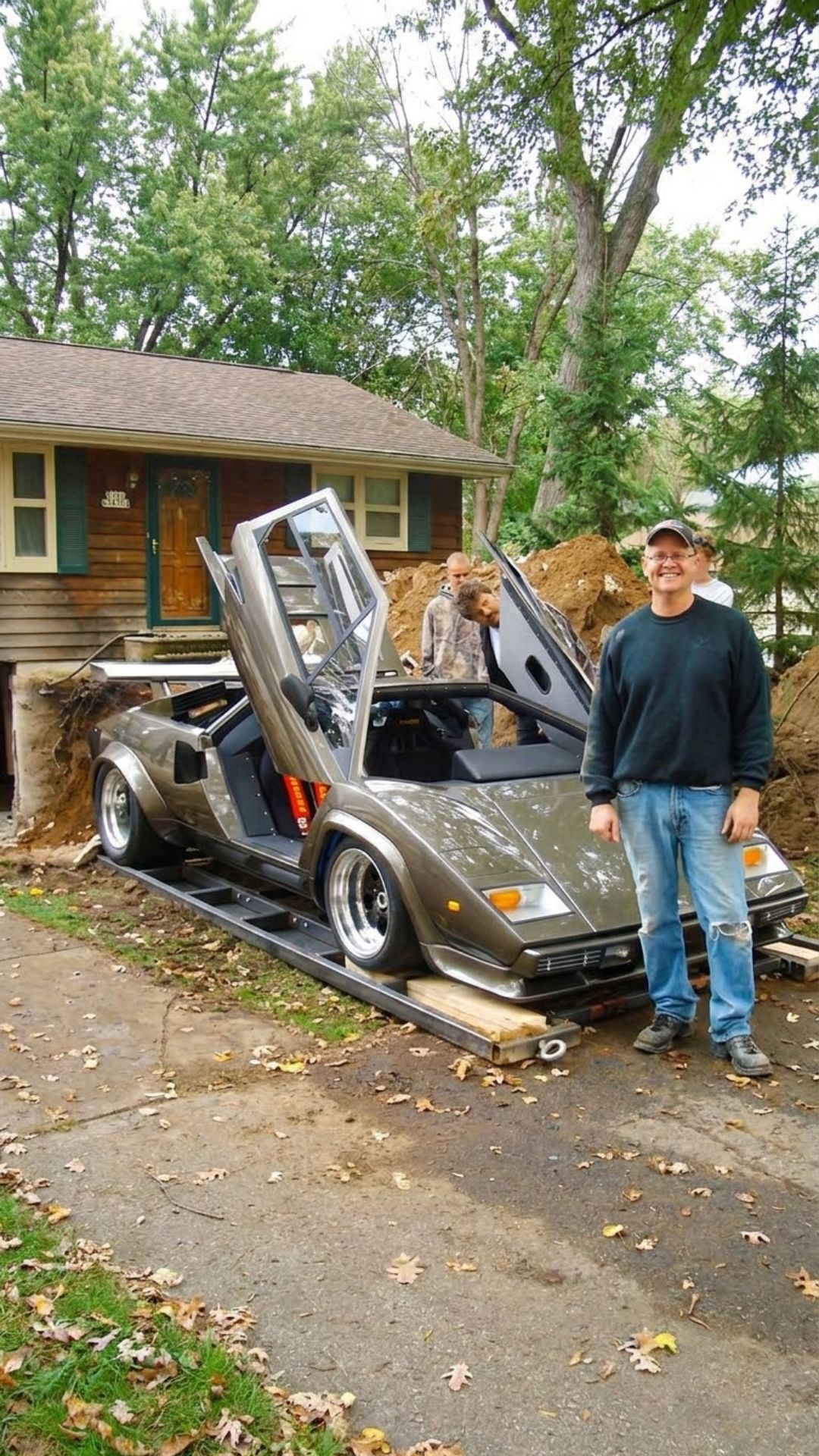
The bodywork was one of the most labor-intensive parts of the build. Imhoff shaped aluminum panels by hand over carefully constructed forms, working to reproduce the sharp, angular proportions that made the Countach instantly recognizable. He also fabricated details such as the distinctive scissor-style doors rather than accepting a rough approximation.
By the time the project was finished, the result looked remarkably close to the Italian supercar that had inspired it. Photos of the completed car show the long, wedge-shaped profile, wide stance and dramatic bodywork that made the original Countach famous. Underneath that appearance, however, was a home-built chassis and a V8-powered mechanical package that made the car something quite different from a production Lamborghini.
After roughly 17 years of work, Imhoff had finally achieved what he had set out to do. Then he discovered that building a car and removing a car were two very different engineering problems.

The Lamborghini Was Trapped In The Basement
The obvious question eventually became unavoidable: how do you get a finished car out of a basement when the house was never designed to let a car leave through the front door?
The answer was as dramatic as the project itself. Imhoff hired a contractor to remove part of the basement wall and excavate the ground outside the house, creating a sloped path that would allow the completed car to be pulled upward and out.
It was an almost absurd conclusion to such a painstaking project.
For years, Imhoff had carefully measured aluminum panels to millimeters and fabricated a complex chassis from scratch. Yet one of the final obstacles had nothing to do with horsepower, suspension geometry or bodywork. He simply needed to make a hole in the house.
Once the opening and ramp were prepared, the Countach was towed into daylight. Seventeen years after entering the basement as a dream, it finally emerged as a finished car.
He Eventually Let The Car Go
The story did not end with Imhoff keeping the Countach forever. After completing the project, he eventually sold it, reportedly for around $89,000 after investing roughly $65,000 in the build.
Years later, the car returned to the market. In 2023, LamboCars reported an asking price of $229,000, a remarkable figure for a one-off replica whose greatest value may not be in the materials or mechanical parts at all, but in the story attached to it.
That story is difficult to reproduce.
A wealthy collector can buy an original Countach. A skilled builder can assemble a replica. But very few people can say they spent nearly two decades constructing one by hand in their own basement, only to demolish part of their house when the project was finally complete. The car is unusual. The way it was built is even more unusual.

The Real Achievement Was Never The Lamborghini
It is tempting to look at Imhoff’s project simply as a story about a man who wanted a Lamborghini but could not justify buying one. That misses what makes the story memorable.
The remarkable part is the transformation of an idea into an object through thousands of small decisions. Imhoff had to solve problems involving metal forming, structural design, mechanical systems, fit and finish and fabrication, often without the conveniences available to a major automotive manufacturer. The Countach became less a replica and more a record of what one determined person could accomplish with enough skill and time.
And then there is the basement. For 17 years, the room where the car was built was also the place that trapped it. The same walls that sheltered the project eventually had to be torn apart so the finished machine could escape. That is the detail that turns a remarkable home-built car into a story people remember.

Ken Imhoff spent 17 years building a Lamborghini Countach replica in his basement, shaping much of it by hand and engineering the car piece by piece. When it was finally finished, there was one last problem: the completed Lamborghini could not get out. Imhoff had to remove part of his basement wall and create a ramp before the car could finally reach the open air. He eventually sold it, but its strangest feature may be the story behind how it escaped the basement where it was born.
P.S. The story is based on Ken Imhoff’s own account as reported by Jalopnik, along with later coverage from LamboCars and other automotive publications. The original reporting provides the strongest detail on how Imhoff designed and fabricated the car, while later listings document its subsequent sale history and asking price. Sources: https://www.lambocars.com/ken-imhoffs-basement-built-lamborghini-countach-which-took-17-years-to-complete-is-for-sale/