In 1957, Tulsa, Oklahoma, buried a brand-new Plymouth Belvedere beneath the courthouse lawn and promised to open it exactly 50 years later. The gold-and-white coupe had only four miles on its odometer, and organizers imagined that someone in 2007 would finally drive away in a piece of mid-century America. But when workers opened the underground vault, they did not find the pristine time capsule everyone had imagined. They found a car that had spent decades submerged in muddy water, its body badly corroded and its mechanical parts deteriorated. The strangest part of the story came afterward: once the car had finally been rescued from the ground, almost nobody wanted to take responsibility for it.
Tulsa Buried A Brand-New Plymouth
The idea was part of Tulsarama!, a weeklong celebration in 1957 marking Oklahoma’s 50th year of statehood. Among the festivities was an unusual publicity stunt: Tulsa would bury a brand-new 1957 Plymouth Belvedere underground and leave it there for half a century.
The car was more than transportation. It was supposed to be a snapshot of American life in 1957, sealed away so people in 2007 could look back at what their predecessors thought the future would look like. Alongside the Plymouth went a collection of contemporary objects, including government documents, publications, photographs, coins and other memorabilia. Even the car itself was prepared with the future in mind, with gasoline and oil stored in the trunk in case someone in 2007 needed them to get the vehicle running.
There was also a contest. Tulsa residents were asked to predict the city’s population in 2007, and the person whose estimate came closest would receive the Plymouth and a $100 savings bond. The entries were sealed inside the time capsule along with the car, creating a second mystery that would not be solved until the vault was opened.
The organizers believed they were creating a gift from 1957 to the future. They had no idea what the ground was preparing to give back.
Ever wonder what happens when you bury a brand-new car for 50 years? The story of ‘Miss Belvedere’ is as shocking as it gets. Watch the full reveal now!
The Vault Was Supposed To Protect It
The Belvedere was placed inside a concrete underground vault beneath the Tulsa County Courthouse lawn. The structure was promoted as extraordinarily strong, even described in contemporary accounts as being designed to withstand a nuclear attack.
The car itself was carefully wrapped and protected before burial. From the outside, everything about the project suggested that Tulsa was taking preservation seriously. The plan was simple: keep the car sealed away from the world, open the vault on June 15, 2007, and reveal a 50-year-old brand-new Plymouth.
But a time capsule does not have to be perfect on the outside to fail.
Over the decades, water found its way into the vault. By the time the Plymouth was ready to come out, the supposedly protected chamber had become a muddy environment that had exposed the car to prolonged moisture and corrosion.
The vault had preserved the idea of the time capsule much better than it had preserved the automobile.

Fifty Years Later, The Crowd Finally Saw The Car
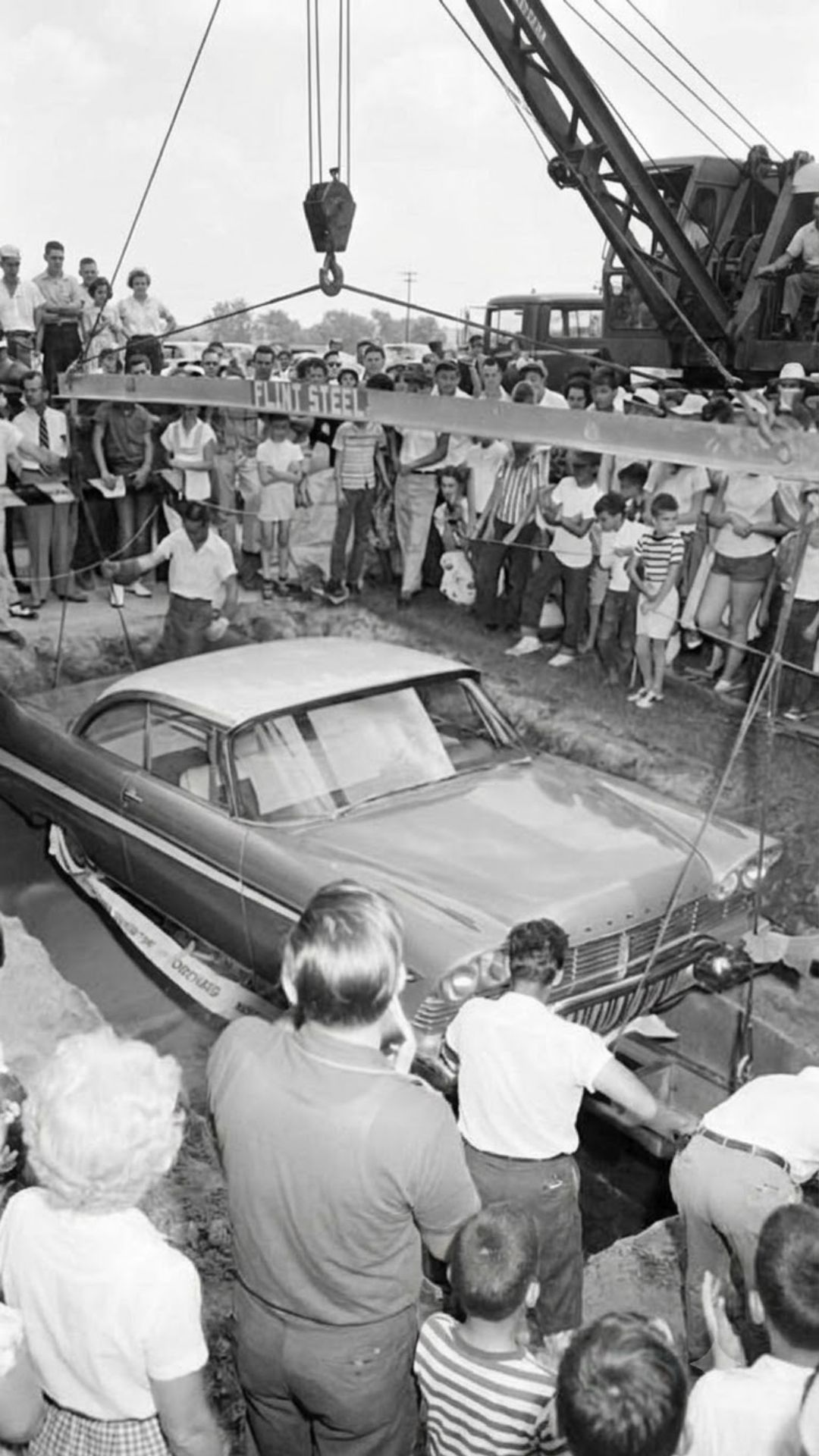
On June 15, 2007, after exactly half a century underground, a crane finally lifted the Plymouth from its vault. Hundreds of spectators had gathered, and journalists from around the world came to watch what was supposed to be a triumphant technological time capsule reveal.
Instead of a gleaming 1957 classic, they saw a muddy, heavily corroded shell.
The car had been badly damaged by decades of water intrusion. Rust had attacked the body and mechanical components, and the engine was no longer the symbol of American automotive confidence that Tulsa had buried in 1957. Contemporary coverage described the result as a bucket of rust rather than the perfectly preserved automobile many people had expected.
The disappointment was enormous because the entire event had been built around a fantasy that suddenly disappeared in front of thousands of people.
Everyone had spent years imagining the moment the keys would turn and the old-new Plymouth would roar back to life.
Instead, the most important thing the car demonstrated was how little control humans have over 50 years of water, soil and corrosion.
The Winner Had Been Dead For Decades
Then the second surprise arrived.
The original contest winner was identified as Raymond Humbertson, whose 1957 prediction of Tulsa’s future population had come closest to the actual 2007 figure. His estimate was 384,743; the city’s eventual population was reported as 382,457.
There was only one problem.
Humbertson had died in 1979, nearly three decades before the Plymouth was unearthed. He had no children, so the car and the savings account passed to surviving relatives. His family reportedly knew little about why he had entered the contest in the first place.
The prize had been designed in 1957 for a person to receive half a century later. By the time the future arrived, the winner himself had been gone for 28 years. And the prize waiting for his family was not exactly the car they had been promised.

Someone Tried To Save Miss Belvedere
Despite the damage, people did not immediately give up on the Plymouth.
The car was eventually taken to New Jersey, where Dwight Foster of Ultra One became involved in efforts to stabilize and preserve it. The objective gradually shifted away from returning the Belvedere to factory-new condition. Instead, the hope was to stop further deterioration and preserve the automobile as a historical artifact.
The work revealed just how badly the decades underground had affected the car. Parts of the carburetor and distributor had essentially deteriorated away, suspension components had seized, a steering tie rod was broken, and the interior had suffered extensive damage. Even the glass had been etched by the corrosive material that had covered the car.
A donor 1957 Plymouth was obtained to provide replacement components, and extensive rust-removal treatments were attempted. More than $15,000 was reportedly invested before the effort to restore the car was halted after its underlying condition proved too severe to justify turning it back into a functioning classic. Miss Belvedere could be cleaned. But she could not realistically be returned to the life she was supposed to have.
Then Nobody Knew What To Do With It
This created an unusual problem.
A normal rusty 1957 Plymouth might be worth restoring or selling for parts. Miss Belvedere was different. Its mechanical value was limited, but its historical value was enormous. It was the actual car Tulsa had buried in 1957, complete with the story, the original time capsule and the evidence of what had happened during those five decades.
That made the car strangely difficult to place.
The city of Tulsa was not interested in taking permanent responsibility for it, and the Smithsonian also declined. For years, Miss Belvedere remained in storage at Ultra One’s New Jersey warehouse, caught between two identities: too historically important to throw away, yet too badly damaged to be a desirable collector car.
Hemmings described the situation perfectly: the Plymouth had escaped its watery tomb but was still effectively trapped in limbo.
It had spent 50 years underground waiting for the future. Then it spent another decade waiting for someone willing to keep it.

The Ruined Car Eventually Found A Home
In 2015, the Historic Auto Attractions Museum in Roscoe, Illinois, agreed to take Miss Belvedere. The car was finally shipped there in 2017, ending its long period of uncertainty.
Today, the museum treats the Plymouth not as a restoration project but as a historical artifact. The museum’s own history page lists Miss Belvedere among the vehicles housed in its expanded East Wing.
And that may be the most appropriate ending for the car.
Miss Belvedere was never going to become a pristine 1957 Plymouth again. Its rust, corrosion and damaged components are now part of the story. The car does not show visitors what America hoped a 50-year time capsule would look like; it shows them what actually happens when a machine is left underground for half a century and the protection around it fails.
The Car That Was Supposed To Survive The Future
When Tulsa buried Miss Belvedere, the people watching probably imagined the future as something clean and predictable. They pictured citizens in 2007 opening the vault, admiring a remarkably preserved automobile and driving away in a piece of 1950s America.
Instead, the future exposed a much more complicated truth.
The car survived, but not in the way anyone expected. The original winner was gone. The vault had leaked. The Plymouth could not be restored to the condition everyone had dreamed about, and for years there was nowhere for it to go.
Yet that failure is precisely what makes Miss Belvedere valuable.
A perfect 1957 Plymouth preserved untouched for 50 years would have been an extraordinary collector car. A ruined Plymouth that tells the story of what Tulsa believed about America, technology and the future in 1957 may be something more interesting. They buried a new car so the future could see it. The future looked back—and found a warning about trying to preserve the past.
In 1957, Tulsa buried a brand-new Plymouth Belvedere beneath the courthouse lawn as a 50-year time capsule. The city expected future generations to open the vault in 2007 and discover an almost perfectly preserved example of American automotive optimism. Instead, water had breached the vault, leaving the car badly corroded and structurally damaged after decades underground. Even the contest winner had died long before the Plymouth was unearthed, leaving his relatives to inherit a prize that was far different from what had been imagined. Attempts to stabilize the car eventually stopped short of a full restoration, and for years Miss Belvedere sat unwanted in storage. In 2017, it finally found a permanent home at Historic Auto Attractions in Illinois, where it remains a historical artifact rather than a functioning classic car. What began as a celebration of America’s future ultimately became one of the most unusual reminders of how quickly the future can change the meaning of the past.
P.S. The story is based primarily on Hemmings’ account of Miss Belvedere, supported by contemporary coverage of the 2007 excavation and later reporting on its preservation. Tulsa Historical Society documents the original Tulsarama celebration and the objects buried with the Plymouth, while Historic Auto Attractions confirms that the car remains part of its collection. Sources: Hemmings, Tulsa Historical Society, Associated Press/contemporary 2007 coverage, Old Cars Weekly, Historic Auto Attractions. Source: https://www.hemmings.com/stories/though-freed-from-a-muddy-gumbo-miss-belvedere-now-mired-in-limbo/