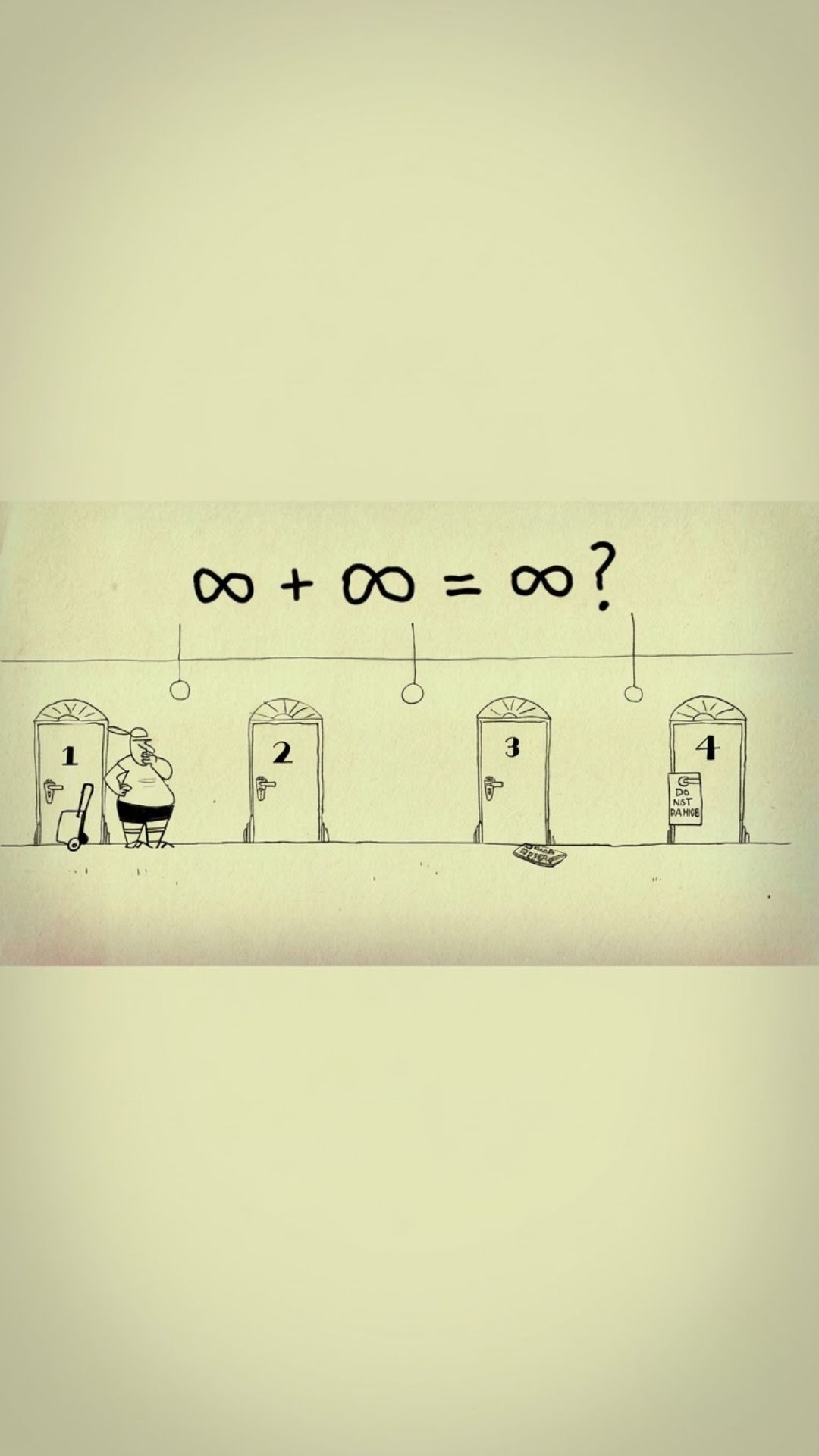
Imagine walking into a hotel where every room is occupied. The desk clerk checks the computer, smiles, and hands you a key anyway. There is no cancellation, no hidden suite and no mistake. The hotel simply has infinitely many rooms, numbered 1, 2, 3 and onward forever. In the strange world created by mathematician David Hilbert, being completely full does not mean there is no room left. It can still accommodate you—and, under the right rules, infinitely many more guests.

The Hotel That Should Not Exist
Hilbert’s Grand Hotel is not a real building. It is a mathematical thought experiment designed to expose just how differently infinity behaves from anything we experience in ordinary life.
In a normal hotel, the words “every room is occupied” settle the matter. One more guest means one more person than the hotel can accommodate. Even adding a single room requires physical space, construction and a limit to how large the building can become.
Hilbert imagined a hotel without that limit. Its rooms are numbered 1, 2, 3, 4 and so on, with no last room. Every room is occupied, yet a new guest arrives.
That sounds like the hotel is already full and therefore cannot accept anyone else. But mathematics gives the manager a way out.
Think an infinite hotel can fit everyone? Think again! Ever wondered what actually happens when infinity runs out of space? Tap the link to uncover this mind-bending concept.
One New Guest Somehow Gets A Room
The manager asks the guest in room 1 to move to room 2. The guest in room 2 moves to room 3. The guest in room 3 moves to room 4, and so on.
At first, it seems like this only shifts the problem down the hallway. But because there is no final room, every existing guest can move forward without anyone being left behind.
Once the reshuffling is complete, room 1 is empty. The new arrival takes it.
Nothing about this would work in a finite hotel. If the building had 100 rooms, moving everyone one door down would eventually leave someone with nowhere to go. In an infinite hotel, there is always another room number.
The strange part is that the hotel has not become less full. It was full before the move, and it is still full afterward. Yet it has somehow created a vacancy. That is the first clue that infinity does not behave like an ordinary number.

Then An Infinite Bus Arrives
One extra guest is strange enough. Hilbert’s example becomes much more difficult when an entire bus arrives.
Now imagine that an infinite bus pulls up outside the hotel. It contains infinitely many passengers, and every one of them needs a room.
A finite hotel would have no meaningful answer. But Hilbert’s manager simply changes the rule.
Every current guest moves from room n to room 2n. The guest in room 1 moves to room 2. Room 2 moves to 4. Room 3 moves to 6. The existing guests now occupy all the even-numbered rooms.
That leaves every odd-numbered room—1, 3, 5, 7 and onward—empty. The new passengers can move into those rooms. The hotel has just created infinitely many vacant rooms without asking a single existing guest to leave.

Why Half Of Infinity Can Still Be Infinity
This is the part that clashes most violently with everyday intuition.
In a finite hotel, half the rooms are obviously fewer than all the rooms. If a hotel has 100 rooms, only 50 are odd-numbered. Fifty cannot equal 100.
But with the positive integers, the odd numbers and all the positive integers can be paired off indefinitely. The first room corresponds to the first even number, the second room to the second even number, and so forth.
Mathematicians describe this using the idea of a one-to-one correspondence. The set of natural numbers and the set of even numbers have the same cardinality, even though the even numbers form only a subset of the natural numbers.
This is one reason the paradox is so useful. It does not reveal a mistake in mathematics. Instead, it reveals a mistake in our intuition when we try to apply finite ideas to infinite collections.
The lesson is subtle but powerful: “full” and “unable to add anything” are no longer equivalent once the collection is infinite.
Hilbert Was Trying To Show Us Something Bigger
David Hilbert was one of the most influential mathematicians of the 20th century. He worked across geometry, algebra, mathematical logic, functional analysis and the foundations of mathematics, and he famously presented 23 major problems at the International Congress of Mathematicians in Paris in 1900.
The hotel thought experiment emerged from Hilbert’s work and lectures on set theory, where he wanted to make the strange properties of infinite sets easier to understand.
His timing mattered. Georg Cantor’s work had already shown that infinity was not simply one enormous quantity. Infinite sets could have surprising relationships with one another, and mathematical “size” could be defined in ways that did not match physical intuition.
The hotel turned those abstract ideas into a story anyone could picture.
Instead of asking readers to think about symbols and definitions, Hilbert gave them a building, a manager and a growing line of impossible guests.

What If Infinitely Many Buses Arrived?
The thought experiment can be pushed even further.
Suppose an infinite number of buses arrive, and each bus carries an infinite number of passengers. At first, it seems that even Hilbert’s hotel must finally reach its limit. But the mathematical trick still works.
Each passenger can be identified by two numbers: the number of the bus and the passenger’s position on that bus. Those pairs can be arranged systematically and matched with the natural numbers, giving every person a unique room.
In set-theory language, the collection of pairs of natural numbers has the same cardinality as the natural numbers themselves. Symbolically, mathematicians write this relationship as ℕ × ℕ ≅ ℕ.
For finite quantities, multiplying two numbers gives a larger number. For countably infinite sets, the result can behave very differently. An infinite collection multiplied by another infinite collection can still have the same cardinality as the original infinite collection.
At this point, the hotel has stopped behaving like a building and started behaving like a map of mathematical possibility.
Not All Infinities Are The Same
Hilbert’s hotel demonstrates one particular kind of infinity: countable infinity.
The natural numbers can be listed one by one forever. No matter how far the list goes, every individual number can occupy a specific position.
But Georg Cantor showed that some infinite sets are larger than this. The real numbers—the numbers containing all the decimals between 0 and 1, for example—cannot be completely listed in the same way.
His famous diagonal argument demonstrated that there are more real numbers than natural numbers. In other words, mathematics contains different sizes of infinity.
That may be the deepest idea hiding inside the hotel. The thought experiment begins with a simple question about an imaginary building and ends by confronting one of the most surprising discoveries in mathematics: infinity is not a single gigantic quantity. It has structure, levels and relationships that have no close equivalent in everyday life.

The Hotel Was Never About Hotels
Hilbert’s Grand Hotel has remained popular for more than a century because almost anyone can understand the setup.
A full hotel should have no empty rooms. A bus full of new guests should make the problem worse. An infinite number of buses should make the situation completely hopeless. Yet each time, mathematics finds another way to rearrange the occupants.
The hotel is therefore not really a puzzle about accommodation. It is a demonstration of what happens when the ordinary rules of quantity stop applying. “More” does not always mean what we think it means, and “full” does not always mean finished.
That is why the story still appears in mathematics, philosophy and discussions of infinity today. It takes an idea that is nearly impossible to visualize and turns it into something as familiar as a hotel corridor.
Hilbert’s Grand Hotel begins with an apparently impossible situation: every room in an infinitely large hotel is occupied, yet another guest arrives. By moving each guest from room n to room n + 1, the manager creates an empty room without evicting anyone. When infinitely many new guests arrive, moving each existing guest to room 2n frees every odd-numbered room for the newcomers. The exercise illustrates a fundamental property of countably infinite sets: an infinite set can have the same mathematical size as a proper subset of itself. From there, the paradox leads to an even stranger conclusion—some infinities are larger than others.
P.S. This story draws on Wiris’s 2026 explanation of Hilbert’s paradox, alongside mathematical references on the infinite hotel and Cantor’s ideas about infinity. Sources: https://www.wiris.com/en/blog/hilberts-paradox-article/