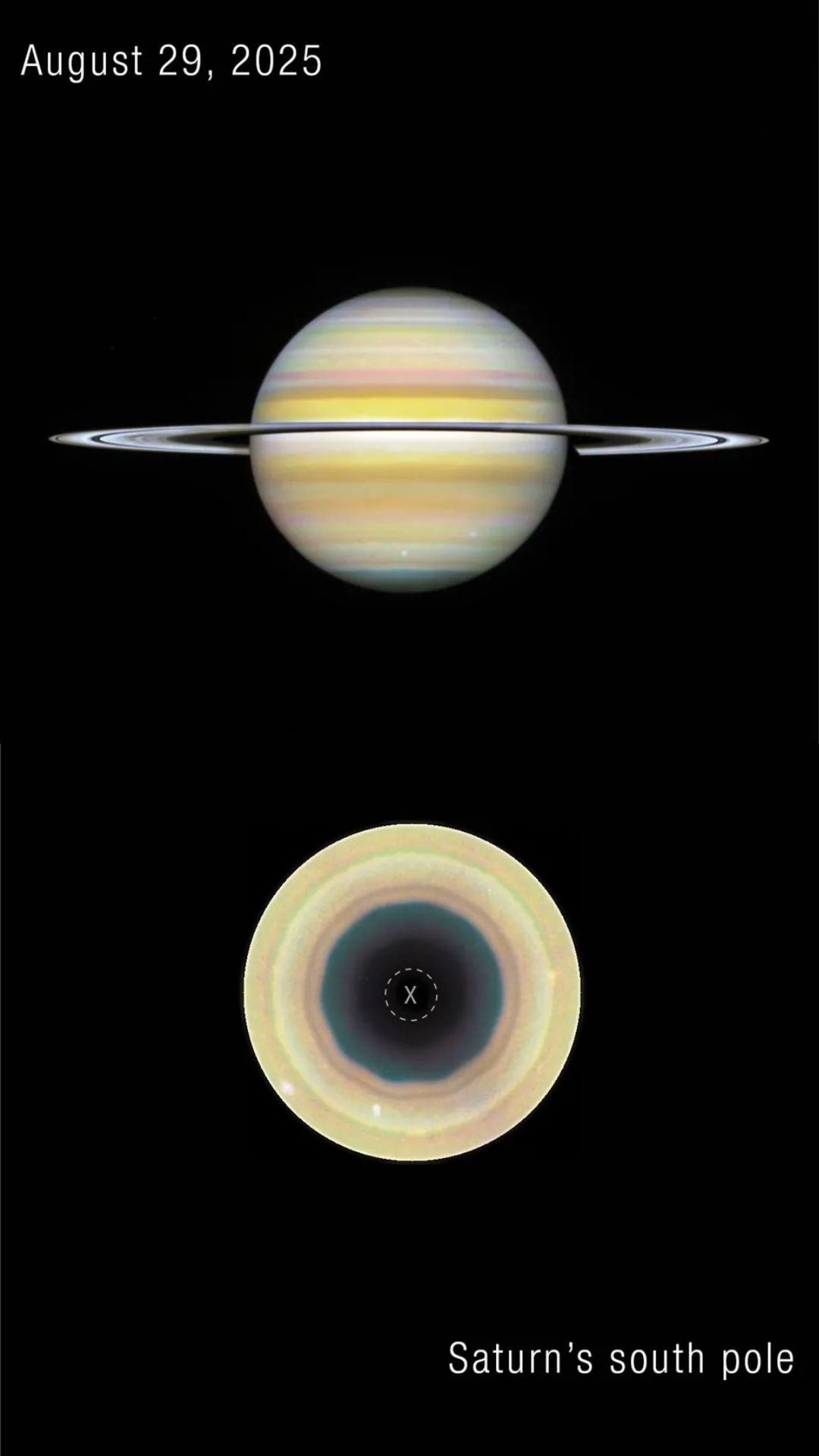
For decades, astronomers searched Saturn’s southern skies for a counterpart to the planet’s famous northern hexagon. They found nothing like it. Then Hubble images revealed something unexpected: a giant atmospheric wave with 10 distinct sides circling Saturn’s south pole. The feature appears to have emerged only in recent years and extends through multiple layers of the atmosphere. Scientists now have evidence of a new geometric pattern on Saturn—but they still do not know why it appeared, how long it will survive, or whether it will eventually become as stable as the famous hexagon in the north.
Saturn Already Had One Impossible Shape
Saturn has long been famous for something that looks almost artificial: a gigantic six-sided pattern surrounding its north pole.
The Saturn hexagon was first noticed in images from the Voyager spacecraft in the early 1980s. Later observations by the Cassini spacecraft showed that the feature was not a temporary cloud formation but a persistent atmospheric structure spanning roughly 20,000 miles (30,000 kilometers). It is associated with a powerful jet stream and winds reaching about 200 miles per hour.
For decades, astronomers wondered whether Saturn should have some kind of matching geometric feature at its south pole. They kept looking. Until recently, there was no obvious answer.
Discover why Saturn is the most terrifying planet in our solar system! From its mysterious, disappearing rings to the massive, haunting hexagon storm at its pole, this video dives deep into the destructive forces and alien wonders captured by the Cassini mission. Watch now to uncover these hidden space secrets!
Hubble Has Now Found A 10-Sided Pattern
NASA’s Hubble Space Telescope has now revealed something remarkably different at Saturn’s south pole: a large atmospheric wave with 10 sides, known as a decagon.
The feature is not a painted shape on Saturn’s clouds. It is a wave embedded within one of the planet’s powerful jet streams. Hubble observations show that it extends through multiple layers of the atmosphere, meaning the phenomenon is not confined to a thin layer of visible clouds.
The discovery is significant because NASA describes it as the first large, regular-sided jet pattern observed in Saturn’s southern hemisphere.
And there is an important difference between what we see now and what we saw decades ago. This southern pattern appears to be relatively new.

The Shape Was Not There When Cassini Was Watching
Cassini spent more than 13 years studying Saturn before the mission ended in 2017. During that time, its instruments saw no sign of a long-lived southern structure resembling the newly discovered decagon.
Astronomers had actually been searching for a southern counterpart to the northern hexagon in Hubble observations since the 1990s. But the evidence remained elusive. NASA says the new Hubble data confirm that the southern feature can be traced back to observations from 2023.
Researchers found subtle indications that something was beginning to form. A faint, undulating band became noticeable in 2024, and observations taken from Earth in 2025 provided stronger hints of the developing structure.
Then Hubble gave astronomers the sharper view they needed. What had looked like an irregular atmospheric disturbance increasingly revealed itself as a remarkably organized 10-sided wave. Saturn had apparently been changing in front of them.
This Is Not Just A Shape. It Is A Moving Atmospheric System
One reason the discovery matters is that the decagon is embedded in a powerful jet stream.
Saturn’s atmosphere is divided into bands that move at different speeds and interact with one another. At the poles, those interactions can produce atmospheric waves and other structures. NASA researchers believe the geometric boundaries may be related to waves generated where fast-moving gas farther from the pole interacts with slower-moving gas closer to it.
That helps explain why the shape can become so regular.
The decagon is not a solid object and does not have a permanent boundary. It is an organized pattern inside a constantly moving atmosphere.
Even its apparent position changes slightly depending on the wavelength of light Hubble uses. Different wavelengths allow astronomers to see different altitudes within Saturn’s atmosphere, revealing how the structure extends vertically.
In other words, scientists are not looking at a simple outline. They are looking at a three-dimensional atmospheric phenomenon.

Why Is Saturn Doing This Now?
That is the biggest unanswered question.
Scientists know the decagon is associated with a jet stream, but they do not yet know what caused the structure to develop in the first place. They also do not know whether it will remain stable for decades, disappear after a few years or evolve into something even more unusual.
The northern hexagon provides an intriguing comparison.
That structure has remained stable for more than 40 years of direct observation and may have existed much longer. The southern decagon, by contrast, appears to have emerged only recently, giving researchers an opportunity to watch a large-scale atmospheric pattern form rather than simply studying one that is already established.
That makes the discovery particularly valuable. Astronomers may now be watching Saturn perform an atmospheric experiment in real time.
The Ten Sides Could Teach Us About Saturn Itself
The unusual geometry is not merely a curiosity.
Patterns like the northern hexagon have helped scientists study the behavior of Saturn’s atmosphere, including the dynamics of jet streams, atmospheric waves and circulation at different depths. The new southern decagon could provide another natural laboratory for understanding how those processes work.
There is also an important scientific opportunity that did not exist when Cassini was operating.
Hubble can observe Saturn repeatedly from Earth orbit and compare images taken across different wavelengths and years. That allows researchers to track how the southern feature changes over time instead of relying on a single snapshot from a spacecraft flyby.
The next stage is therefore not simply taking another photograph. It is watching.
Researchers plan to continue observing the feature with Hubble and other telescopes, including the James Webb Space Telescope, while using computer models to investigate how the structure formed and how it interacts with Saturn’s atmosphere.
Think Saturn is just a ringed planet? Think again! Dive into the mysteries of the Saturn system, from its icy moons like Enceladus to the bizarre chemistry of Titan. Join us for a mind-bending look at these alien worlds. Watch now to discover why Saturn is much more than a planet!
Saturn Is Still Hiding Surprises
Saturn is often introduced as the planet of rings, but its atmosphere may be just as strange as its appearance.
The northern hexagon was already one of the most unusual structures known anywhere in the solar system. Now its southern hemisphere has produced a different geometric pattern—one that is not simply a mirror image, and one that scientists appear to have caught while it is still developing.
That gives the discovery a quality that is easy to miss in a single image.
Scientists did not merely find a strange shape. They found evidence that the atmosphere of a giant planet can change its geometry on a timescale short enough for humans to watch.
The decagon may eventually weaken or disappear. It may remain for decades. It may reveal entirely new behavior as Saturn moves through its seasonal cycle.
For now, there is only one certainty. Something new is happening around Saturn’s south pole.
Saturn has spent decades famous for one giant atmospheric shape: the hexagon surrounding its north pole. Now Hubble has revealed something new in the opposite hemisphere—a 10-sided atmospheric wave that appears to have begun emerging around 2023. The feature is embedded in a powerful jet stream and extends through multiple atmospheric layers, making it far more than a strange pattern in a cloud deck. Scientists still do not know why it formed or how long it will last. For the first time, they may have the chance to watch a new geometric structure develop on another planet.
P.S. This article is based primarily on NASA’s September 2026 report on Hubble’s discovery of the southern decagon, with additional context from NASA’s Saturn and Hubble resources. Souce: https://www.sciencedaily.com/releases/2026/09/260903064229.htm