At 91, Dale “Grey Beard” Sanders had already done something most people would consider impossible: complete the Appalachian Trail from Georgia to Maine. Then he decided to do it again after losing the record for oldest thru-hiker to an even older friend. During his latest journey, Sanders fell 71 times, including six falls he considered serious. One sent him to the hospital, another came just 200 yards from the finish. Yet on August 31, 2026, he stood atop Maine’s Mount Katahdin and reclaimed the record he had once held at 82.
He Had Already Set The Record Once
Sanders was 82 when he first completed the Appalachian Trail in 2017, becoming the oldest person to thru-hike the entire route. The trail stretches about 2,193 miles, running from Springer Mountain in Georgia to Mount Katahdin in Maine.
A thru-hike does not necessarily mean walking the entire trail in one uninterrupted journey. The Appalachian Trail Conservancy allows hikers to complete all sections within a year, with breaks between portions of the route. Sanders used that format during his latest attempt as well.

But four years later, the record was gone. In 2021, his friend M.J. Eberhart—known on the trail as Nimblewill Nomad—completed the trail at 83 and became the new oldest thru-hiker. Sanders did not seem ready to let the matter end there.
Within months, he began planning a comeback.
Proof that it’s never too late for an adventure. Join us as we follow Greybeard on the final miles of his epic journey. Witness a record-breaking moment of human spirit!
At 91, The Comeback Was Much Harder
Sanders started his latest journey on September 6, 2025, in West Virginia. He then completed the trail in sections, with short breaks along the way, before finally reaching Mount Katahdin nearly a year later.
The problem was that this attempt was much harder than his first.
Despite six months of training, Sanders admitted he did not feel as prepared as he wanted. At 91, the physical demands of the trail were becoming impossible to ignore, even for someone with decades of experience in endurance activities.
Then came the falls. By his own count, he went down 71 times during the journey. Six were what he called hard falls, including one in Vermont that left him badly scraped and another near the very end of the trail. Still, he kept moving.

One Fall Sent Him To The Hospital
In June, while descending Killington Mountain in central Vermont, Sanders fell forward in a field of boulders. He scraped his legs, arms and hands, but escaped without broken bones. Rather than abandoning the hike, he kept going.
Several weeks later, the situation became more serious.
His left arm went numb, and he was taken to a Maine hospital after doctors initially feared he might have suffered a stroke. It turned out to be a pinched nerve, and he was eventually cleared to resume hiking. But the episode shook him enough that he seriously considered giving up.
Then another setback arrived at home.
In early August, Sanders returned to Tennessee after the death of his mother-in-law. His wife encouraged him to continue rather than end the attempt. He went back to the trail.
The decision mattered because he was getting close to the finish.
The Most Brutal Fall Came Near The End
For someone who had already walked thousands of miles, the final stretch should have been the easy part.
Instead, one of Sanders’ six hard falls happened only about 200 yards from the finish. By then, his body had absorbed months of steep climbs, uneven rocks, rough descents and repeated tumbles. The fact that he was still moving at all was remarkable.
There was even a point during one 12-mile day when exhaustion finally caught up with him. Sanders lay down on the trail and said he needed a “power nap.” He briefly fell asleep, then got back up about two minutes later and continued hiking.
The episode says something about the way Sanders approached the journey. He did not pretend his body was 30 years younger. He simply kept going with the body he had.
Other Hikers Started Following His Journey
The record was initially Sanders’ main objective, but that changed during the hike.
Thousands of people followed his progress on social media, and fellow hikers began recognizing him on the trail. Some offered food and encouragement, turning sections of the journey into something more communal than Sanders had expected. He joked that on the friendlier stretches, people brought him treats like caramel frappes.
Meredith Ewenson, who encountered Sanders while leading a hiking group in New Hampshire, said she was struck by how quickly he moved despite his age. Her group eventually caught up with him at an Appalachian Mountain Club hut, where Sanders told them he had arrived hours earlier.
The attention gradually changed the meaning of the trip. Sanders still wanted the record, but he began telling people that the larger mission was encouraging others. His own words were that the record had become secondary to the motivation people drew from watching him continue. That may be why the story resonated far beyond hiking circles.
He Was Doing This Long Before He Was 91
Sanders’ endurance story did not begin with the Appalachian Trail.
Born in Kentucky in 1935, he was bullied as a child because of his small size. He eventually found confidence in individual sports such as swimming and acrobatics, later served in the Navy and spent a long career in parks and recreation before retiring in 2002.
He also has a remarkable record outside the Appalachian Trail. At 87, Sanders became the oldest person to paddle the full length of the Mississippi River, an 87-day journey that began on his 87th birthday.
That history helps explain why a second Appalachian Trail attempt was not completely out of character. For Sanders, extreme endurance was not a one-time stunt. It had become a way of life.

Then He Reached Mount Katahdin
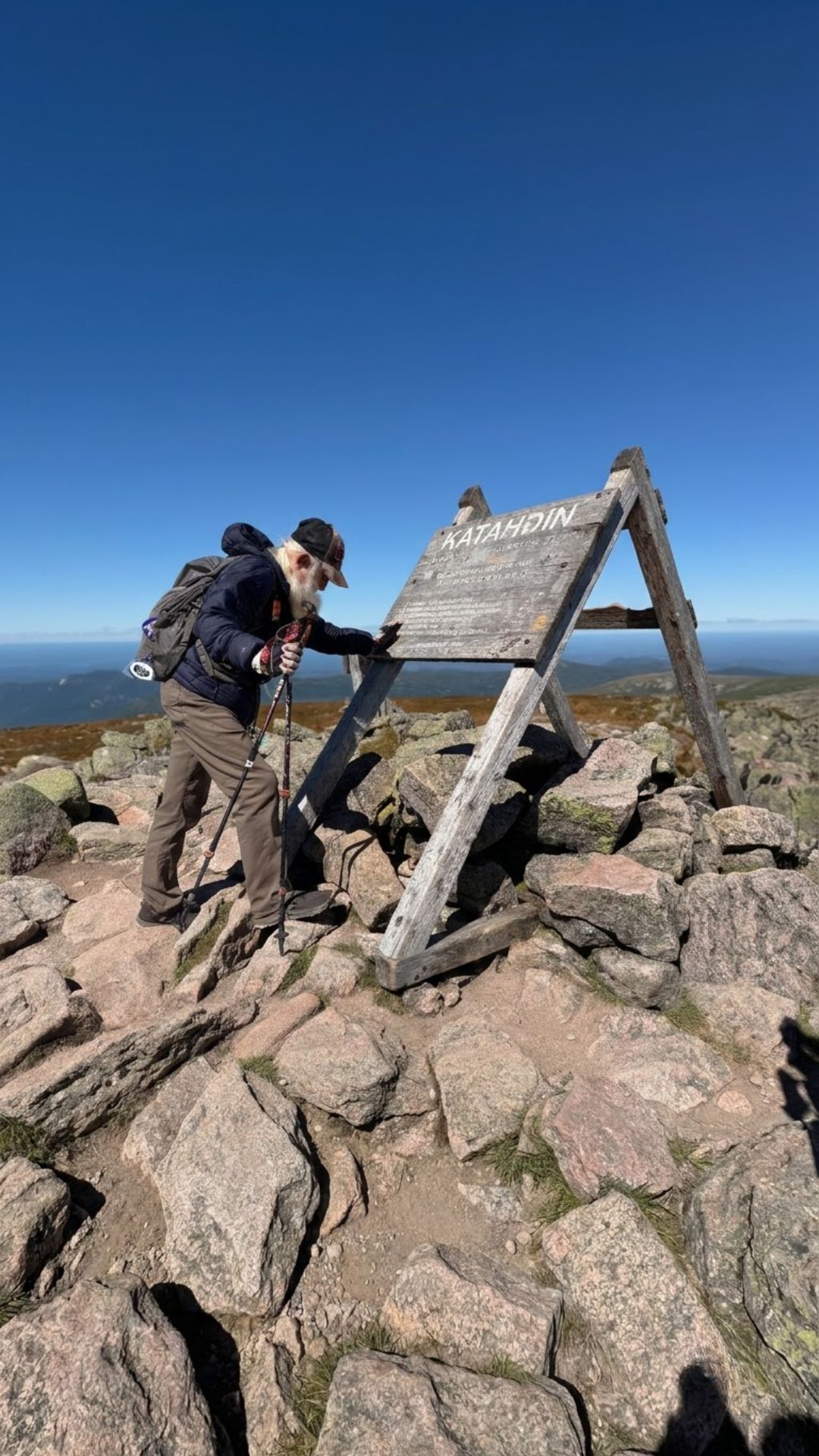
On August 31, 2026, Sanders finally reached the summit of Mount Katahdin in Maine, completing his latest Appalachian Trail journey and reclaiming the record for the oldest person to complete a thru-hike.
He did not respond with a long speech or elaborate celebration.
Instead, he paused at the summit and prayed.
He thanked God, his support team and the people who had helped him reach the top. After nearly a year on the trail, the record was his again.
The number that may best define the journey, however, is not 91.
It is 71. Seventy-one falls. Six hard ones. A hospital visit. A moment when he considered quitting. A death in the family. And one final fall just 200 yards from the end. Yet he kept walking.

Then He Reached Mount Katahdin
Dale “Grey Beard” Sanders did not reclaim the Appalachian Trail record by having an easy journey. At 91, he walked 2,193 miles from Georgia to Maine in sections, fell 71 times and endured injuries, exhaustion and a hospital visit along the way. He had already set the record at 82, lost it to an older friend at 83, and spent years planning his return. When he finally reached Mount Katahdin on August 31, 2026, the record belonged to him again. His achievement is remarkable not because he never stumbled, but because he repeatedly got back up.
P.S. This article is based primarily on reporting by The Associated Press and The Guardian on Dale “Grey Beard” Sanders’ 2026 Appalachian Trail comeback, including his 71 falls, medical scare, previous record and final ascent of Mount Katahdin. Source: https://apnews.com/article/appalachian-trail-oldest-hiker-grey-beard-fd7a9a735c2cc1d31412535a2d36f6d8