In the early hours of March 18, 1990, two men dressed as Boston police officers walked into the Isabella Stewart Gardner Museum and carried out one of the most extraordinary art thefts in history. In just 81 minutes, they stole 13 masterpieces by artists including Rembrandt, Vermeer and Degas, leaving behind empty frames and a mystery that has endured for more than three decades. The paintings have never been recovered, and no one has ever been convicted.
The Night Two Fake Cops Stole 13 Masterpieces
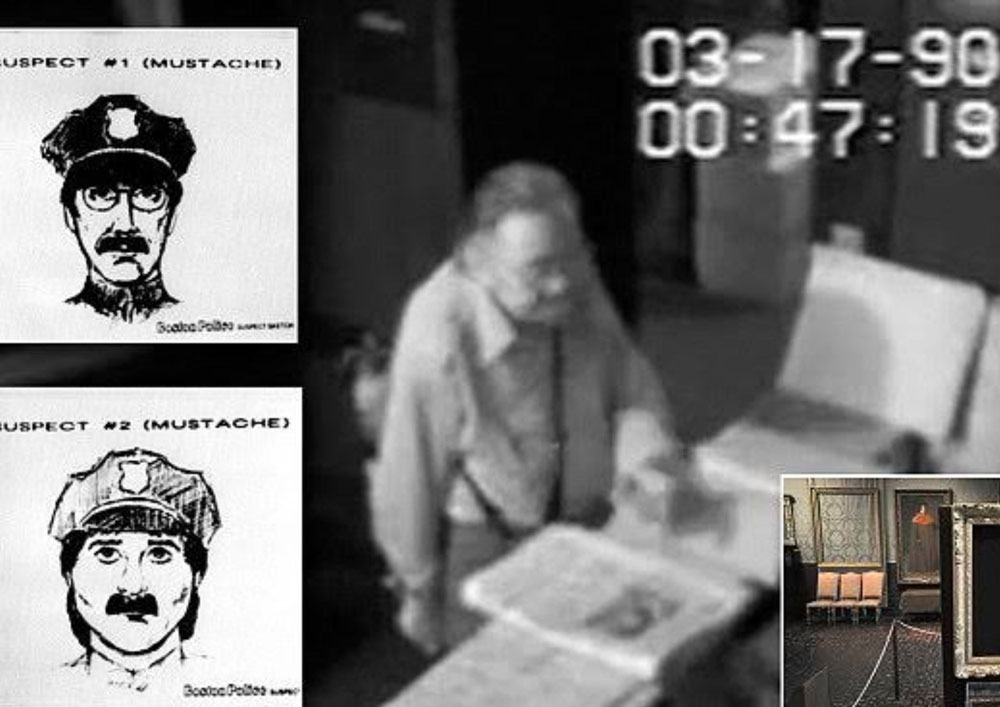
At 1:24 a.m. on March 18, 1990, two men dressed as Boston police officers walked up to the Isabella Stewart Gardner Museum and rang the night bell. The museum was quiet, the galleries were closed, and only two security guards were on duty. The men claimed they were responding to a disturbance.
The guard at the entrance made a decision that would become one of the most consequential mistakes in American art history: he let them inside.
Once through the door, the men overpowered the guards, handcuffed them and took them to the basement. Then they had the museum almost entirely to themselves.
For the next 81 minutes, they moved through the galleries and removed 13 works of art, including masterpieces by Rembrandt, Vermeer, Degas and Manet. The FBI estimates the stolen collection was worth more than $500 million at the time of the theft, making it the largest property crime in U.S. history.
Then the thieves simply left. No dramatic getaway. No shootout. No bodies. Just empty frames hanging on the walls. And more than three decades later, those paintings are still missing.

They Only Needed 81 Minutes
The Dutch Room
The thieves spent much of their time on the museum’s second floor, beginning with the Dutch Room. Among the works they took were two paintings by Rembrandt: A Lady and Gentleman in Black and The Storm on the Sea of Galilee.
The latter is particularly significant. It is believed to be Rembrandt’s only known seascape, making it one of the most recognizable missing works in the entire art world. They also took Rembrandt’s small Self-Portrait and Govaert Flinck’s Landscape with an Obelisk.
Then they took Vermeer’s The Concert.
Only around 36 paintings by Johannes Vermeer are known to exist, making the stolen work exceptionally rare. The thieves also removed several works by Edgar Degas and a Chinese bronze beaker from the Shang Dynasty.
Watch this episode of History’s Greatest Mysteries to explore who may have orchestrated the Gardner Museum heist—and why 13 masterpieces remain missing more than three decades later.
They Didn’t Take Everything
This is one of the strangest aspects of the robbery.
The thieves had access to other valuable works, yet they left them behind. They appeared to select certain objects rather than simply grabbing everything they could carry.
Some paintings were removed from their frames. Others were cut directly from the canvas.
In the case of the Rembrandt paintings, the frames remained behind.
The thieves even took a Napoleonic eagle finial from the top of a flag.
In total, 13 objects disappeared that night.
They had been inside for 81 minutes.
Then they were gone. They didn’t need hours. They only needed one night, two uniforms and a museum with weaknesses they understood.
The Morning After, the Museum Had 13 Empty Spaces
The Theft Was Bigger Than the Paintings
When the museum’s staff discovered what had happened, the scale of the loss quickly became apparent.
The stolen works included some of the most important pieces in the Gardner collection. But unlike money or jewelry, these objects could not simply be replaced.
A stolen masterpiece can be almost impossible to sell openly. Its identity is known to experts, museums and law-enforcement agencies around the world. Anyone attempting to put one of the paintings onto the legitimate art market would immediately risk exposing the crime.
That created a strange situation.
The thieves had stolen objects worth hundreds of millions of dollars, but those objects were effectively toxic.
They could hide them.
They could move them.
They could potentially use them as leverage.
But openly selling them would be extraordinarily difficult.
The Empty Frames
The museum made another unusual decision.
It did not simply replace the missing works with other paintings.
The empty frames remained.
Visitors can still see the spaces where Rembrandt’s paintings once hung. In the Dutch Room, two empty frames mark the places where the stolen works were cut away during the robbery. The museum deliberately preserves these absences as a reminder of what was taken.
That may be the most haunting part of the entire story.
The thieves wanted the paintings.
But what they left behind became part of the museum’s history too. The paintings disappeared. The empty spaces remained.

Someone Had to Know What They Were Looking For
The Inside Job Question
Almost immediately, investigators faced an obvious question.
How did two men who apparently knew enough to impersonate police officers also know where to go once they were inside?
The robbery wasn’t random.
The thieves moved through specific galleries and selected specific objects. They knew they had time to search the museum, and they knew how to exploit weaknesses in its security procedures.
The museum’s own account says the first guard violated protocol by allowing the men through the employee entrance after they claimed to be responding to a disturbance. Once inside, the thieves subdued both guards and prevented them from raising the alarm.
The thieves also took the museum’s surveillance footage from that night, further complicating the investigation.
That combination naturally fueled speculation that the criminals had inside knowledge.
Were they working from information provided by someone familiar with the museum?
Had someone told them exactly which rooms to enter?
Or did they simply get extraordinarily lucky?
Investigators have spent decades trying to answer those questions.
The Missing Paintings Went Underground
The FBI has said the stolen works were separated after the robbery and may have traveled through different parts of the United States. The Bureau has also investigated leads suggesting that some pieces may have moved along the Eastern Seaboard and through the Mid-Atlantic states toward the South.
That makes the case even harder. The paintings don’t have to remain together. One could be hidden in a private collection. Another could be sitting in storage. Another could have changed hands several times. The thieves didn’t need to keep the entire haul in one place.
They only needed to make the pieces disappear. If the thieves knew exactly what they were looking for, who taught them?

Three Decades Later, the Frames Are Still Empty
The Isabella Stewart Gardner Museum theft remains unsolved.
No one has been convicted of stealing the 13 works, and none of the stolen artworks has been recovered. The FBI continues to seek information about their whereabouts, while the museum continues to offer a reward of up to $10 million for information leading to the safe return of all 13 works.
That reward is remarkable in itself.
The museum isn’t simply trying to find stolen property.
It is trying to restore a collection that was deliberately designed by Isabella Stewart Gardner as a specific experience. The missing paintings leave physical gaps in that vision that cannot be filled with substitutes.
And the longer the paintings remain missing, the more mysterious the case becomes.
The suspects’ identities remain unresolved.
The paintings remain scattered somewhere in the world.
The exact chain of custody after the robbery remains uncertain.
And the central question has survived every theory, every lead and every investigation: Where did the paintings go?
Perhaps one of them is still hidden in an attic, basement or private collection.
Perhaps someone knows exactly where they are.
Perhaps the people who originally stole them are long gone, leaving behind only a trail that investigators have spent decades trying to reconstruct.
But every day the museum remains open, visitors can still see the evidence. Not behind glass. Not in a police file. On the walls. Empty frames marking the places where some of the world’s most valuable artworks once hung. The thieves walked into the museum disguised as police officers. They walked out carrying 13 masterpieces. And somehow, after more than three decades, the biggest question remains exactly the same: Where are the paintings?
The Isabella Stewart Gardner Museum heist remains remarkable not simply because 13 masterpieces vanished, but because they disappeared almost without a trace. Two men walked in wearing police uniforms, spent just 81 minutes inside, and left behind empty frames that still hang on the museum walls today. More than three decades later, the paintings remain missing, the thieves have never been conclusively identified, and one of the greatest art mysteries in American history is still waiting for its final chapter.