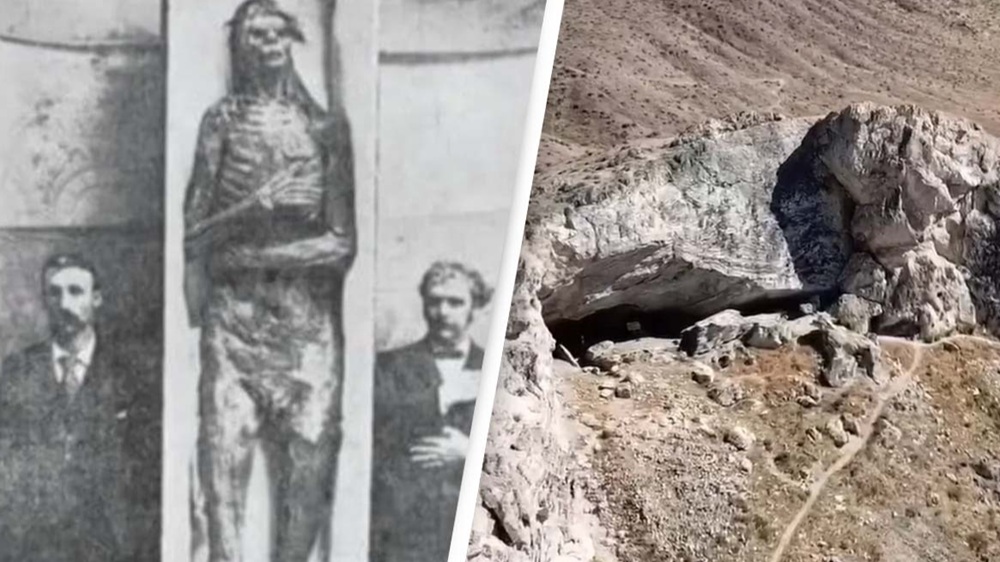
For generations, Northern Paiute traditions told of the Si-Te-Cah, a feared people associated with the Nevada landscape around Lovelock. Later accounts transformed the story into something far more sensational: a race of red-haired giants who lived in Lovelock Cave and were accused of cannibalism. When archaeologists eventually studied the cave and its human remains, however, the evidence did not reveal a lost race of giants. Instead, it exposed something more interesting—the complicated way a real archaeological site became the center of an enduring American legend.
The Cave That Started the Mystery
Lovelock Cave lies in western Nevada, in a landscape shaped by the ancient lake systems of the Great Basin. People used the cave for shelter and other activities for thousands of years, and its exceptionally dry conditions helped preserve materials that normally disappear from archaeological sites. That made Lovelock unusually valuable to researchers trying to understand how Indigenous communities lived in the region.
Modern attention to the cave began in the early twentieth century for an unexpected reason: bat guano. Miners started removing the material in 1911 for fertilizer and other industrial uses, and their excavation exposed artifacts and human remains buried inside. Later archaeological work recovered thousands of objects, including woven materials, tools, feathers and the famous tule duck decoys now held in museum collections.
The discoveries were important enough without any mystery attached to them. The Smithsonian’s collections document objects from Lovelock Cave dating back thousands of years, including duck decoys made from tule rushes, cordage, feathers and other natural materials. Some examples date to roughly 400 BC to AD 1, demonstrating how much information the cave preserved about ancient hunting and craftsmanship.
But the human remains created a very different story. Some preserved hair appeared reddish, and early reports described unusually large bones. Once those details were connected to existing stories about dangerous people in the region, the legend of the red-haired giants began to take shape.
Uncover the chilling mystery of Lovelock Cave in Nevada, where abnormally giant human skeletons were discovered deep underground. Did ancient giants really roam the Wild West, or is there another explanation? Dive into this fascinating scene to find out. Watch the full video now!
How a Legend Became a Story About Giants
Northern Paiute traditions included stories about the Si-Te-Cah, sometimes described as “Tule Eaters,” who were remembered as enemies of the Paiutes. Different versions of the tradition vary, and later retellings did not always preserve the same details. Some accounts described conflict, a retreat into a cave and a fire set at the entrance, but the dramatic image of a separate race of enormous red-haired people was strengthened by later interpretations.
One important figure in the development of that interpretation was John Reid, a local teacher and researcher who heard stories about the supposed people from childhood. When he encountered large-looking bones and preserved human remains, he believed he had found physical evidence supporting the old tradition. The combination of a real cave, ancient burials, reddish hair and unusual bones made the theory appear persuasive to people already familiar with the legend.
Popular accounts then added increasingly dramatic details. Stories about large sandals, enormous skeletons and people supposedly eight or nine feet tall circulated through newspapers and later publications, turning an uncertain archaeological story into something that sounded like proof of a vanished race. But the further the story traveled, the less distinction there was between what had actually been measured and what had merely been repeated.
That distinction would eventually become critical. If the bones really belonged to giants, careful anatomical analysis should have been able to demonstrate it. When researchers finally examined the remains systematically, the central claim began to collapse.
Scientists Measured the Bones
In the 1980s, researchers examined the so-called Reid Collection, which had been associated with the “Redheaded Giants” story, and compared the remains with other skeletal populations from the Great Basin. Six adult male skeletons with complete enough long bones for stature estimates produced heights of roughly 5 feet 5 inches to 5 feet 11 inches, with an uncertainty of about 2 inches. Their measurements overlapped with populations from places such as Pyramid Lake and Humboldt Sink.
The researchers also found similarities in skull measurements, dental characteristics and other skeletal traits. Rather than revealing a physically distinct race of giant humans, the remains fit within the range of variation already documented among Indigenous populations of the region. The evidence therefore did not support the idea that Lovelock Cave contained the remains of people standing eight or nine feet tall.
The red hair had an equally important explanation. Researchers noted that naturally preserved hair in arid environments can change toward reddish or rusty-brown shades, while red ochre used in burial practices could also stain hair. In other words, reddish hair did not require the existence of a population of naturally red-haired people.
That left the giant story without its strongest physical evidence. The cave contained real human remains, but the measured skeletons did not belong to giants.
What Lovelock Cave Actually Preserved
Once the giant claim is set aside, Lovelock Cave becomes a remarkable archaeological site in its own right. The dry cave environment protected thousands of artifacts associated with Indigenous life in the Great Basin, including hunting equipment, woven materials and the distinctive tule duck decoys that are now part of Smithsonian collections. These objects provide direct evidence of craftsmanship and subsistence strategies rather than relying on later stories to reconstruct the past.
The duck decoys are particularly revealing. Smithsonian records show that some were made from tule rushes, cordage and feathers, and that examples from Lovelock Cave date back to the Middle Archaic period. Their survival is unusually valuable because plant fibers and other organic materials normally decay long before archaeologists can study them.
The cave also helps explain why the giant legend became so difficult to separate from the real archaeology. Human remains and other objects were genuinely unusual, while the cave’s dry conditions preserved details that might otherwise have vanished. Once those discoveries were compared with an old oral tradition, it became easy for ambiguous evidence to appear more conclusive than it really was.
The result was a classic case of archaeology and storytelling becoming entangled. The physical discoveries were real, but the most sensational interpretation went far beyond what the evidence could establish.
How the Giant Legend Survived
The story endured because it contained just enough real material to remain compelling. There really was a cave, there really were ancient burials, and there really were remarkable artifacts. There were also traditions about a dangerous group of people, so when unusual remains were found, the temptation to connect everything was enormous.
The problem was that the most dramatic claims became detached from the measurements. A long bone could become a “giant’s bone,” reddish hair could become proof of a red-haired race, and a traditional story could be repeated as though it were a historical record. Each retelling made the original uncertainty harder to see.
Modern skeletal analysis provides a useful corrective because it allows one of the central claims to be tested directly. The examined remains did not show exceptional stature, and the reported reddish hair has plausible explanations related to preservation and burial practices.
That does not make the traditional stories worthless or unimportant. It simply means that oral tradition, archaeology and later interpretation need to be kept separate when reconstructing the past. A legend may preserve memories of real people or conflicts without every detail being literally true.
Lovelock Cave therefore remains mysterious, but not because scientists have failed to prove the existence of giants. Its deeper mystery is how a genuine archaeological record became transformed into one of America’s most persistent stories about a lost human race.
The red-haired giants of Lovelock Cave make a remarkable story, but the strongest archaeological evidence points somewhere else. The cave preserved real human remains and thousands of artifacts from ancient Indigenous communities, while scientific analysis found no evidence of a separate race of enormous people. Even the reddish hair has plausible explanations involving preservation and burial pigments. What makes Lovelock truly fascinating is the way genuine discoveries, oral traditions and sensational retellings became intertwined, creating a legend far larger than the evidence behind it.
P.S. This story draws on Skeptoid’s examination of the red-haired giants of Lovelock Cave, with the central skeletal claims cross-checked against Nevada historical research and Smithsonian collections documenting artifacts excavated from the site. Source: https://skeptoid.com/episodes/390